

Avoid 0.5–1% Vault Fees: Gold Storage Safe Choices for U.S. Owners
The smartest approach for most owners is a hybrid one: keep a small, liquid portion of your bullion in a rated home safe and store the bulk in an allocated, insured vault. Your holding size, how fast you might need to sell, and how well you’re insured decide the split. A home safe, a bank safe-deposit box, and a private vault each solve a different piece of that puzzle.
TL;DR:
- A TL-15 or TL-30 rated safe with a minimum 60-minute fire rating and proper bolting provides the best protection for larger gold holdings at home.
- Bank safety deposit boxes are secure but limited by operating hours, no inherent insurance, and potential legal or operational delays in access.
- Private vaults with allocated, segregated storage often offer better theft and disaster protection, especially for portfolios exceeding $50,000, but come with ongoing costs and insurance verification.
- Most homeowner policies cap coverage for precious metals at low amounts, requiring a dedicated specie policy or rider for full protection of significant holdings.
- Securing gold effectively involves a layered approach: combination of rated safes, concealment, diversion tactics, and diversified storage locations.
Table of Contents
- What’s the Best Gold Storage Safe Option for Your Situation?
- What Ratings and Features Actually Matter in a Home Safe?
- Are Bank Safe-Deposit Boxes Actually Safe for Gold?
- How Do Private Vaults Compare on Cost and Security?
- Is Your Gold Actually Covered by Insurance?
- What Security Habits Do Experienced Gold Owners Follow?
- Our Take on Realistic Gold Security
- Ready to Choose Your Home Safe? Here’s What to Check
- Where This Article’s Information Came From
- Sources
- FAQ
What’s the Best Gold Storage Safe Option for Your Situation?
The right answer depends almost entirely on how much gold you own. Think of it as three tiers.
Under roughly $10,000. A quality home safe or a bank safe-deposit box usually covers you. Costs stay low, access is fast, and the risk exposure is small enough that a good fireproof safe plus a basic insurance rider handles it.
Between roughly $10,000 and $50,000. This is the gray zone. A home safe still works if it’s properly rated and bolted down, but insurance costs start climbing, and a bank box adds a layer of physical security without full insurance coverage.
Above roughly $50,000. Professional allocated vault storage often becomes the more sensible move. Once holdings cross into that range, a top-tier gun safe plus a specie insurance policy can cost nearly as much annually as vault fees, and the vault still wins on both fire protection and liability transfer, according to a comparison of home, bank, and third-party vault storage.
- Home safe: Fast access, no ongoing fees, but you carry the full insurance and theft-risk burden.
- Bank safe-deposit box: Strong physical security, low cost, but limited hours and typically no insurance included.
- Private vault (allocated): Best protection against theft and disaster, insurance often built in, but costs money every year and delays physical access.
One distinction matters more than any other here: allocated storage means specific bars are titled in your name. Unallocated storage is a pooled claim against the provider, which carries real counterparty risk if that provider runs into financial trouble.
What Ratings and Features Actually Matter in a Home Safe?
Most people buying a home safe for gold focus on size and price and skip the specs that actually determine whether the safe stops a burglar or a fire. Here’s what to check before you buy.
- Burglary rating. An RSC (Residential Security Container) rating means the safe resists basic hand tools for a few minutes, fine for opportunistic theft. A TL-15 rating means it withstood a sustained attack with common tools for 15 minutes; a TL-30 rating pushes that to 30 minutes against a broader tool set, according to industry ratings guidance. For serious bullion holdings, a TL-15 or TL-30 rated safe, such as the Gardall Combination Security-Fire TL15 Money Chest, is worth the extra cost.
- Fire rating. Look for a minimum of 60 minutes at 1,200°F for paper documents, though gold itself melts at a far higher temperature, so the fire rating mostly protects the contents around it (deeds, appraisals, photos).
- Weight and bolting. A safe under 750 pounds can be carried out by two people with a dolly. Bolt it to a concrete floor or wall studs using the manufacturer’s kit, and confirm your installer torques the bolts to spec, not just hand-tight.
- Lock type. Electronic locks with a mechanical override and a relocker (a hidden pin that jams the bolt work if the lock is drilled) offer better protection than basic key locks alone.
- Placement. Interior closets beat garages and basements for both fire exposure and discovery risk. Avoid placing it where a mover, contractor, or houseguest can spot it in passing.
Pro Tip: Ask your installer for the anchor’s shear rating in writing, not just verbal reassurance. A safe bolted with undersized anchors defeats the entire point of buying a TL-rated unit.
Are Bank Safe-Deposit Boxes Actually Safe for Gold?
Bank boxes offer real physical security. Sitting behind a bank’s vault door and time-locked systems, the box itself is hard to breach. But two misconceptions trip people up constantly.
- Banks almost universally disclaim liability for what’s inside your box, and it is not FDIC-insured; you need a separate policy to cover the contents.
- Access is limited to banking hours, which matters if you need to liquidate gold on a weekend or during a bank holiday.
- Fees typically run $50 to $300 a year depending on box size and location.
- Court orders, estate disputes, or bank closures can freeze or delay your access entirely, an operational risk people rarely plan around.
Keep photographs, receipts, and an inventory list of everything in the box stored separately, ideally with your insurer, so you can prove contents and value if something goes wrong.
How Do Private Vaults Compare on Cost and Security?
Private vaulting solves the two biggest weaknesses of home and bank storage: theft risk and insurance limits. The catch is understanding exactly what you’re paying for.
Allocated storage means the vault holds specific, identified bars in your name, and those bars aren’t touched even if the vault operator goes bankrupt. Unallocated storage is cheaper but leaves you as a general creditor if the company collapses, a real risk worth avoiding for meaningful holdings.
Fee structures usually run 0.5% to 1% of stored value annually, though some vaults charge flat fees for smaller holdings. Before signing with any provider, run through this checklist:
- Confirm the vault carries independent insurance from a named underwriter, not just a vague “fully insured” claim.
- Ask how often independent audits verify the physical inventory against client records.
- Verify your metal is segregated, not commingled with other clients’ holdings.
- Review transport and delivery terms: how long does withdrawal take, and what does armored transport cost?
Is Your Gold Actually Covered by Insurance?
Most homeowner policies cap jewelry and precious metals coverage at a shockingly low $200 to $2,500 sub-limit, regardless of what your policy’s overall dwelling coverage looks like. That gap surprises a lot of first-time buyers who assume “insured house” means “insured gold.”
For anything beyond pocket change, you need either a scheduled personal property rider (sometimes called an inland marine floater) or a dedicated specie policy for larger holdings.
- Scheduled rider: Typically costs 1% to 2% of insured value annually, covers a specific, itemized list of items.
- Specie policy: Broader coverage designed for bullion and precious metals, pricing varies by insurer and storage method.
- Documentation insurers want: Purchase receipts, serial numbers on bars, high-resolution photos, and third-party appraisals for larger pieces.
Statistic Callout: A $30,000 gold holding insured through a scheduled rider at 1.5% annually runs roughly $450 a year, cheaper than most people expect once they actually price it out.
Store that documentation somewhere other than next to the gold itself. A digital backup plus an off-site paper copy, according to gold storage documentation guidance, gives you a claim trail even if the safe and its contents are both compromised.
What Security Habits Do Experienced Gold Owners Follow?
The safe is only one layer. Practitioners who’ve thought hard about this recommend a four-layer approach: secrecy, invisibility, diversion, and fortress, in that order of importance, according to a layered security framework.

Secrecy comes first because most thefts are target-driven. The fewer people who know you own gold, or how much, the smaller your risk. Invisibility means concealment: in-wall or in-floor installation, disguised storage, nothing that screams “safe” to a stranger walking through your house. Diversion means a decoy, a cheap visible safe with a little cash in it, while the real holding sits elsewhere. Fortress is the actual rated, bolted safe, and it comes last because hardware alone rarely stops a determined, informed thief.
A few practical habits round this out: use silica packs or Goldenrod rods to control humidity around silver and mixed collections, handle coins and bars with cotton gloves to avoid oils and fingerprints, and once your holdings pass the point where one loss would hurt, split storage across two locations.
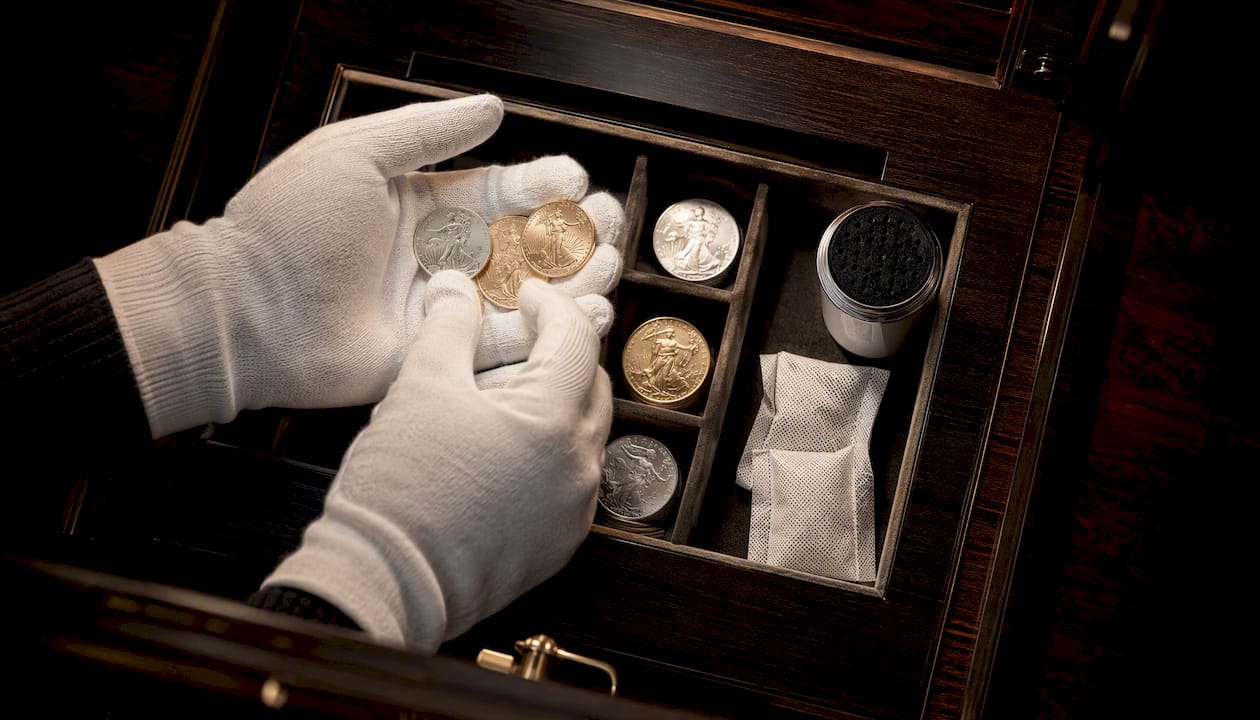
Pro Tip: If you’re moving or between homes and need temporary secure storage for your safe or metals, a reputable storage and moving service can bridge that gap safely instead of leaving valuables in transit or a garage.
Our Take on Realistic Gold Security
Most articles about storing gold sell one of two extremes: an expensive vault subscription or a bargain-bin safe with a fireproof sticker on it. Neither reflects how actual gold owners behave. The hardware side of this equation shows that a $400 safe with no bolt-down kit and a basic key lock is not protecting a $40,000 gold position, no matter what the box says on the label.
We carry the product classes that actually matter for this decision, including fire-rated home safes from manufacturers like AMSEC, TL-15 rated money chests from Gardall for larger holdings, and dedicated jewelry safes for mixed collections. The mistake we see most often isn’t picking the wrong brand. It’s buying a safe that’s undersized for the rating tier the holding actually needs, then skipping the bolt-down installation that makes the rating meaningful in the first place.
— Safes and Security Solutions
Ready to Choose Your Home Safe? Here’s What to Check
If you’ve landed on “home safe, or home safe plus vault,” the next step is matching the hardware to your actual holding size instead of guessing. This article covers product classes such as fire-rated home units, jewelry-specific safes, and commercial-grade money chests built for sustained tool attacks, not just a padlock upgrade.
Before you buy, check three things on any product page: the fire rating in minutes and degrees, the UL or TL burglary rating, and whether a bolt-down kit ships with the unit or needs to be ordered separately. For smaller collections or mixed jewelry and coins, the Gardall JS1718-W-C Jewelry Safe offers velvet-lined interior storage built for exactly that use case. For larger bullion holdings that need serious burglary resistance, look at the Gardall Matte Finish Safes line, and for fire protection on documents and smaller metal holdings, the American Security UL1511 2-Hour Fire Safe carries a genuine UL-listed 2-hour rating. Browse the specs, compare weight and bolt patterns against your install space, and contact sales for installation guidance before your gold sits in anything less than what its value requires.
Where This Article’s Information Came From
Key figures and recommendations in this guide draw from CBS News, OnlineGold.org, Minted Metal, and Bullion.Directory.
Sources
- Best practices for storing physical gold safely: What investors need to know - CBS News
- Onlinegold
- How to Store Gold | Minted Metal
- Bullion
FAQ
What is the best safe for storing gold?
A TL-15 or TL-30 rated safe with a fire rating of at least 60 minutes, bolted to a concrete floor or wall studs, offers the strongest home protection for meaningful holdings.
What is the safest way to store gold at home?
Combine a rated, bolted-down safe with secrecy and concealment: limit who knows about your holdings, avoid obvious placement, and consider a decoy safe for smaller visible items.
What is the safest place to store gold?
For large holdings, an allocated, insured private vault typically beats home storage on both theft and disaster protection; for smaller amounts, a rated home safe or bank safe-deposit box works fine.
Is it illegal to store gold at home?
No. There’s no law against storing gold at home in the United States; the real risks are practical ones like theft, fire, and inadequate insurance coverage rather than legal restrictions.