

Why Use Underfloor Safes Commercially: The Full Picture
Underfloor safes are the most secure commercial safe solution available for businesses that need concealment, insurance compliance, and efficient cash handling in one installation. They sit flush with the floor, encased in concrete, invisible to anyone who doesn’t already know they’re there. For a retail store, restaurant, or office managing daily cash deposits, that invisibility is the first line of defense. Beyond concealment, the right underfloor safe can determine whether your insurance claim gets paid after a break-in or gets denied outright.
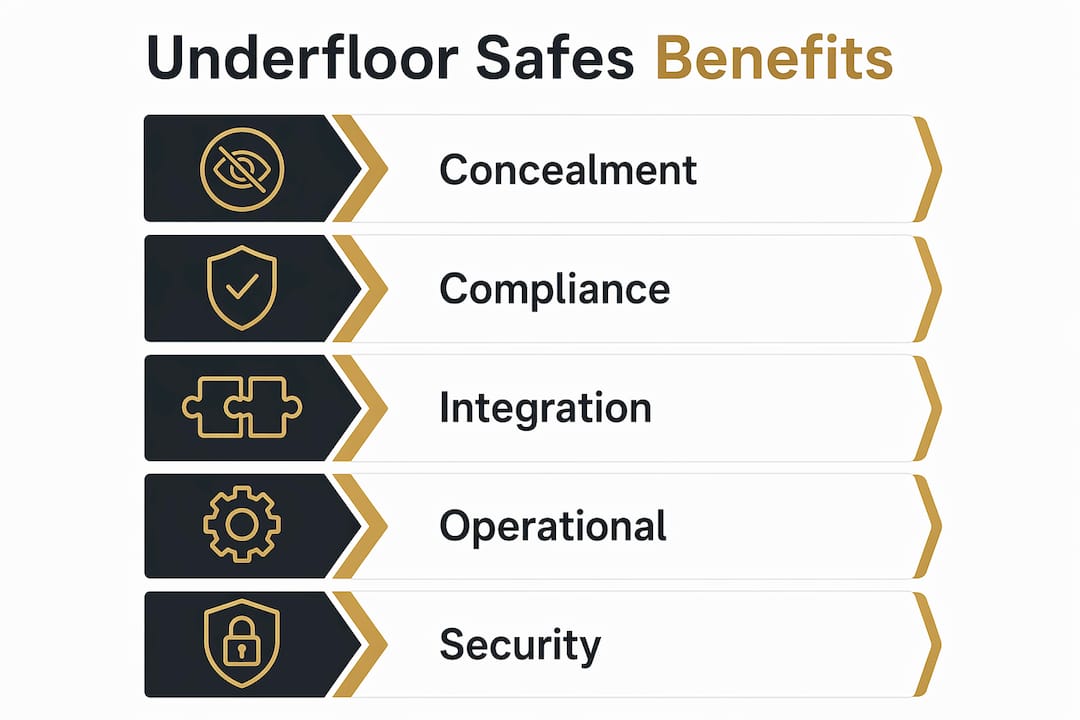
Here’s why commercial businesses choose underfloor safes:
- Concealment deters theft. A burglar can’t target what they can’t find. Liberty Safe security experts confirm that underfloor safes frustrate burglars by removing any clear target during a rushed robbery.
- Concrete anchoring prevents removal. Unlike freestanding safes, an underfloor model becomes part of the building structure itself.
- Deposit models reduce internal theft. Staff can drop cash without ever accessing the main compartment, creating a clear chain of custody.
- Space efficiency. No floor footprint means no lost square footage in tight commercial spaces.
- Insurance compliance. Many commercial policies require safes meeting specific burglary ratings. Without the right rating, a claim can be denied after theft.
Why use underfloor safes commercially: the core advantages
The concealment factor alone separates underfloor safes from every other commercial safe solution. A wall safe can be spotted. A freestanding safe can be wheeled out. An underfloor safe, properly installed and covered with a rug or floor panel, gives a burglar nothing to work with during the minutes they have on site.
- Discreet by design. No visible profile means no psychological trigger for opportunistic theft. Businesses that don’t advertise their safe’s existence reduce the chance of being targeted in the first place.
- Physical removal is nearly impossible. Concrete encasement means the safe is structurally part of the building. Prying it out requires tools and time that most burglars won’t risk.
- Deposit functionality limits exposure. Deposit underfloor safes let employees secure cash without ever opening the main compartment. Only a manager with the combination accesses the full interior.
- Space savings matter in commercial settings. A restaurant back office or retail stockroom has no room for a bulky freestanding unit. Underfloor models use zero above-ground space.
- Advanced locking mechanisms. Models like the FireKing Depository Safe feature programmable electronic locks and anti-fishing mechanisms that prevent deposited cash from being retrieved through the drop slot.
Pro Tip: Place your underfloor safe in a low-visibility area that’s still convenient for managers, such as inside a back office closet rather than the main stockroom floor. The goal is quick authorized access without the safe being visible during normal business hours.
Limitations and disadvantages worth knowing before you commit
Underfloor safes aren’t the right fit for every business, and ignoring the drawbacks leads to expensive mistakes.
- Professional installation is mandatory. Cutting into a concrete floor, applying moisture barriers, and pouring new concrete correctly requires a licensed contractor or security installer. DIY attempts risk structural damage and void insurance compliance.
- Higher upfront cost. The combined price of the safe unit plus professional installation typically exceeds the cost of a comparable freestanding model. For businesses on tight budgets, that gap matters.
- Permanent placement. Once set in concrete, the safe doesn’t move. Businesses planning to relocate within a few years should weigh that permanence carefully before committing.
- Trip hazard potential. Deposit-style models with a protruding drop slot sit slightly above floor level. Placing one in a high-traffic path creates a genuine safety liability.
- Not automatically fire- or waterproof. Standard underfloor safes offer excellent burglary resistance but may lack fire or water ratings unless you specifically select a model built for environmental protection. Water-tight and fire-resistant models exist but cost more.
- Moisture and corrosion risk. Concrete floors can hold moisture. Without a proper moisture barrier during installation, the locking mechanism can corrode and seize over time, making the safe inaccessible.
Installation considerations that determine long-term performance
Getting the installation right the first time saves money, protects your insurance eligibility, and prevents the corrosion problems that plague poorly installed units.
- Site assessment before any cutting. A professional checks for plumbing lines, electrical conduit, and post-tension slab cables before touching the floor. Cutting through a post-tension cable can compromise the entire slab.
- Moisture barrier application. The cavity must be lined with a moisture barrier before the safe goes in. This step is the one most often skipped in non-professional installations, and it’s the reason locking mechanisms fail years later.
- Concrete encasement. The safe is set, leveled, and surrounded with high-strength concrete. This bonds it to the building structure and makes removal without heavy demolition equipment essentially impossible.
- Flush finishing. A properly finished installation sits flush with the surrounding floor. A flush-mount cover plate conceals the access point entirely.
- Workflow and safety positioning. The optimal installation location balances security (away from exterior walls and visible areas) with operational convenience (accessible to authorized staff without disrupting foot traffic).
- Insurance specification compliance. Your insurer may specify minimum burglary ratings, anchoring methods, or safe placement requirements. Professional installation documents that these requirements were met, which protects your claim eligibility.
Pro Tip: If your business is already planning a renovation or a new concrete pour, schedule the safe installation at the same time. Setting the safe during an active pour eliminates the cost of cutting and re-pouring separately, and the result is structurally cleaner.
What to actually store in a commercial underfloor safe
The type of contents determines which model you need, particularly whether you require a standard floor safe or a deposit-style unit.
- Daily cash deposits and register takings. This is the primary use case for deposit-style underfloor safes in retail, hospitality, and food service. Cash goes in through the drop slot; only authorized managers retrieve it.
- Contracts, licenses, and sensitive business records. Paper documents are vulnerable to both theft and fire. A fire-resistant underfloor model protects originals that would be costly or impossible to replace.
- High-value merchandise or jewelry. Jewelry stores and boutiques use underfloor safes to store inventory overnight, keeping it out of display cases and out of sight.
- Firearms. Businesses with licensed firearms on premises, such as shooting ranges or gun dealers, use underfloor safes for secure, regulation-compliant overnight storage.
- Backup hard drives and data storage devices. Physical data backups stored in a fire-resistant underfloor safe survive scenarios where cloud backups might be inaccessible.
- Proprietary materials and trade secrets. Physical prototypes, formulas, or sensitive company documents benefit from the same concealment and access control that protects cash.
For businesses storing a mix of these items, check out the commercial safe buying guide from Safes and Security Solutions to match the right model to your specific contents.
Insurance compliance and operational benefits that directly affect your bottom line
Your safe isn’t just protecting cash. It’s protecting your ability to make an insurance claim when something goes wrong. Commercial insurance policies can deny theft claims outright if the safe used doesn’t meet the security rating specified in the policy.
- Burglary ratings determine claim eligibility. Safes certified to EN 1143-2 standards, such as the Chubbsafes ProGuard DT rated to ECB•S Grades D1 and D2, meet the burglary resistance thresholds most commercial insurers require for high-cash environments.
- Deposit safes create an auditable chain of custody. When only managers can access the main compartment, accountability for cash discrepancies becomes straightforward. That paper trail matters during both internal audits and insurance investigations.
- Premium reductions are possible. Insurers sometimes reduce premiums for businesses that demonstrate certified safe storage, particularly for cash-heavy operations.
- Environmental protection supports business continuity. A fire- or water-resistant underfloor safe keeps critical documents and cash accessible after a disaster, reducing recovery time.
- Operational efficiency improves. Deposit safes remove the need for managers to supervise every cash drop. Staff deposit independently; managers retrieve on their own schedule. That separation reduces both theft risk and the time managers spend on cash handling.
Statistic callout: Commercial floor safes are considered essential for insurance compliance, and claims may be denied when safes fail to meet insurer security requirements. Selecting a certified model before a loss occurs is the only way to guarantee coverage holds.
How underfloor safes fit industry-specific regulations and standards
Different industries carry different compliance obligations, and the safe you choose needs to meet the specific standards your sector requires.
Retail and food service businesses handling high cash volumes typically need safes that satisfy their commercial property insurer’s burglary rating requirements, often aligned with UL Residential Security Container (RSC) ratings or EN 1143-2 grades for higher-value environments. Financial services firms and law offices may face stricter requirements, with some insurers mandating UL TL-15 or TL-30 rated units for cash or document storage above certain thresholds.
Firearms dealers must comply with ATF storage regulations, which specify minimum security standards for overnight firearm storage. An underfloor safe that meets or exceeds those standards satisfies both the regulatory requirement and the insurance requirement simultaneously.
For businesses in regulated industries, consulting your insurance broker and your compliance officer before purchasing is the correct sequence. The 2026 buyer’s guide from Safes and Security Solutions covers the rating systems most relevant to American commercial buyers.
How underfloor safes integrate with alarms and CCTV systems
A safe installed in isolation is a single point of protection. Integrated with your existing alarm and surveillance infrastructure, it becomes part of a layered security system that’s significantly harder to defeat.

Most commercial security integrators position CCTV cameras to cover safe access points directly. This creates a video record of every access event, which supports both internal accountability and insurance claims. If a deposit discrepancy occurs, footage of the drop slot provides immediate evidence.
Alarm systems can be configured to trigger on unauthorized access attempts near the safe location, particularly useful for after-hours intrusion. Some electronic lock systems on deposit safes, including programmable units like those on the FireKing line, log access codes and timestamps internally, giving you a digital record that complements your camera footage. Pairing your safe with a CCTV backup system ensures that footage is preserved even if on-site recording equipment is damaged or stolen during a break-in.
How underfloor safes affect daily operations in a commercial setting
The operational impact of switching to an underfloor deposit safe is felt immediately in cash-handling workflows.
Before a deposit safe, cash management often requires a manager present for every register closeout, creating scheduling bottlenecks at shift changes. With a deposit-style underfloor unit, staff drop cash independently at the end of each shift. The manager retrieves and counts at a single scheduled time. That change alone reduces the number of people with access to open cash and cuts the time managers spend supervising routine deposits.
Internal theft risk drops because the deposit mechanism physically prevents employees from accessing what they’ve already deposited. The chain of custody is built into the hardware. Accountability becomes easier to enforce, and discrepancies are easier to trace.
For businesses managing multiple locations, standardizing on a single deposit safe model across sites creates consistent cash handling protocols. Training is simpler, auditing is faster, and the security posture is uniform.
Commercial use cases that show underfloor safes in practice
The businesses that benefit most from underfloor safes share one characteristic: they handle cash or high-value items daily, in environments where multiple staff members have varying levels of access.

A mid-size restaurant chain, for example, uses deposit-style underfloor safes at each location so servers and shift supervisors can drop cash after each service without a manager present. The general manager retrieves and reconciles once daily. That single process change reduces both internal theft exposure and the time spent on cash supervision.
A jewelry retailer uses a standard underfloor safe in the back office to store high-value inventory overnight. Display cases are cleared at closing; pieces go into the underfloor unit. A burglar who breaks in after hours finds empty cases and no visible safe. For guidance on selecting the right model for retail use, Safes and Security Solutions offers a dedicated cash deposit safe guide covering deposit safe features relevant to retail environments.
Law offices and financial advisory firms use fire-resistant underfloor models to store original client documents, executed contracts, and physical backup media. The combination of concealment and fire protection addresses both theft and disaster recovery in a single unit.
Key Takeaways
Underfloor safes deliver concealment, insurance compliance, and operational efficiency that freestanding alternatives can’t match in commercial environments.
| Point | Details |
|---|---|
| Concealment deters burglars | Underfloor safes give burglars no visible target, reducing the likelihood of being targeted. |
| Insurance compliance protects claims | Safes must meet insurer-specified burglary ratings, or theft claims can be denied. |
| Deposit models reduce internal theft | Staff deposit cash without accessing the main compartment, creating a clear chain of custody. |
| Professional installation is mandatory | Correct moisture barriers, concrete encasement, and anchoring require a licensed installer. |
| Fire and water resistance requires a specific model | Standard underfloor safes resist burglary but need specialized construction for environmental protection. |