

Why Use Time-Lock Safes: Benefits, Risks, and Best Practices
A time-lock safe enforces a preset waiting period before it can be opened, even when the correct code or key is used. That single feature changes the entire risk calculation for a would-be thief. If immediate access is the attacker’s advantage, a forced delay removes it. Retail stores, pharmacies, small businesses handling daily cash, and homeowners with firearms or high-value collections are the clearest beneficiaries.
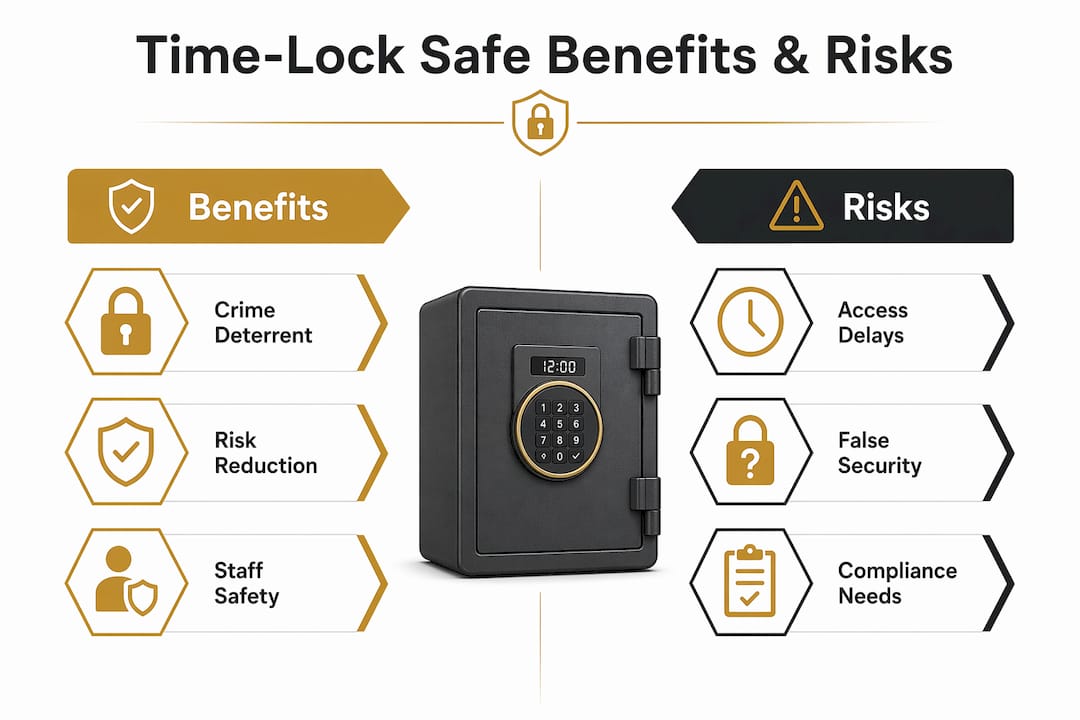
Three practical benefits stand out immediately:
- Deterrence: A thief who cannot get to the cash in two minutes has little reason to stay.
- Anti-coercion: Even if an employee is forced to hand over a code, the safe still will not open on demand.
- Auditability: Scheduled access windows and electronic logs create a record that supports loss-prevention investigations.
Table of Contents
- How time-lock safes actually work
- Who actually benefits from a time-delay safe
- The security advantages that actually matter
- When a time-lock safe is the wrong choice
- How to implement a time-lock safe so it actually works
- What to look for when buying a time-lock safe
- Key Takeaways
- A practical view on time-lock safes
- Ready to find the right time-lock safe for your situation?
- Useful sources
How time-lock safes actually work
A time-lock safe is a container fitted with a timer mechanism that blocks opening until a preset interval has elapsed, regardless of whether the correct combination is entered. That distinction separates it from a standard safe, where knowing the code is sufficient for immediate access.
| Feature | Mechanical time lock | Electronic time lock |
|---|---|---|
| Power dependency | None — runs on wound springs and gears | Requires battery or mains power |
| Delay adjustability | Fixed or limited range | Fully programmable, resettable |
| Audit trail | No | Yes — logs access attempts and openings |
| Failure mode | Spring wear, winding neglect | Battery failure, firmware issues |
| Best for | High-security vaults, power-unreliable sites | Businesses needing schedules and logs |
Mechanical time locks operate like wind-up clocks, using springs and gears that run independently of any external power source. That makes them immune to power outages and electrical surges. Electronic models trade that independence for flexibility: resettable timers, pre-set daily schedules, and digital audit trails are features mechanical designs simply cannot offer.
Both types mount the timer mechanism inside the door, which is the key tamper-prevention detail. An attacker cannot reach the timer without first defeating the door itself. For added reliability, high-security practice uses multiple movements on a single door — typically three — so that if one fails, another still controls access. For a deeper look at how lock types compare on cost and security ratings, the safe lock types guide at Safes and Security Solutions covers the full spectrum.

Common delay settings typically run in the 1–15 minute range, adjustable to match the environment and policy. After the delay expires, there is usually a short open window before the lock resets.
Who actually benefits from a time-delay safe
The use case almost always involves a setting where cash, controlled substances, or high-value items change hands frequently and staff are exposed to the public.
- Retail and convenience stores: Back-office cash drawers and drop safes are prime targets. A time-delay safe means a robber who forces a clerk to open the safe still walks away empty-handed for at least several minutes.
- Pharmacies: Pharmacy regulators have promoted and in some jurisdictions required time-delayed safes for controlled-substance storage. Visible deployment across a pharmacy chain reduces targeting by organized theft groups.
- Gas stations and check-cashing businesses: High cash volume, late-night hours, and limited staff make these environments particularly vulnerable to quick-hit robberies.
- Jewelry dealers and pawn shops: High-value, portable inventory makes these businesses attractive targets; a delay buys time for alarm response.
- Gun owners and home users: Firearms stored for self-defense present a genuine tradeoff (covered in the limitations section), but collectors with multiple firearms or high-value items benefit from the added layer. The gun safe selection guide at Safes and Security Solutions walks through that decision in detail.
- Small businesses with daily cash flow: Any operation that accumulates cash between bank runs — restaurants, salons, small retailers — fits the profile.
The common thread is frequency of access combined with public exposure. If your staff regularly opens a safe in view of customers or during vulnerable hours, a time-delay configuration is worth serious consideration.
The security advantages that actually matter
The anti-coercion rationale is the oldest and most compelling reason to use a time-lock. Time locks were originally developed specifically to prevent criminals from kidnapping or torturing people who know a combination and then using that information to force access. The timer inside the door means the combination alone is not enough.
- Deterrence: Most robbery attempts are opportunistic and time-sensitive. A delay of even five minutes dramatically increases the attacker’s exposure to cameras, bystanders, and police response.
- Anti-coercion protection: Staff can truthfully tell an attacker that the safe cannot open regardless of what they do. That removes the incentive for violence against employees.
- Wider police-response window: The enforced wait gives surveillance systems more time to capture usable footage and gives responding officers a better chance of arriving while the threat is still present.
- Operational accountability: Paired with audit trails and limited user codes, a time-delay safe creates a record of who accessed the safe and when — useful for internal loss-prevention investigations.
Time-delay safes change offender behavior and can improve a business’s risk profile with insurers. That is not a guarantee of lower premiums, but it is a documented factor in underwriting conversations.
Pro Tip: Post a clearly visible “Time-delay safe in use — staff cannot override” notice at your point of sale. The sign does as much deterrence work as the safe itself, because it communicates the delay before a robbery attempt even begins.
When a time-lock safe is the wrong choice
Not every situation calls for a delay mechanism, and ignoring the tradeoffs creates its own risks.
- Emergency access to firearms: A time-lock on a home defense gun safe defeats the purpose. If rapid access during a home intrusion is the priority, a standard biometric or keypad lock is the right tool. A time-lock configuration belongs on a secondary storage safe for the collection, not the bedside firearm.
- Medical supply access: Any setting where staff need immediate access to supplies in a life-safety scenario should not have a time-delay on that specific storage.
- Operational friction: A 10-minute delay at a busy retail counter will frustrate customers and slow legitimate transactions. Plan access schedules around business rhythms, not just security theory.
- Power and battery failure: Electronic models that lose power mid-delay can lock out authorized users at the worst possible time. Battery backup and a tested emergency protocol are non-negotiable.
The most common time-delay safe failures in service calls are not mechanical. Incorrect configuration, missing documentation, and staff workarounds — leaving the safe ajar, sharing override habits — are the top causes of security gaps. The hardware rarely fails on its own; the procedures around it do.
Insurance and legal considerations deserve a direct note: time-lock safes can support underwriting conversations and may satisfy specific regulatory requirements (particularly in pharmacy settings), but they do not automatically replace other security obligations. Confirm current requirements with your insurer and, where applicable, your industry regulator.
How to implement a time-lock safe so it actually works
The device is only as effective as the procedures around it. Security experts recommend treating the time-lock as part of a system, not a standalone solution.
Documented procedures:
- Write a formal access schedule that specifies who can open the safe, during which hours, and under what authorization.
- Set a code-change cadence — quarterly at minimum, immediately after any staff departure.
- Implement dual-control for high-value access: two authorized users present to open.
- Document the delay setting, battery-check schedule, and emergency lockout procedure in writing.
Signage and deterrence:
- Post visible notices at customer-facing entry points stating that a time-delay is in force and staff cannot override it.
- Pair the safe with a commercial alarm system and CCTV coverage of the safe area.
Staff training and maintenance:
- Train every authorized user on what to do when a delay is active during a robbery: comply with attacker demands for non-safe items, do not attempt to override, and activate a silent alarm if available.
- For electronic models, check and replace batteries on a fixed schedule. For mechanical models, verify winding and movement function during regular maintenance checks.
- Audit access logs monthly to catch anomalies early.
For broader property security practices that complement a time-lock setup, the essential property security tips guide at Safes and Security Solutions covers cameras, alarms, and physical hardening together.
What to look for when buying a time-lock safe
| Specification | Mechanical | Electronic |
|---|---|---|
| Delay range | Fixed (model-dependent) | Programmable, typically 1–15 min |
| Audit trail | No | Yes |
| Power requirement | None | Battery + optional mains backup |
| Redundancy | Multiple movements standard | Battery backup required |
| Recommended use | Vault doors, high-security storage | Retail, pharmacy, cash-handling |
| Certifications to check | UL Listing | UL Listing + firmware version |
A practical buying checklist:
- Delay range: Confirm the model supports the delay duration your policy requires.
- Mechanical vs. electronic: Match the choice to your power reliability and need for audit logs. The digital vs. mechanical safe locks comparison at Safes and Security Solutions breaks this down further.
- Battery backup: Mandatory for any electronic model in a commercial setting.
- Dual-user codes: Supports dual-control policies without sharing a single code.
- UL certification: Confirms the safe meets independently tested construction standards.
- Professional installation: Anchoring matters. A safe that can be removed from the premises defeats the delay entirely.
Cost scales with size, certification level, lock complexity, and installation. Safes and Security Solutions carries time-lock–capable configurations across home and commercial categories, with product selection guidance and professional installation support available through the site.
Key Takeaways
A time-lock safe is worth buying when immediate access is the attacker’s primary advantage — pair it with signage, documented procedures, and surveillance to get the full security benefit.
| Point | Details |
|---|---|
| Core function | Enforces a preset delay that blocks access even with the correct code, removing the coercion incentive. |
| Best use cases | Retail cash handling, pharmacies, jewelry, and small businesses with daily cash accumulation. |
| Delay range | Common settings run 1–15 minutes; match the delay to your environment and access workflow. |
| Biggest risk | Staff workarounds and misconfiguration, not hardware failure — procedures matter as much as the device. |
| Where to buy | Safes and Security Solutions offers time-lock–capable safes with selection guidance and installation support. |
A practical view on time-lock safes
Time-lock safes solve a specific problem that standard safes cannot: they make the combination worthless under pressure. That is a narrow but genuinely important capability, and it is one that gets underestimated because most buyers focus on steel thickness and fire ratings rather than the behavioral effect on an attacker.
What we see consistently is that the businesses that get the most out of a time-delay configuration are the ones that treat it as a policy tool, not just a hardware purchase. The signage, the staff training, the access schedule — those are what turn a delay mechanism into a deterrent. The safe enforces the rule; the procedures define what the rule is.
For homeowners, the calculus is different. A time-lock makes sense for a secondary storage safe holding a collection or high-value items, but it should never be the lock on a firearm kept for immediate defense. Knowing which safe does which job is the real buying decision.
Ready to find the right time-lock safe for your situation?
Choosing the right configuration means matching delay range, lock type, and certification to your actual risk profile — not just picking the heaviest door.
Safes and Security Solutions carries a full range of time-lock capable safes for home and commercial use, with detailed specifications and professional installation options. Whether you are securing a retail back office, a pharmacy narcotics cabinet, or a home collection, the product selection tools and support team at Safes and Security Solutions can help you get the configuration right. Browse the full safe range or contact the team directly to get a recommendation matched to your environment.
Useful sources
- Time lock — Wikipedia: Definition, historical origin, and anti-coercion rationale.
- Time Locks: The Unyielding Guardians of High Security — Ablokc: Mechanical vs. electronic mechanisms and redundancy practices.
- Time-Delay Safes: How They Reduce Armed Robberies and Insurance Risk — Advance Security: Operational evidence on deterrence and insurer risk profiles.
- 3 Ways Time-Delayed Safes Make Pharmacies and Communities Safer — OCP: Pharmacy regulatory adoption and industry-wide deployment effects.
- Time Delay Safes: Definition, Security Profile, and Service Considerations — Low Rate Locksmith: Implementation best practices, failure modes, and system design guidance.
Recommended
- Safe Lock Types: 40% More Security & Cost Guide 2026 – Safes and Security Direct
- Top Benefits of Locked Gun Cases for Safe Storage – Safes and Security Direct
- Why Invest In a Safe for Valuables: Real Protection – Safes and Security Direct
- 7 Key Benefits of Smart Safes for Secure Asset Protection – Safes and Security Direct