

Why Use Security Rated Doors for Your Property
TL;DR:
- Security rated doors are tested and certified to resist forced entry, providing verified protection. Most certifications cover the entire doorset, including frame and hardware, not just the door slab, ensuring system integrity. Proper selection and installation of certified doors, paired with layered security measures, significantly enhance property safety and can lower insurance premiums.
Security rated doors are certified door systems tested against standardized attack methods to verify they resist forced entry. Unlike standard doors, these products carry third-party certification under recognized standards such as PAS 24, LPS 1175, EN 1627, and UL 752. The certification covers the complete doorset, including the frame, lock, and hardware, not just the door slab. For homeowners and business owners, understanding why use security rated doors comes down to one fact: certified doors deliver measurable, verifiable protection that standard doors cannot guarantee. They also reduce insurance premiums, support building code compliance, and act as the first line of defense in any layered security strategy.
Why use security rated doors: what certification actually means

A security rating is not a marketing label. It is the result of third-party controlled attack testing that measures how long a door resists specific tools and techniques. That distinction matters because it removes guesswork from your purchasing decision.
The most widely recognized standards operate on a tiered scale:
- PAS 24 is the baseline residential standard in the United Kingdom, testing doors against impact, knife, and pry bar attacks, as well as lock manipulation.
- LPS 1175 and STS 202 BR3/BR4 suit commercial and high-value facilities, with higher grades requiring resistance to more aggressive tools for longer durations.
- EN 1627 is the European standard, with resistance classes RC1 through RC6, where RC2 covers most residential needs and RC4+ applies to high-risk commercial sites.
- UL 752 governs ballistic resistance and applies to specialized commercial environments.
The critical detail most buyers miss is that certification covers the full doorset, not individual components. A door slab rated to EN RC3 loses that rating the moment you swap in a non-certified lock or frame. The rating is a system guarantee, not a component guarantee.
| Standard | Primary Market | Typical Use Case |
|---|---|---|
| PAS 24 | Residential (UK) | Front and rear home doors |
| LPS 1175 | Commercial (UK) | Warehouses, offices, high-value sites |
| EN 1627 (RC1–RC6) | Residential and commercial (Europe) | Broad range by risk class |
| UL 752 | Commercial (US) | Ballistic-rated specialist applications |
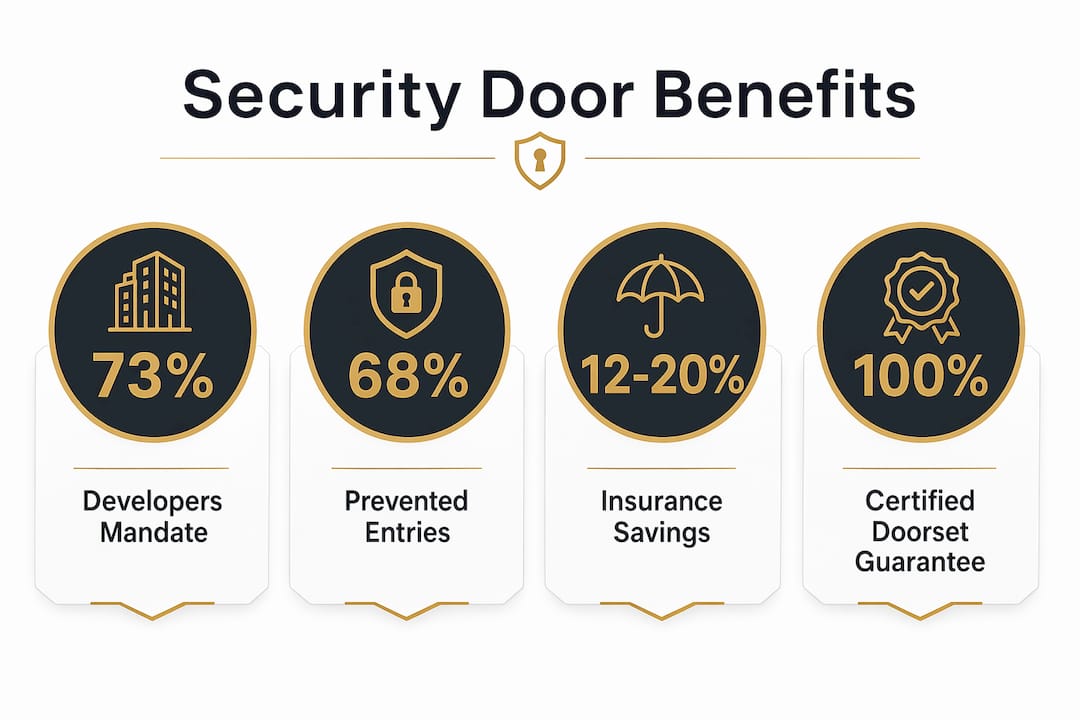
Commercial developers recognize this value. 73% of commercial developers now mandate certified doors in new builds. That figure reflects a shift from treating certified doors as optional to treating them as a baseline requirement.
What are the practical benefits of security rated doors?
The most direct benefit of a certified security door is delay. Security rated doors act as a proactive physical barrier that increases the time, noise, and effort an intruder must invest. Most opportunistic burglars abandon an attempt within 60 seconds if they cannot gain quick access. A certified door is specifically engineered to exceed that threshold.
The financial benefits are equally concrete:
- Insurance premium reductions. Buildings with EN RC3+ or UL-certified doors often receive commercial property insurance discounts of 12% to 20%. For a business paying $5,000 annually in property insurance, that represents up to $1,000 in yearly savings.
- Legal and regulatory compliance. Certified doors satisfy building code requirements that uncertified doors cannot. Using an uncertified door can void your insurance policy and invalidate planning permits.
- Increased property value. Certified security features improve tenant confidence and buyer perception, particularly in commercial real estate.
- Lower long-term costs. Certified doors are built to withstand sustained physical stress. They outlast standard doors in high-traffic and high-risk environments, reducing replacement frequency.
Pro Tip: Check your property insurance policy before purchasing. Many insurers specify minimum door certification standards. Matching or exceeding those standards can unlock discounts without requiring a separate application.
68% of forced-entry incidents occur at properties where certified doors are required but absent. That statistic shows the gap between what regulations demand and what many property owners actually install. Closing that gap is the simplest risk reduction move available.
What materials and types of security rated doors are available?
Material choice determines how a door performs across security, durability, maintenance, and appearance. Each material has a distinct profile.
Steel delivers the highest forced-entry resistance and suits side entrances, rear doors, and commercial service points. Steel doors are heavy, low-maintenance, and difficult to deform under pry bar or kick attacks. The trade-off is weight and a more industrial appearance that some homeowners find unsuitable for front-of-house use.
Composite doors combine a solid timber or foam core with a glass-reinforced plastic (GRP) skin. Composite doors offer strong security and insulation for residential fronts, making them the most popular choice for home front doors where aesthetics matter alongside performance.
Timber doors certified to PAS 24 or EN 1627 provide a traditional appearance with genuine security credentials. They require more maintenance than steel or composite but remain a strong choice for period properties where visual character is a priority.
uPVC is cost-effective and widely used, but uPVC is less resistant to forced entry than steel or composite. It suits low-risk applications but should not be the first choice for rear or side entrances on commercial properties.
Frame and hardware quality are as important as the door material itself. A steel door fitted in a weak timber frame provides far less protection than its rating suggests. The frame must be anchored to the masonry structure, not just the surrounding timber, to perform as certified.
- Match door material to the specific entry point and risk level.
- Prioritize steel or composite for rear and side entrances.
- Verify that frame specification is included in the doorset certification.
- Check that hinges and multi-point locking systems carry their own certification ratings.
How do you select and install a security rated door correctly?
Selecting the right certified door starts with assessing your property’s risk profile. A residential front door in a low-crime area has different requirements than a commercial warehouse rear entrance. Match the certification level to the actual threat, not the highest available rating.
The most common installation error is frame attachment to masonry, which is the most frequent failure point in otherwise well-specified doorsets. Professional installers prioritize structural fixation at this point because a door is only as strong as its weakest anchor.
Component integrity is non-negotiable. Substituting individual components of a certified doorset voids the security rating entirely. If you replace the certified cylinder with a non-rated alternative, the door no longer performs to its tested specification. Every component must remain as certified.
Pro Tip: Ask your supplier for the full doorset certification document, not just a product brochure. The document lists every certified component by specification. If a supplier cannot provide it, the door is not genuinely certified.
Maintenance also affects long-term performance. Inspect multi-point locking mechanisms every six months. Lubricate hinges and lock barrels annually. Check frame fixings for movement or corrosion, particularly on exterior-facing installations. A certified door that is poorly maintained loses its practical security advantage over time.
How do security rated doors fit into a broader security strategy?
A certified security door is a physical barrier. It is not a complete security system. The most effective property protection combines certified doors with active deterrents and monitoring systems, creating multiple obstacles that deter intruders at every stage of an attempted entry.
A layered security approach pairs certified doors with perimeter lighting, CCTV coverage, alarm systems, and access control. Each layer adds time and risk for an intruder. The combination is far more effective than any single measure alone.
Most break-ins target overlooked side and rear entrances. Homeowners who invest in a certified front door but leave an uncertified rear door in place have addressed only part of the problem. A security audit should map every entry point before any purchasing decision.
- Audit all entry points, including garage doors and utility access.
- Install certified doors at rear and side entrances before upgrading front doors that may already meet basic standards.
- Pair certified doors with motion-activated lighting to increase deterrence at night.
- Connect door sensors to a monitored alarm system for real-time response capability.
The role of a certified door is to buy time. Time for an alarm to trigger, for a monitoring center to respond, and for law enforcement to arrive. That time advantage is what makes certified doors a foundational element of any serious home security plan.
Key Takeaways
Security rated doors are the most verifiable physical security investment available to homeowners and business owners, combining certified forced-entry resistance with measurable insurance savings and regulatory compliance.
| Point | Details |
|---|---|
| Certification is a system guarantee | The full doorset, including frame, lock, and hardware, must be certified together. |
| Insurance savings are real | EN RC3+ or UL-certified doors can reduce property insurance premiums by 12% to 20%. |
| Material must match the entry point | Steel suits rear and commercial doors; composite is best for residential front doors. |
| Installation quality determines performance | Frame attachment to masonry is the most common failure point and requires professional installation. |
| Certified doors work best in layers | Pair certified doorsets with CCTV, lighting, and alarms for maximum deterrence. |
What I’ve learned after years of advising on physical security
The most consistent mistake I see is treating door certification as a box-ticking exercise. A property owner installs a PAS 24 front door, considers the job done, and leaves an uncertified rear door and a hollow-core side entrance completely unaddressed. The certified front door provides genuine protection. The uncertified rear door provides a faster route in.
The second mistake is component substitution. A customer upgrades to a certified doorset, then replaces the supplied cylinder with a cheaper alternative six months later. The door is now uncertified. The insurance discount they claimed may no longer be valid. The protection they paid for no longer exists.
Certification is not marketing. It is a documented, third-party-verified test result. When a door carries an EN 1627 RC3 rating, that means a trained tester attacked it with specific tools for a defined period and failed to breach it. No uncertified door can make that claim with any evidence behind it.
My honest advice: treat your security door budget as a system budget, not a door budget. Allocate for the certified doorset, professional installation, and a cylinder rated to TS 007 three-star or equivalent. That combination delivers the protection the certification promises. Cutting corners on any one element undermines the whole investment.
— Safes and Security Solutions
Certified security doors available from Safes and Security Solutions
Safes and Security Solutions stocks fully certified doorsets that meet recognized standards for both residential and commercial applications. Every doorset includes matched, certified components so your rating stays intact from day one.
Professional installation guidance and warranty support come with every purchase. Certified doors from Safes and Security Solutions also support insurance premium reductions, giving you a financial return alongside the security benefit. Browse the full range of certified security products to find the right doorset for your property type, risk level, and budget. If you are building a complete security setup, the top home security products guide is a practical starting point.
FAQ
What does a security door rating actually mean?
A security door rating confirms that the complete doorset passed third-party attack testing under a recognized standard such as PAS 24, EN 1627, or LPS 1175. The rating specifies which tools were used and how long the door resisted them.
Are security rated doors worth the extra cost?
Certified doors reduce insurance premiums by 12% to 20% and significantly lower forced-entry risk, making them cost-effective over a standard door’s lifespan. The upfront cost is typically recovered through insurance savings within a few years.
Can I replace the lock on a certified security door?
Replacing any certified component, including the cylinder or lock, with a non-certified alternative voids the doorset’s security rating. Always use components specified in the original certification documentation.
Which door material is best for home security?
Composite doors are the best choice for residential front doors, balancing security, insulation, and appearance. Steel doors provide superior forced-entry resistance for rear, side, and commercial entrances.
Do security rated doors help with building code compliance?
Certified security doors satisfy building code requirements that uncertified doors cannot meet. Using an uncertified door where certification is required can void your insurance policy and invalidate planning permits.
Recommended
- How to Choose Burglary Rated Home Safes – Safes and Security Direct
- 7 Top Security Features Every Property Owner Should Know – Safes and Security Direct
- Industry Security Best Practices: Protect Property and Reduce Risk – Safes and Security Direct
- Why use security audits to protect your property – Safes and Security Direct