

Why Choose Professional Monitoring for Your Property
TL;DR:
- Professional monitoring provides 24/7 security with rapid emergency dispatch, removing delays caused by homeowner unavailability. It dispatches emergency services within 14 to 75 seconds, offering faster, verified response compared to self-monitoring. The service often qualifies for insurance discounts, reduces property damage, and ensures continuous protection regardless of connectivity issues or homeowner response.
Professional monitoring is defined as a 24/7 security service where trained operators watch your alarm system and dispatch emergency responders automatically, without waiting for you to act. The question of why choose professional monitoring comes down to one critical fact: emergencies do not wait for you to wake up, check your phone, or have cell service. A monitored alarm system removes the human delay from the equation entirely. Trained operators handle the emergency call while you are asleep, traveling, or simply unavailable. That independence is the core advantage no self-monitoring setup can replicate.
Why choose professional monitoring over self-monitoring?
Professional monitoring dispatches emergency services within 14 to 75 seconds of a verified alarm. Self-monitoring, by contrast, requires you to receive an alert, assess the situation, and place a 911 call yourself. That process realistically takes anywhere from 2 minutes and 40 seconds to 9 minutes. In a fire or break-in, those extra minutes determine whether damage is contained or catastrophic.

The operational difference is not just speed. Professional monitoring provides independent emergency response that does not depend on your availability at all. If you are in a meeting, on a plane, or in a dead zone, the monitoring center still acts. Self-monitoring collapses the moment you are unreachable.
Police and emergency services also treat these two alarm types differently. Verified alarms from professional monitoring centers receive priority dispatch over unverified, self-reported calls. That means faster police arrival, not just faster notification.
How professional monitoring works
Professional monitoring centers are built around UL-listed central stations, which are facilities that meet strict Underwriters Laboratories standards for reliability and staffing. These centers use geographic redundancy and cellular backup, meaning that if one center loses power or connectivity, another automatically takes over. Your alarm signal does not go unanswered because of a local infrastructure failure.
Here is what happens when your alarm triggers:
- The monitoring center receives the signal within seconds.
- An operator attempts to verify the alarm, often through a call to your home or video verification.
- If the alarm is confirmed, or if no one answers, the operator dispatches the appropriate emergency service.
- You receive a notification about what happened and what action was taken.
- The operator stays on the line with dispatch until responders arrive.
Professional monitoring handles fire, medical, and security emergencies through the same process, operating 365 days a year. That scope matters for homeowners who want one system covering multiple risk types.
Pro Tip: Ask your monitoring provider whether their central station is UL-listed. That certification is the industry benchmark for reliability and is not universal across all providers.
Key benefits of professional monitoring vs. DIY
The advantages of professional monitoring stack up across several categories that self-monitoring simply cannot match.
| Benefit | Professional monitoring | Self-monitoring |
|---|---|---|
| Emergency dispatch speed | 14–75 seconds after verified alarm | 2:40 to 9 minutes after owner acts |
| Coverage when unavailable | Continuous, operator-handled | Fails if owner is unreachable |
| Police response priority | Verified alarm, prioritized dispatch | Unverified, lower priority |
| Insurance discount eligibility | Typically qualifies | Rarely qualifies |
| Fire and medical coverage | Included in most plans | Owner must call separately |
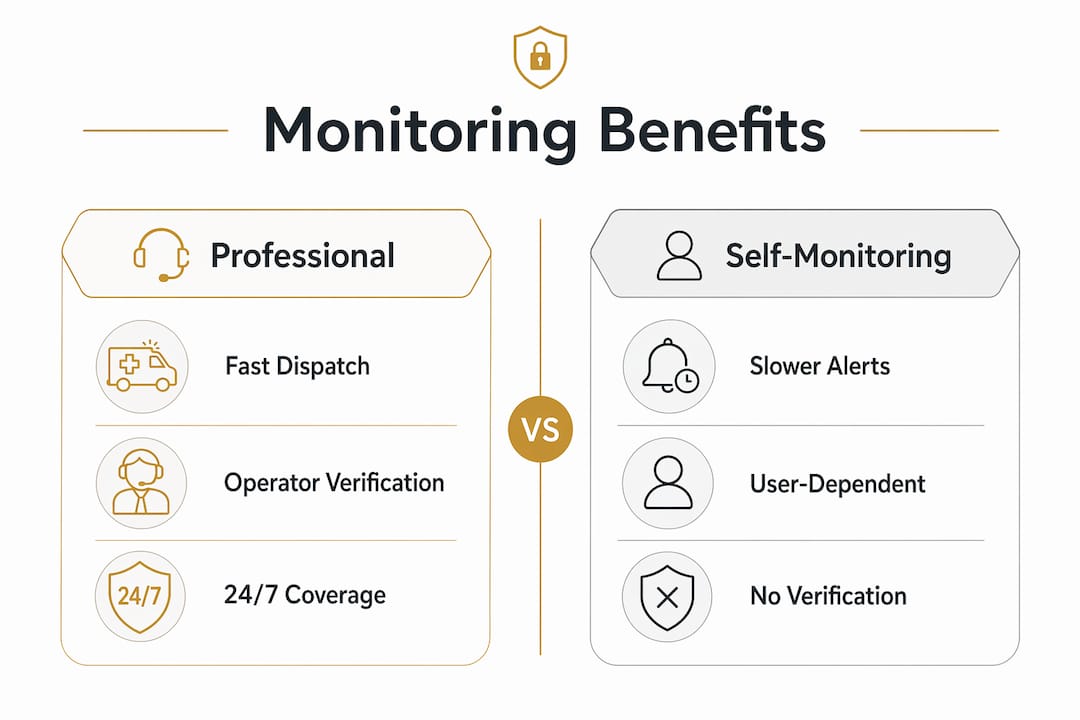
The response time gap is the most consequential difference. Self-monitoring delays averaging up to 9 minutes give a burglar enough time to grab valuables and leave before police arrive. A fire can double in size every minute. Shaving 7 or 8 minutes off the response time is not a minor convenience. It is a meaningful reduction in loss.
Operator verification also changes how police respond. Many jurisdictions have adopted policies that deprioritize unverified alarm calls because false alarms consume patrol resources. A monitoring center that confirms an alarm before calling dispatch gets your call treated as a real emergency. That distinction affects how quickly a patrol car arrives at your address.
Beyond speed, professional monitoring provides coverage that never sleeps. You do not need to check your phone at 3 a.m. or interrupt a vacation to manage an alarm. The operator handles it, notifies you after the fact, and keeps a record of every event.
Is professional monitoring worth the cost?
Professional monitoring plans typically cost between $25 and $80 per month, depending on the level of coverage and technology included. That range puts annual costs between $300 and $960 before any offsets.
Here is where the math shifts in your favor:
- Insurance discounts. Homeowners insurance discounts for professionally monitored systems can reach $75 to $300 per year. For many households, that savings alone covers a significant portion of the monthly fee.
- Reduced losses. Faster emergency response directly reduces property damage in fires and limits theft in burglaries. The financial value of that faster response is difficult to quantify in advance but very clear after an incident.
- No equipment redundancy. Self-monitoring often requires you to invest in backup notification systems, additional cameras, and redundant alerts. Professional monitoring bundles that reliability into the monthly fee.
When you factor in insurance savings, the net annual cost of professional monitoring can drop to near zero for many households. The remaining cost buys you 24/7 trained response, verified alarm handling, and priority dispatch. That is not an expense. That is a transfer of risk.
Pro Tip: Call your homeowners insurance provider before signing a monitoring contract. Ask specifically which UL-listed monitoring certifications qualify for their discount. Some insurers require specific certifications to apply the full discount.
When professional monitoring matters most
Professional monitoring delivers the greatest value in specific situations where the cost of a delayed response is highest.
- High-value properties. Homes or businesses with expensive equipment, inventory, or irreplaceable assets face disproportionate losses from even a short response delay. Professional monitoring closes that window.
- Frequent travelers. If you are away from home regularly, self-monitoring is not a realistic option. A monitoring center covers your property whether you are across town or across the country.
- Commercial businesses. After-hours break-ins at retail locations, warehouses, and offices are common. A monitored system with video verification gives operators the information they need to dispatch police with confidence.
- High-crime areas. Properties in neighborhoods with elevated burglary rates benefit from the priority dispatch that verified alarms receive. Local police departments respond faster to confirmed calls.
- Elderly residents and medical alert users. Professional monitoring centers handle medical emergencies the same way they handle security alarms. A fall or cardiac event triggers the same automatic dispatch process, without the resident needing to reach a phone.
- Remote locations. Properties with poor cell coverage or long emergency service response times benefit from cellular backup monitoring that maintains signal even when local networks are stressed.
Home automation integration also extends the value of professional monitoring. Smart locks, video doorbells, and connected smoke detectors all feed into a monitored system, giving operators more context to verify alarms accurately. That context reduces false alarms and improves the quality of every dispatch decision. You can read more about alarm system basics to understand how these components work together.
Key Takeaways
Professional monitoring is the most reliable security choice because it dispatches emergency services automatically within seconds, independent of whether the homeowner is available, awake, or reachable.
| Point | Details |
|---|---|
| Response speed advantage | Professional monitoring dispatches help in 14–75 seconds vs. up to 9 minutes for self-monitoring. |
| Independent emergency response | Operators act without homeowner involvement, covering gaps during travel, sleep, or lost connectivity. |
| Verified alarm priority | Emergency services prioritize confirmed alarms from monitoring centers over unverified self-reported calls. |
| Net cost can approach zero | Insurance discounts of $75–$300 per year can offset most or all of the monthly monitoring fee. |
| Broadest coverage scope | One monitored system handles fire, medical, and security emergencies around the clock, every day. |
The real reason I recommend professional monitoring
Most homeowners ask me whether professional monitoring is worth it, and they frame it as a cost question. That framing misses the point. The real question is whether you are comfortable being the single point of failure in your own security system.
Self-monitoring puts the entire response chain on you. You have to be awake, connected, calm, and fast. Professional monitoring removes that dependency entirely. I have seen property owners who were confident in their self-monitoring setup until the one night their phone was on silent or their battery died. The system worked. They did not.
The other misconception I hear constantly is that professional monitoring just sends you a notification faster. It does not. It replaces you in the response chain entirely. The operator does not wait for your approval. They verify the alarm and call dispatch. That is a fundamentally different level of protection.
For business owners, the calculus is even clearer. Your liability exposure, your inventory value, and your after-hours vulnerability all point to the same conclusion. A monitored system with a UL-listed center is not a luxury. It is the baseline for serious property protection.
The cost objection dissolves when you run the actual numbers. After insurance discounts, many property owners pay less than $10 a month net for round-the-clock professional coverage. That is less than a streaming subscription for a service that could prevent tens of thousands of dollars in losses.
— Safes and Security Solutions
Professional monitoring options from Safes and Security Solutions
Safes and Security Solutions carries a broad selection of security systems designed to work with professional monitoring services, including cameras, alarm panels, and sensors built for both residential and commercial properties.
Every system in the Safes and Security Solutions catalog is selected for compatibility with UL-listed monitoring centers, so you get the verified alarm priority and cellular backup reliability that professional monitoring requires. Whether you are protecting a single-family home, a retail location, or a multi-site business, the right equipment makes the difference between a system that works and one that just looks like it does. Browse the full range at Safes and Security Solutions to find the setup that fits your property and your monitoring plan.
FAQ
What is professional monitoring for a home security system?
Professional monitoring is a service where trained operators at a central station watch your alarm system 24 hours a day and automatically dispatch emergency services when an alarm is triggered. It operates independently of the homeowner, meaning response happens even when you are asleep or unavailable.
How fast does professional monitoring dispatch emergency services?
Professional monitoring centers dispatch emergency services within 14 to 75 seconds of a verified alarm. Self-monitoring requires the homeowner to act, which adds 2 minutes and 40 seconds to 9 minutes of delay.
Does professional monitoring reduce homeowners insurance costs?
Many insurance providers offer discounts between $75 and $300 per year for professionally monitored systems. The exact discount depends on your insurer and whether the monitoring center holds specific UL certifications.
Is professional monitoring better than self-monitoring?
Professional monitoring provides faster dispatch, independent response, and priority treatment from emergency services. Self-monitoring depends entirely on the homeowner being available and responsive, which creates gaps in coverage during travel, sleep, or connectivity loss.
What types of emergencies does professional monitoring cover?
Most professional monitoring plans cover fire, medical, and security emergencies through the same dispatch process. Monitoring centers operate every day of the year and handle all signal types through a single integrated response system.
Recommended
- What Is a Monitored Alarm System? Your 2026 Guide – Safes and Security Direct
- Why remote security monitoring cuts false alarms by 97% – Safes and Security Direct
- The Role of Monitoring Centers in Modern Security – Safes and Security Direct
- Why surveillance cameras protect your property and why it matters – Safes and Security Direct