

What Is Intrusion Detection? A Complete 2026 Guide
TL;DR:
- An intrusion detection system monitors network traffic and system logs to detect suspicious activity without blocking it. Its effectiveness depends on proper tuning, ongoing management, and integration with other security measures, especially given the rise of encrypted traffic. Combining network and host-based detection with physical security creates a layered defense that is more resistant to evasion.
An intrusion detection system (IDS) is defined as a passive security tool that monitors network traffic and system logs to identify unauthorized or suspicious activity, generating alerts without blocking traffic. Unlike a firewall, an IDS watches and reports. It does not intervene. Understanding what is intrusion detection, and how it fits into a broader security architecture, is the first step toward building a defense that actually holds up under real attack conditions. The National Institute of Standards and Technology (NIST) frames IDS as a core component of defense-in-depth, the layered security model that most enterprise and government networks follow today.
What is intrusion detection and how does it work?
An IDS works by continuously monitoring network traffic or host activity and comparing what it sees against known threat patterns or established behavior baselines. Two primary detection methods power modern systems: signature-based and anomaly-based detection. Each has a distinct role, and most production deployments use both together.

Signature-based detection matches incoming traffic or system events against a database of known attack signatures. It is fast and accurate for recognized threats like SQL injection attempts, port scans, and known malware payloads. The weakness is obvious: it cannot catch what it has never seen before.
Anomaly-based detection builds a baseline of normal behavior for a network or host, then flags deviations. A server that suddenly starts sending large volumes of data to an external IP at 3 a.m. triggers an alert even if no matching signature exists. This method is the primary defense against zero-day exploits.
Modern IDS platforms add heuristic analysis and machine learning on top of these two methods. Machine learning models can identify subtle patterns across thousands of events that no human analyst would spot manually. The tradeoff is complexity. Machine learning in IDS requires continuous tuning to stay accurate as network behavior evolves.
- Signature-based detection: high accuracy for known threats, blind to new attack types
- Anomaly-based detection: catches novel threats, higher false positive rate
- Heuristic analysis: rule-based logic that bridges the gap between the two
- Machine learning: improves over time but demands skilled configuration and ongoing maintenance
Pro Tip: Start with a two-week baselining period before activating anomaly detection. Alerts generated before a solid baseline is established are almost always noise, and noise trains your team to ignore alerts.
One critical limitation affects all detection methods equally. Over 90% of internet traffic is now encrypted. Traditional signature and anomaly detection cannot inspect the contents of encrypted packets without deep packet inspection (DPI), which introduces its own performance and privacy tradeoffs. Any IDS deployment in 2026 must account for this reality.
What are the main types of intrusion detection systems?
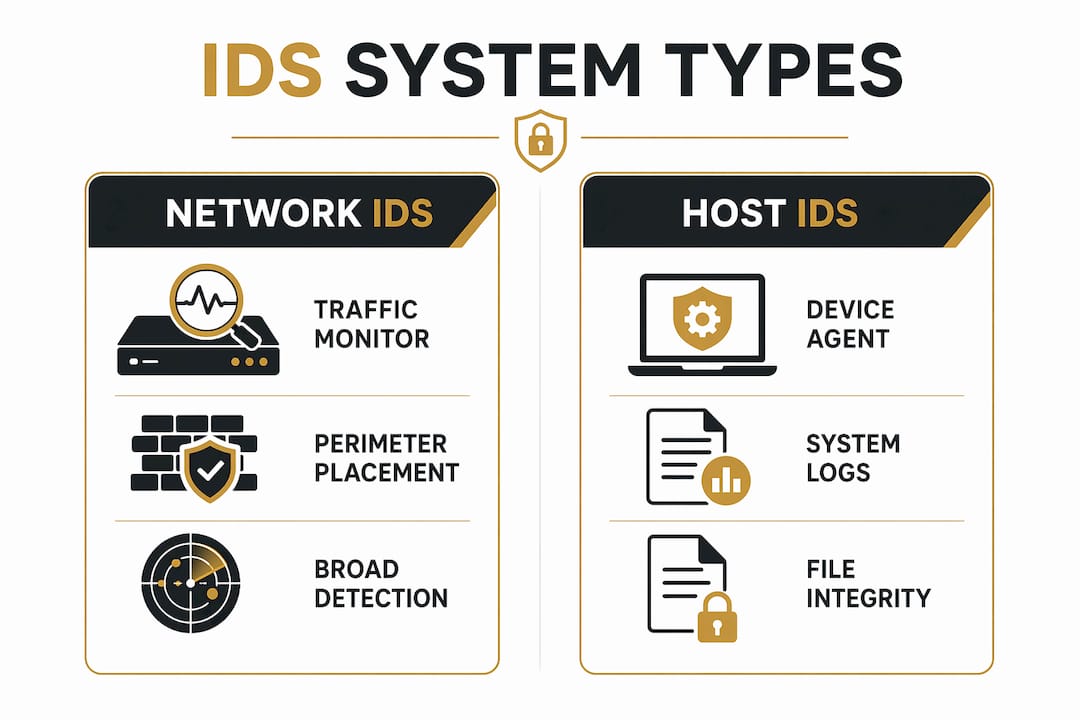
The two primary categories of intrusion detection systems are Network-based IDS (NIDS) and Host-based IDS (HIDS). They monitor different layers of your environment and serve different purposes.
| Type | What it monitors | Best deployment location | Primary use case |
|---|---|---|---|
| NIDS | Network traffic flows | Perimeter, behind firewall, at chokepoints | Detect external attacks and lateral movement |
| HIDS | Individual host activity, logs, file changes | Servers, endpoints, critical workstations | Detect insider threats, malware, file tampering |
NIDS sits at network chokepoints, typically at the perimeter or directly behind the firewall. Enterprise deployments install NIDS at ingress points to capture all inbound and outbound traffic before it reaches internal systems. A NIDS sees everything crossing the wire but knows nothing about what happens inside an individual machine.
HIDS runs as an agent on individual devices. It monitors system calls, log files, file integrity, and running processes. A HIDS catches threats that never touch the network wire, such as a user copying sensitive files to a USB drive or a process modifying system binaries. The limitation is scale: deploying and managing HIDS agents across thousands of endpoints requires significant operational overhead.
Physical intrusion detection systems for buildings use entirely different technology. The National Protective Security Authority (NPSA) distinguishes physical systems, which use motion detectors, door contacts, and control panels, from network IDS, which is software-based monitoring. Both serve a detection function, but they operate in separate domains and require separate expertise.
For home users, the calculus is different. Consumer security software and router protections typically provide sufficient coverage for residential networks without the complexity and latency that enterprise IDS introduces. The layered security approach that works for a corporate data center is overkill for a home network with a handful of devices.
What are the benefits and limitations of intrusion detection?
The core benefit of an IDS is visibility. Without it, attacks can run undetected for weeks or months. The passive monitoring role of an IDS means it generates detailed logs of every suspicious event, giving Security Operations Center (SOC) analysts the forensic data they need to reconstruct an attack timeline after the fact.
Key benefits of deploying an IDS include:
- Forensic logging: Every alert includes timestamps, source and destination IPs, and event context, which is critical for post-incident investigation.
- Compliance support: Regulations like PCI DSS and HIPAA require evidence of monitoring. IDS logs satisfy audit requirements directly.
- SOC triage support: Alerts feed into SIEM platforms, giving analysts a structured queue to work through rather than hunting blindly.
- Early warning: An IDS catches reconnaissance activity, such as port scans and credential stuffing, before an attacker reaches their target.
The limitations are equally real and should not be minimized.
An IDS does not stop a single packet. Its value is entirely dependent on the speed and skill of the humans or automated systems that act on its alerts.
Alert fatigue is a documented operational problem. A poorly tuned IDS generates hundreds of false positives per day. Security teams that see the same false alert repeatedly start ignoring the alert category entirely, which is exactly when a real attack slips through. Tuning is not a one-time setup task. It is an ongoing operational discipline.
Encrypted traffic remains the most significant technical limitation. Without DPI, an IDS monitoring encrypted sessions sees only metadata: connection timing, packet size, and endpoint addresses. Sophisticated attackers who encrypt their command-and-control traffic can operate inside a network for extended periods without triggering a single signature-based alert.
How does intrusion detection fit into a layered security strategy?
An IDS occupies the detection layer in a defense-in-depth architecture. Each layer handles a distinct function, and the IDS role is specifically to watch, record, and alert. Other tools handle the rest.
- Firewall: Controls access at the perimeter. Blocks connections based on rules. The firewall is the first line of defense, not the last.
- IDS: Monitors traffic that passes the firewall. Identifies suspicious patterns and generates alerts for analyst review.
- IPS (Intrusion Prevention System): Sits inline and actively blocks malicious packets in real time. An IPS is an IDS with an enforcement mechanism added. The tradeoff is that a misconfigured IPS can block legitimate traffic.
- SIEM (Security Information and Event Management): Aggregates logs and alerts from IDS, firewalls, endpoints, and applications into a single platform for correlation and analysis.
- SOAR (Security Orchestration, Automation, and Response): Automates the response to common alert types, reducing the manual workload on SOC analysts and cutting response time from hours to minutes.
The relationship between IDS and IPS is the most commonly misunderstood distinction in network security. An IDS tells you a threat exists. An IPS acts on that information immediately. Most modern enterprise deployments use both: IDS for broad visibility and forensic logging, IPS for active blocking of high-confidence threats.
Pro Tip: Place your NIDS behind the firewall, not in front of it. Monitoring pre-firewall traffic floods your IDS with noise from internet-wide scanning. Post-firewall placement focuses detection on threats that actually penetrated your perimeter.
Integration with a home defense layered plan follows the same logic at a smaller scale. Alarms, cameras, and access controls each handle one layer. The detection layer, whether digital or physical, feeds information to whoever is responsible for response. The architecture is the same. Only the tools change.
For home and small business owners, pairing network monitoring with smart home security sensors creates a detection layer that covers both digital and physical threats without enterprise complexity.
Key Takeaways
An intrusion detection system is a passive monitoring tool that generates alerts and forensic logs, and its effectiveness depends entirely on the quality of the people and systems that act on those alerts.
| Point | Details |
|---|---|
| IDS is passive, not preventive | An IDS alerts on threats but does not block them. Pair it with an IPS for active response. |
| Two core detection methods | Signature-based catches known threats; anomaly-based catches novel attacks and zero-days. |
| NIDS vs. HIDS serve different roles | Deploy NIDS at network chokepoints and HIDS on critical hosts for full coverage. |
| Encryption limits visibility | Over 90% of traffic is encrypted, requiring DPI or advanced analytics to maintain detection accuracy. |
| Tuning is ongoing, not optional | Continuous alert tuning prevents fatigue and keeps detection focused on real threats. |
The uncomfortable truth about IDS deployments
After working with security teams across home and business environments, one pattern stands out: organizations buy an IDS and assume the work is done. It is not. An IDS out of the box is a noisy, imprecise instrument. The value comes from weeks of tuning, baselining, and building the operational processes that turn raw alerts into meaningful responses.
The encrypted traffic problem is also more serious than most buyers realize. If your IDS cannot inspect encrypted sessions, and most cannot without significant additional investment, you are monitoring a shrinking fraction of your actual traffic. Attackers know this. They encrypt everything now.
The teams that get real value from intrusion detection treat it as a program, not a product. They assign ownership, review alert trends weekly, and update detection rules when the threat environment shifts. They also combine their IDS with physical security measures, because a network that is digitally monitored but physically accessible is still vulnerable.
The most effective security posture I have seen combines network monitoring, host-based detection, physical access controls, and a clear escalation process. None of those elements works well in isolation. Together, they create a detection capability that is genuinely hard to evade.
— Safes and Security Solutions
Security products that complement your detection strategy
Physical and digital security work best together. An IDS monitors your network. Cameras, alarms, and access controls monitor your physical space. Safes and Security Solutions carries a full range of products designed to close the gaps that software alone cannot cover.

From professional-grade surveillance cameras to fire-resistant and burglary-resistant safes, the catalog at Safes and Security Solutions is built for both residential and commercial clients who take layered protection seriously. Whether you are hardening a home office or securing a business location, the right physical controls make your digital monitoring far more effective. Browse the full range and find the products that fit your environment.
FAQ
What is the difference between IDS and IPS?
An IDS monitors traffic and generates alerts without blocking anything. An IPS sits inline and actively blocks malicious packets in real time.
What are the two main types of intrusion detection systems?
Network-based IDS (NIDS) monitors traffic across a network segment, while Host-based IDS (HIDS) monitors activity on individual devices such as servers and endpoints.
Does a home user need an intrusion detection system?
Most home users do not need enterprise-grade IDS. Consumer security software and router-level protections typically provide sufficient coverage for residential networks.
How does encryption affect intrusion detection?
Over 90% of internet traffic is now encrypted, which limits traditional IDS visibility. Effective detection of encrypted threats requires deep packet inspection or advanced behavioral analytics.
What is the biggest operational challenge with IDS?
Alert fatigue is the most common problem. A poorly tuned IDS generates excessive false positives, causing security teams to overlook real threats. Continuous tuning is the only reliable solution.
Recommended
- How to prevent break-ins: a practical guide for homeowners – Safes and Security Direct
- Home security terminology explained: a clear guide – Safes and Security Direct
- DIY Home Surveillance Guide for Homeowners in 2026 – Safes and Security Direct
- Alarm systems: Essential roles, real impact, strategies – Safes and Security Direct