

What Is a Night Deposit Safe? A Practical Guide
TL;DR:
- A night deposit safe is a secure unit used for after-hours cash storage, either operated by a bank or owned by a business. Bank depositories transfer custody to the bank, while private safes remain under the business’s control until deposit. Choosing the right option depends on your cash volume, security needs, and liability considerations.
A night deposit safe is a secure, one-way drop unit that holds cash, checks, and envelopes after hours until they can be processed. The term covers two distinct things: a bank night depository, which is a secure exterior drop box installed by a bank that collects funds overnight and credits them the next business day, and a private depository safe (also called a drop safe or cash drop safe), which is a steel unit your business owns and controls on-site. If you run a cash-heavy operation and need the bank to take custody overnight, the bank night depository is your tool. If you need intermediate storage between shifts, or you want on-site control before an armored pickup, a privately owned deposit safe is the better fit.
Pro Tip: Arrive at a bank night depository with your sealed bag and key or PIN already in hand. Minimize time at the hopper, and if the area looks unsafe, drive away and return later.
- Bank night depository: bank-operated, exterior, funds credited the next business day
- Private depository safe: business-owned, on-premises, no bank custody until you make a deposit
- Both use tamper-evident bags and one-way drop mechanisms to prevent unauthorized retrieval
Table of Contents
- How does a bank night depository compare to a private deposit safe?
- How does a night deposit actually work, step by step?
- Who actually uses night depositories and deposit safes?
- What security features should you look for in a deposit safe?
- How to run a secure deposit procedure without gaps
- What does installation and insurance actually cost?
- How to choose the right deposit safe and where to buy one
- Key Takeaways
- The feature most buyers overlook
- Safes and Security Solutions: deposit safes built for real cash-handling needs
- Useful sources
How does a bank night depository compare to a private deposit safe?
These two solutions share a name family but serve different masters. Understanding the gap between them saves you from buying the wrong thing.
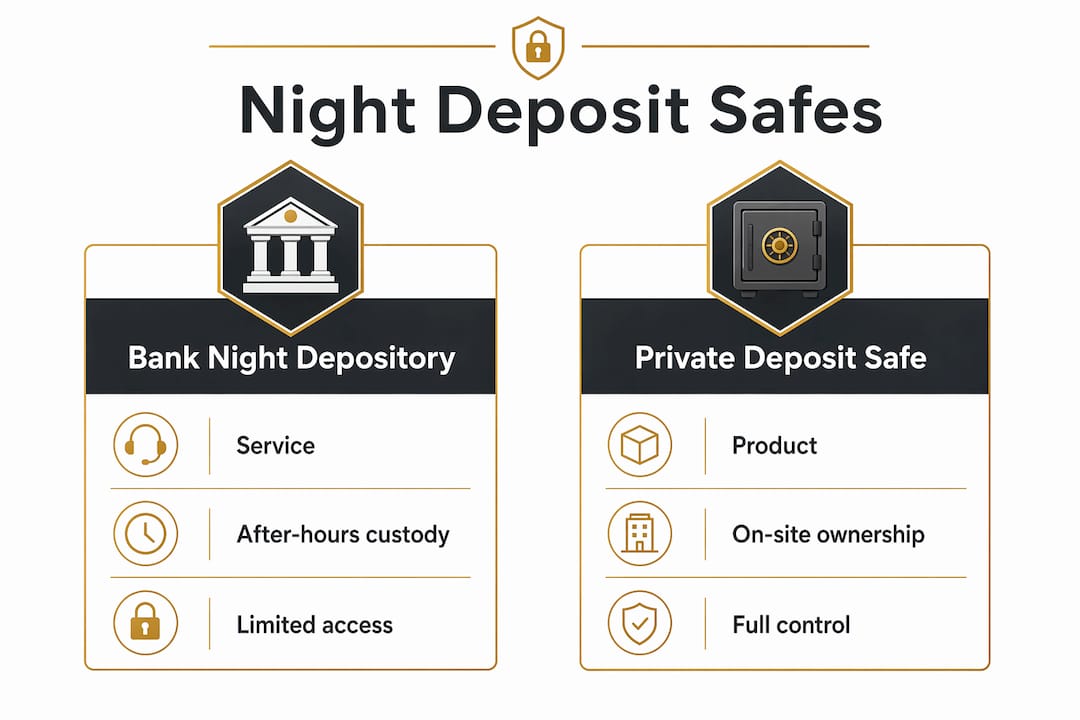
A bank night depository is a service. You sign a night depository agreement that spells out fees, access credentials, liability terms, and how disputes are handled. The bank issues you a physical key or electronic credential and provides lockable, tamper-evident bags. You drop the bag; the bank processes it the next business day. Unlike an ATM, night depositories accept coins and have no volume cap on cash or checks.
A private depository safe is a product. You purchase it, anchor it, and own the chain of custody entirely. Employees drop cash through a slot or hopper throughout a shift; only an authorized manager with the combination or key retrieves the contents. No bank is involved until you make a conventional deposit.
| Feature | Bank night depository | Private depository safe |
|---|---|---|
| Intended use | After-hours bank custody | On-site interim cash storage |
| Access method | Key or PIN issued by bank | Combination, keypad, or dual-key |
| Anti-fishing design | Rotating drum or trap-door | Internal baffles, one-way slot |
| Capacity | No stated volume limit | Varies by model and interior size |
| Installation | Wall-mounted at bank branch | Freestanding, anchored, or wall-mounted |
| Typical cost | Service fee plus key deposit | One-time purchase plus installation |
| Chain of custody | Transfers to bank on drop | Stays with business until deposit |
| Fire/burglary rating | Bank-grade vault | Varies; look for UL-rated models |
Pro Tip: Before signing a bank night deposit agreement, ask specifically about the liability clause for funds missing between the hopper and the vault. That gap is where most disputes originate.
How does a night deposit actually work, step by step?
Bank night depository mechanics
The exterior hopper uses a rotating drum or trap-door mechanism so the outside and inside openings are never open at the same time. This blocks “fishing,” where someone tries to retrieve bags with a hook or tool after dropping them. You insert your sealed bag, close the handle, and the bag falls into a locked internal chamber. Bank staff collect all deposits when the branch opens, log each bag on a record sheet, and process them. Funds are credited to your account on the next business day.
Always re-open the exterior door after closing the handle to confirm the bag has cleared the hopper. A bag stuck halfway is the single most common vulnerability at any night drop location.
Private deposit safe mechanics
A depository safe has two distinct access points: a small external slot, chute, or rotary drum for deposits, and a main door secured by a combination dial, electronic keypad, or dual-key system for retrieval. Once cash drops through the slot, internal baffles prevent anyone from reaching back in. Time-delay electronic locks add another layer: even with the correct code, the door won’t open for a preset period, typically 5–15 minutes, which discourages smash-and-grab attempts.
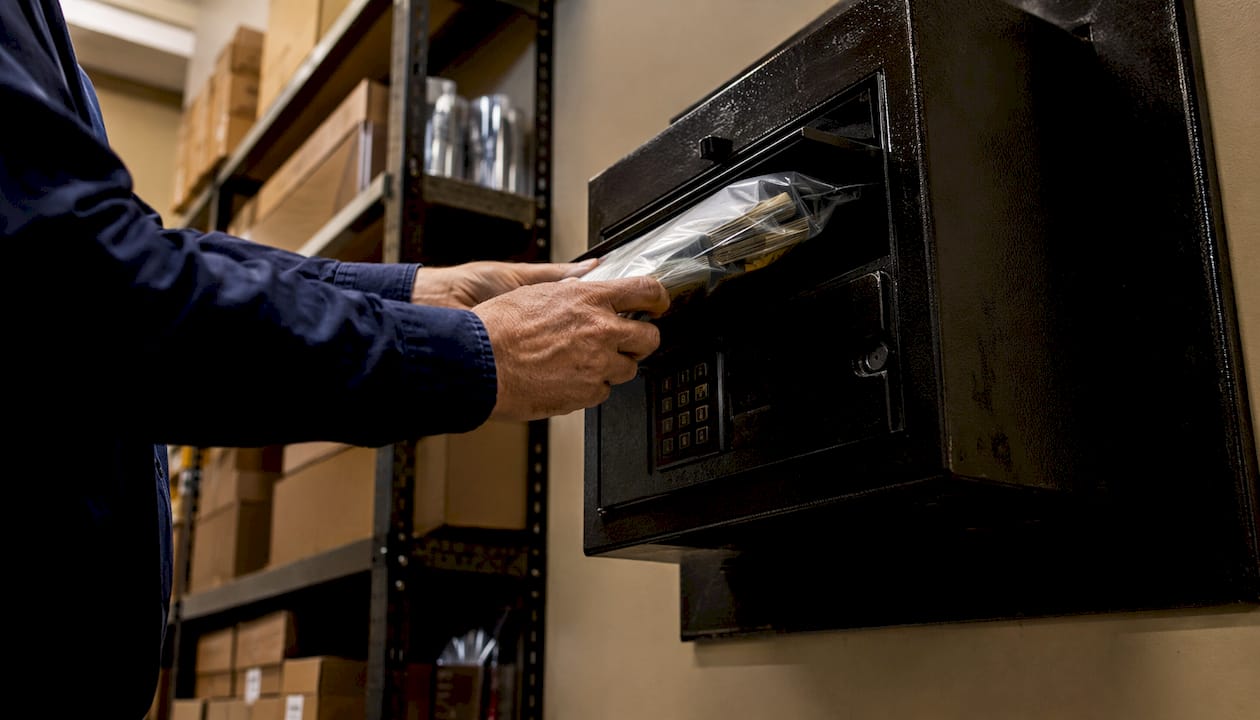
Pro Tip: After every drop into a private safe, tug the slot cover or hopper to confirm it’s fully closed. An improperly seated hopper can be forced open.
Who actually uses night depositories and deposit safes?
Night depositories work best for businesses with predictable daily cash receipts that need to move funds off-site quickly. Restaurants, convenience stores, laundromats, and service businesses with daily cash volume are the classic users. The ongoing relevance of night deposit services for cash-heavy small businesses comes down to one thing: reducing the amount of money sitting in your building overnight.
Private deposit safes fit a wider range of situations:
- Retail stores where cashiers drop excess bills throughout each shift to keep register totals low
- Hotels and motels where front-desk staff make overnight drops and a manager reconciles in the morning
- Late-night businesses that can’t safely reach a bank branch after closing
- Homeowners storing collectibles, jewelry, or documents who want a drop-in option without opening the main safe
- Businesses using armored pickup that need a secure holding point between shifts and courier arrival
Many businesses run both: a drop safe on-site for shift-by-shift deposits, then a bank night depository run at the end of the day. That hybrid approach keeps register cash low, limits internal theft exposure, and gets funds into bank custody the same night. For more on why retail operations rely on drop safes, the pattern is consistent across industries.
What security features should you look for in a deposit safe?
Time-delay locks and integrated surveillance are the two features that most meaningfully deter theft. A time-delay lock removes the immediate payoff for a robbery: even if someone forces an employee to open the safe, the delay helps allow time for an alarm response. Surveillance provides forensic evidence if an attempt is made.
Must-have features:
- Anti-fishing baffles or a rotating drum in the deposit slot
- Electronic keypad with an audit trail (records who opened the safe and when)
- Time-delay function (a delay of several minutes is standard for retail)
- Anchoring hardware or a pre-drilled floor-bolt pattern
- Tamper-evident deposit bags compatible with the slot dimensions
Nice-to-have features:
- UL-listed burglary rating (TL-15 or higher for commercial use)
- Fire rating (look for at least 1-hour protection at 1,700°F for paper currency)
- Dual-control (two-person) access for high-value environments
- Alarm wiring ports for integration with your existing security system
- Surveillance camera mount bracket or adjacent placement planning
Capacity matters more than buyers expect. Measure your typical daily cash volume and bag dimensions before purchasing. A safe that holds only a few hundred dollars in loose bills will bottleneck a busy retail operation within a week.
Pro Tip: Check your business insurance policy before buying. Many insurers require a UL-rated safe and documented anchoring to honor a cash-loss claim. Get the spec sheet from the manufacturer and send it to your broker before you finalize the purchase.
How to run a secure deposit procedure without gaps
Operational success depends on staff training and consistent recordkeeping as much as on the safe itself. A well-specified safe with sloppy procedures is still a liability.
Step-by-step deposit procedure:
- Count and verify cash with a second employee present (dual control).
- Complete the deposit slip with amount, denomination breakdown, and employee initials.
- Seal the tamper-evident bag and record the bag number.
- For bank deposits: have your key or PIN ready before leaving the building; park in a well-lit area close to the hopper; confirm the bag clears the hopper before walking away.
- For private safes: drop the bag through the slot, confirm the hopper is fully closed, and log the drop time.
- File the deposit record with a supervisor or in a secure log.
Situational awareness rules:
- Abort a bank deposit if anyone is loitering near the hopper or the area feels unsafe.
- Vary your deposit times when possible; predictable schedules invite surveillance by bad actors.
- Use well-lit parking and, where possible, have a second person present for bank runs.
Pro Tip: When opening a commercial account, negotiate the right to be present when your deposit bags are opened and counted. It delays posting by a day but eliminates most disputes about missing funds.
For detailed staff controls and chain-of-custody documentation templates, the guidance on securing a deposit safe covers the procedural side in depth.
What does installation and insurance actually cost?
Cost breaks down into three buckets: the safe itself, installation, and ongoing fees.
- Safe purchase: Entry-level drop safes start under $200 for basic residential models. Commercial-grade units with time-delay locks, UL ratings, and larger capacity typically run $400–$1,500+. Heavy-duty floor safes with fire ratings sit at the higher end.
- Installation: Anchoring a freestanding safe to a concrete floor requires hardware and, for commercial installs, professional labor. Wall-mount models need framing access. Budget for an electrician if your electronic lock needs a hardwired power source.
- Bank service fees: Night deposit services vary by bank and account type; fees and key deposits are set by individual institutions. Check your commercial account agreement for the current schedule.
- Maintenance: Electronic lock batteries need periodic replacement. Combination locks benefit from annual servicing. Tamper-evident bags are a recurring supply cost.
On the insurance side, night deposit agreements commonly limit bank liability for funds missing between the hopper and the vault, placing the burden of proof on you. Keep pre-deposit records: itemized lists, bag numbers, photos if your policy allows. For on-site safes, your business property policy may cover cash losses up to a stated limit, but only if the safe meets the insurer’s rating requirements.
Pro Tip: For under-counter installations in space-constrained environments, read the under-counter deposit safe guide before measuring. Slot orientation and door swing direction affect whether a model fits your setup.
How to choose the right deposit safe and where to buy one
Work through this checklist before purchasing:
- Intended use: Bank-run at end of day, shift-by-shift drops, or both?
- Capacity: How much cash volume per shift? What bag dimensions do you use?
- Lock type: Electronic keypad with audit trail for businesses; combination for simpler home use.
- Time-delay: Required for any retail or hospitality environment.
- Fire rating: Needed if you store documents or large cash reserves.
- Anchoring: Freestanding units must be bolted down; confirm floor material before ordering.
- Surveillance integration: Plan camera placement at the same time as safe placement.
- Budget: Match spec to risk level; don’t over-buy for a home application or under-buy for a high-volume retail floor.
Safes and Security Solutions carries a range of deposit and drop safes built for both homeowner and commercial use, with detailed specs on lock types, interior dimensions, and anchoring hardware. Product pages include the documentation most insurers need to confirm coverage eligibility.
Key Takeaways
A night deposit safe, whether bank-operated or privately owned, is the most practical way to move cash out of circulation between business hours and protect it from theft overnight.
| Point | Details |
|---|---|
| Two distinct products | A bank night depository transfers custody to the bank; a private drop safe keeps custody with your business. |
| Anti-fishing design matters | Rotating drums and internal baffles prevent retrieval through the deposit slot. |
| Time-delay locks deter robbery | A 5–15 minute delay removes the immediate payoff for a forced-entry attempt. |
| Agreements shift liability | Bank night deposit agreements often place the burden of proof for missing funds on the depositor; keep pre-deposit records. |
| Safes and Security Solutions | Carries deposit and drop safes for homeowners and businesses with specs, anchoring hardware, and insurance documentation support. |
The feature most buyers overlook
Most buyers focus on the lock and the price. The feature that actually determines whether a deposit safe earns its keep is the audit trail. An electronic keypad that logs every open event, with a timestamp and user credential, is what separates a secure cash-handling system from a steel box with a combination. When a discrepancy shows up, and in any cash-heavy business it eventually will, the audit log is the only objective record you have. A mechanical combination lock offers zero forensic value.
The same logic applies to the bank side. The night deposit agreement is not a formality. It is the document that determines whether the bank owes you anything if a bag goes missing between the hopper and the vault. Read the liability clause before you sign, not after a dispute. And if your bank won’t let you be present when bags are opened, that’s worth knowing before you commit to the service.
Capacity is the other underestimated variable. Businesses routinely buy a safe that fits today’s cash volume and outgrow it within a year. Size up by one tier. The price difference is small; the operational headache of replacing an anchored unit is not.
Safes and Security Solutions: deposit safes built for real cash-handling needs
Safes and Security Solutions stocks deposit and drop safes across the full range of business and homeowner needs, from compact under-counter units for small retail to commercial-grade floor safes with time-delay locks, UL burglary ratings, and alarm wiring ports. Every product listing includes interior dimensions, slot specifications, anchoring hardware details, and the manufacturer documentation your insurer needs to confirm coverage. Installation support is available, and the team can help you match capacity and lock type to your specific cash volume and shift structure. Browse the full deposit safe range or contact Safes and Security Solutions directly to get a quote and confirm which model fits your floor plan and insurance requirements.
Useful sources
- Investopedia: Night Depository — Definition, features, and guidance on negotiating bank agreement terms for business owners.
- LegalClarity: How Does Night Deposit Work — Detailed breakdown of hopper mechanics, liability clauses, and situational-awareness best practices.
- Corporate Finance Institute: Night Depository — Comparison of night depositories and ATMs, including volume and coin acceptance differences.
- AccountingInsights: What Is a Night Deposit — Overview of electronic lock features, time-delay functions, and surveillance integration.
- Low Rate Locksmith: Depository Safes — Technical explanation of drop safe mechanics, access point design, and use cases by business type.
- WallStreetMojo: Night Depository — Features, processing timeline, and comparison with ATM deposit services.
- Safes and Security Solutions: How to Store Cash Overnight — Step-by-step guidance for after-hours deposits and on-premises cash security.
- Safes and Security Solutions: Cash Deposit Safe for Business — Comparison of bank depositories and business-owned safes with buying guidance.