

What Is a Cash Management Safe? A Business Owner's Guide
TL;DR:
- A cash management safe automates cash validation, counting, and digital logging to reduce errors and theft.
- Its real-time audit trail enhances security, accountability, and improves cash flow through provisional bank credit.
A cash management safe is defined as a technology-enhanced security device that automates the validation, counting, and real-time digital recording of cash deposits. Unlike a standard safe, it functions as both a physical security unit and a cash management system, converting physical cash into digital data the moment it enters the unit. The industry term for the most advanced versions is “smart safe,” and both terms are used interchangeably throughout this guide. For business owners and individuals handling significant cash volumes, these devices reduce shrinkage, cut counting errors, and speed up bank crediting in ways a traditional safe simply cannot match.
What is a cash management safe and how does it differ from a standard safe?
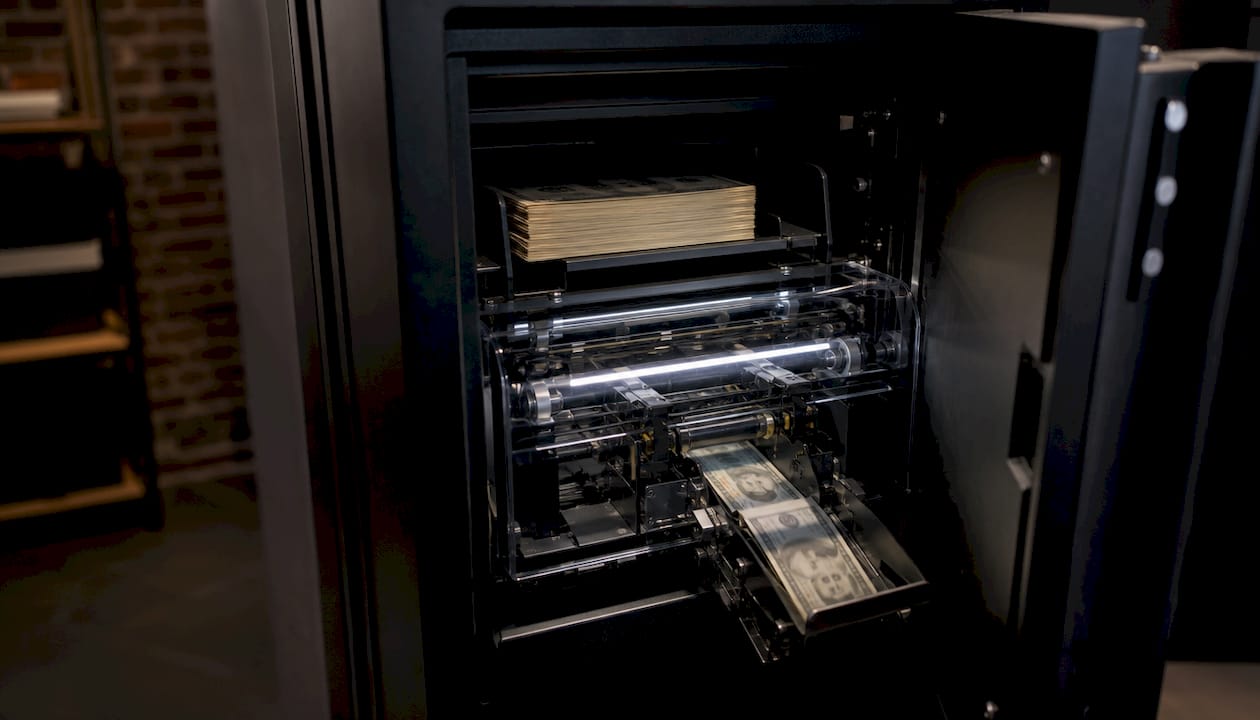
A cash management safe does far more than lock cash away. It automates authentication, counting, and digital logging of every deposit in real time, creating a timestamped record of who deposited what and when. That record is the core difference between a smart safe and a conventional lockbox.
Standard safes offer physical protection only. A cash management safe adds a layer of data intelligence. Every bill inserted passes through a validator that checks for counterfeits, counts the denomination, and records the transaction against a specific user ID. The result is a live audit trail that a manager can review remotely without ever opening the safe.
This shift matters because most cash losses in retail and hospitality do not come from external theft. They come from internal errors, undetected shrinkage, and manual counting mistakes. A smart safe addresses all three simultaneously, which is why the industry treats it as a management tool rather than just a better lock.
How do cash management safes work to secure and manage cash?
The operating mechanism inside a cash management safe combines bill validation hardware with connected software. When a cashier or manager inserts bills, the safe runs each note through sensors that detect magnetic ink, paper thickness, and infrared patterns to flag counterfeits. Simultaneously, the unit counts and records each denomination.
Key functions built into most cash management safes include:
- Bill validation: Counterfeit detection using magnetic, infrared, and ultraviolet sensors on every note inserted.
- Automatic counting: Real-time denomination tallying with no manual input required from the depositor.
- User-level logging: Each deposit is tied to a PIN or employee ID, creating individual accountability.
- Connectivity: Most units transmit deposit data to a cloud dashboard or back-office software via an internet connection.
- Provisional credit integration: Deposit data is shared with the business’s bank, allowing provisional credit within 1–2 business days before armored carriers physically collect the cash.
The physical housing is tamper-resistant steel, typically anchored to the floor or a counter. The combination of locked hardware and live data reporting means that even if someone attempted to access the unit, the software would flag the anomaly immediately.
Pro Tip: Place the safe in a low-traffic, non-public area. Visibility increases risk. A discreet location is one of the simplest and most effective security controls available.
What are the main benefits of using a cash management safe?
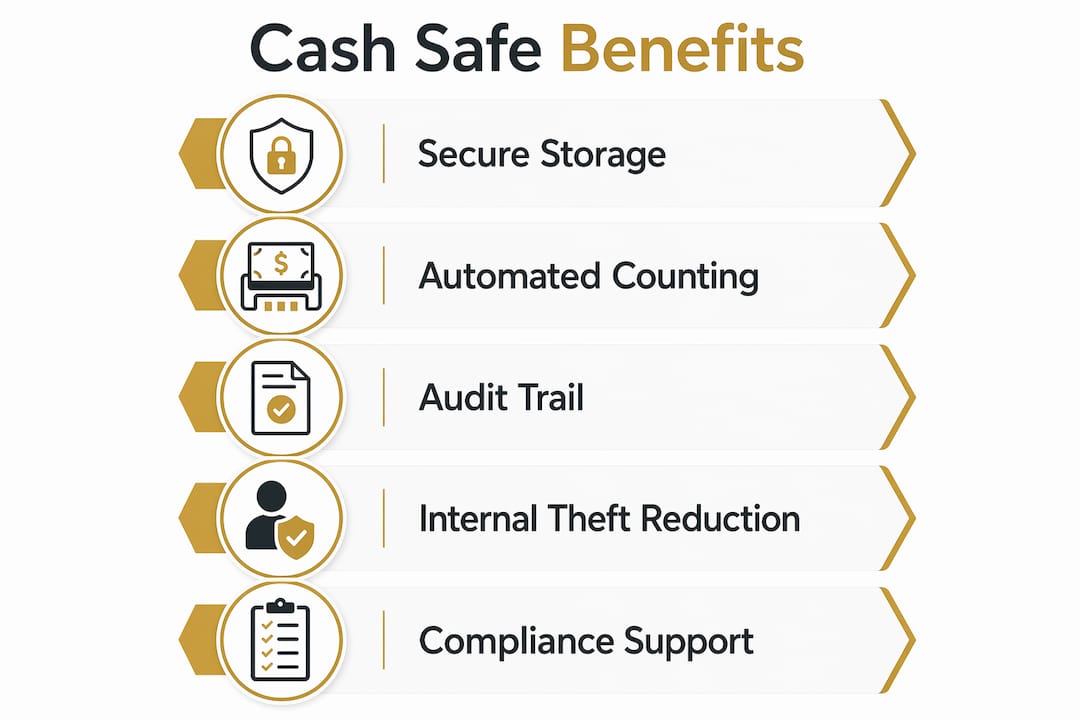
The benefits of cash management safes fall into three clear categories: security, efficiency, and financial visibility. Each one addresses a real cost that cash-heavy businesses absorb every day without realizing it.
- Reduced theft and shrinkage. Smart safes reduce cash handling time by 50–80% compared to manual methods. Less time handling cash means fewer opportunities for errors and theft.
- Faster reconciliation. Automated counting eliminates the end-of-shift counting ritual. Managers get accurate totals instantly, freeing staff for customer-facing work.
- Stronger audit trails. Every deposit is logged by user ID and timestamp. This level of accountability changes employee behavior. Staff who know every transaction is recorded handle cash more carefully.
- Improved cash flow. Provisional bank credit means the business can access funds before the armored carrier arrives. For retailers managing tight operating budgets, that one or two day improvement in cash availability is a genuine financial advantage.
- Employee safety. When cash moves directly from the register to a locked smart safe, employees carry less cash and spend less time counting in visible areas. That reduces the risk of robbery during shift changes.
The audit trail and accountability improvements also support compliance. Businesses subject to internal audits or franchise standards can produce detailed cash reports without reconstructing records manually.
What operational and financial nuances should you know?
Cash management safes carry real costs and real limitations that buyers frequently underestimate. Understanding these before purchase protects your return on investment.
Provisional credit is not ownership transfer. When a bank grants provisional credit after a deposit is verified, the cash still belongs to the merchant. Liability remains with the merchant until armored carriers physically remove the cash. Only an explicit contractual agreement with a cash management service provider can transfer that liability.
Recurring costs add up. The safe itself is only part of the expense.
- Proprietary software subscriptions are required for the smart features to function.
- Maintenance contracts cover sensor calibration and hardware repairs.
- Armored transport fees apply each time cash is collected.
- Bank integration fees may apply depending on the financial institution.
These hidden costs impact total cost of ownership significantly. A business that budgets only for the hardware purchase will face unexpected ongoing expenses within the first quarter of operation.
Technology does not replace process. A smart safe with weak procedural controls still produces losses.
“The most common failure in cash management is lacking dual control. Shared PINs or single-employee control over deposits and reconciliation creates a single point of failure that no hardware can fix. Enforced dual control, where no one person can both deposit and reconcile alone, is the procedural foundation that makes the technology work.”
Dual control procedures are not optional extras. They are the baseline that gives the audit trail its integrity.
How do you choose, install, and effectively use a cash management safe?
Selecting the right cash management safe starts with an honest assessment of your cash volume and operational setup. A small retail shop with one register has different needs than a restaurant group with multiple locations.
Selection criteria to evaluate:
- Cash volume per shift: Higher volumes justify units with larger bill capacities and faster processing speeds.
- Number of users: Multi-user environments need robust PIN management and individual access logs.
- Connectivity requirements: Confirm the unit supports your bank’s integration protocol before purchasing.
- Physical footprint: Under-counter models suit tight spaces; freestanding units offer larger capacity. Safes and Security Solutions offers under-counter deposit safe guidance to help match unit size to location.
Installation and setup essentials:
| Step | What to do | Why it matters |
|---|---|---|
| Professional anchoring | Bolt the unit to floor or counter | Prevents removal by force |
| Network connection | Connect to a secure, dedicated line | Protects data transmission |
| User enrollment | Assign individual PINs to each staff member | Creates accountable audit trail |
| Bank integration | Link deposit data to your financial institution | Enables provisional credit |
| Staff training | Run deposit and reconciliation drills | Reduces errors from day one |
Pro Tip: Treat access management like a password policy. Rotate PINs every 90 days, revoke access immediately when an employee leaves, and audit the user log monthly. Strong access control practices are as important as the hardware itself.
Integrated cash management combining hardware, software, and logistics outperforms a standalone safe every time. Before finalizing a purchase, confirm that your armored transport provider, bank, and safe software all communicate with each other. Fragmented solutions increase operational burden without delivering the full benefit.
For individuals storing cash at home, the calculus is simpler. A home cash safe with basic locking and fire resistance covers most personal needs without requiring software integration.
What I’ve learned from watching businesses get cash management wrong
Most businesses that invest in a cash management safe focus entirely on the hardware. They buy a well-rated unit, bolt it down, and assume the work is done. The losses continue anyway.
The pattern I see repeatedly is this: the safe is excellent, but the procedures around it are weak. Staff share PINs because it is convenient. Managers skip the reconciliation review because the dashboard feels like extra work. The audit trail exists, but nobody reads it. The safe becomes an expensive lockbox.
The real value of a smart safe is not in what it locks away. It is in the data it generates and the culture shift it enables. When staff know that every deposit is logged to their name, behavior changes. When managers review the dashboard daily, discrepancies surface in hours rather than weeks. The hardware creates the conditions for accountability. The people have to follow through.
The other mistake I see is treating the purchase price as the total cost. Software subscriptions, armored transport, and maintenance fees are not optional. They are what make the device function as advertised. Budget for them from day one or the ROI calculation will never close.
My honest view: a cash management safe is one of the highest-return investments a cash-heavy business can make. But only when the hardware, software, logistics, and staff procedures work together as a single system.
— Safes and Security Solutions
Safes and Security Solutions: find the right cash safe for your needs
Safes and Security Solutions carries a full range of cash management safes suited for both individual buyers and business owners managing daily cash flow.
Whether you run a single retail location or manage cash across multiple sites, the right safe depends on your volume, your team size, and your bank’s integration capabilities. Safes and Security Solutions offers detailed product listings with specifications, so you can match the unit to your actual operation rather than guessing. Browse the full selection of cash drop safes or explore options for small business buyers to find a unit built for your cash volume and security requirements. Contact the team directly for guidance on installation, bank integration, and ongoing service planning.
FAQ
What is a cash management safe used for?
A cash management safe automates the validation, counting, and digital recording of cash deposits to reduce errors, shrinkage, and manual counting time. Businesses use them to create real-time audit trails and access provisional bank credit faster.
How does a smart safe differ from a regular safe?
A regular safe provides physical security only. A smart safe adds bill validation, automatic counting, user-level logging, and connectivity to bank and back-office software systems.
Can a cash management safe eliminate internal theft?
A smart safe significantly reduces internal theft by logging every deposit to a specific user ID and timestamp. It does not eliminate risk on its own. Dual control procedures and consistent management review are required to close the remaining gaps.
What ongoing costs should I expect with a cash management safe?
Expect recurring costs for proprietary software subscriptions, hardware maintenance, and armored transport fees. These costs are separate from the purchase price and are required for the smart features to function properly.
Is provisional credit the same as the bank owning my cash?
No. Provisional credit gives you access to funds before physical pickup, but liability for the cash remains with you until armored carriers remove it. Only a specific contractual agreement transfers that liability to a service provider.
Key takeaways
A cash management safe delivers its full value only when hardware, software, logistics, and procedural controls operate as one integrated system.
| Point | Details |
|---|---|
| Core function | A cash management safe validates, counts, and logs cash in real time, not just locks it away. |
| Provisional credit benefit | Banks can grant credit within 1–2 business days of deposit verification, improving cash flow before physical pickup. |
| Dual control is non-negotiable | No single employee should deposit and reconcile alone; shared PINs are the most common cause of loss. |
| Budget for recurring costs | Software, maintenance, and transport fees are ongoing and required for smart features to function. |
| Integration beats hardware alone | Combining hardware, software, and armored logistics outperforms any standalone safe purchase. |