

Cash Drawer Security: A 2026 Guide for Retail Businesses
What is cash drawer security, and why does it matter?
Cash drawer security is the combination of physical hardware safeguards and software-integrated controls that protect cash during transactions, limit unauthorized access, and create an audit trail for every drawer opening. It covers everything from the gauge of steel in the drawer body to the POS rules that determine who can open it and when.
The core elements work together: 18–20 gauge steel construction, multi-position locking cylinders, and POS-triggered electronic access that ties every drawer open to a recorded transaction or authorized action. Without that integration, a drawer is just a box. With it, you get accountability at the lane level.
Why does this matter in 2026? Cash remains a significant share of in-person transactions across the United States, and over 50% of retail shrinkage comes from internal factors including employee theft. A secure drawer does not just deter opportunistic theft. It creates the paper trail that lets you catch a pattern before it becomes a serious loss.
Key elements of a complete cash drawer security setup:
- Durable steel construction that resists forced entry and daily wear
- Multi-position lock cylinders with custom or rekeyed keys
- POS-triggered opening that ties every access event to a transaction
- Role-based access controls that restrict voids, refunds, and no-sale opens
- Removable tills assigned one per cashier for shift-level accountability
- Real-time POS alerts for suspicious activity such as repeated no-sale opens
- Regular cash audits, blind balancing, and reconciliation procedures
Star Micronics is one of the most widely referenced manufacturers in this space, producing POS-integrated cash drawers built to the physical and connectivity standards that modern retail requires.
What physical features actually make a cash drawer secure?
The drawer’s construction is your first line of defense. All-steel builds with reinforced rails and metal bill clips prevent forced entry and reduce the mechanical failures that lead to workarounds. When a drawer jams and a cashier props it open, the security model breaks down entirely.
Steel gauge matters more than most buyers realize. Drawers built from steel of sufficient thickness resist prying and physical attack far better than lighter-gauge or plastic-composite units. In high-volume environments like grocery, quick-service restaurants, or cannabis retail, drawers may open hundreds of times per day. Reinforced tracks and metal ball bearings keep the mechanism reliable under that load.
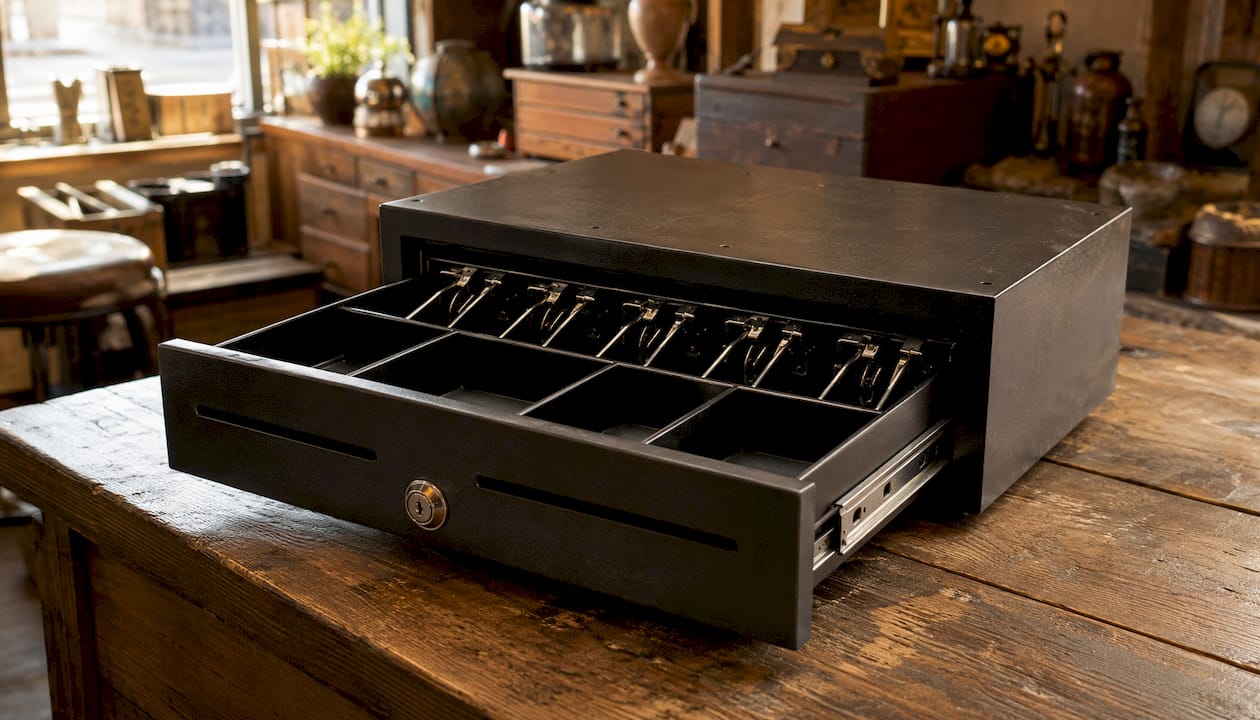
Pro Tip: Weigh a prospective drawer before you buy. A flimsy, lightweight unit will not hold up in a busy store, no matter what the spec sheet says.
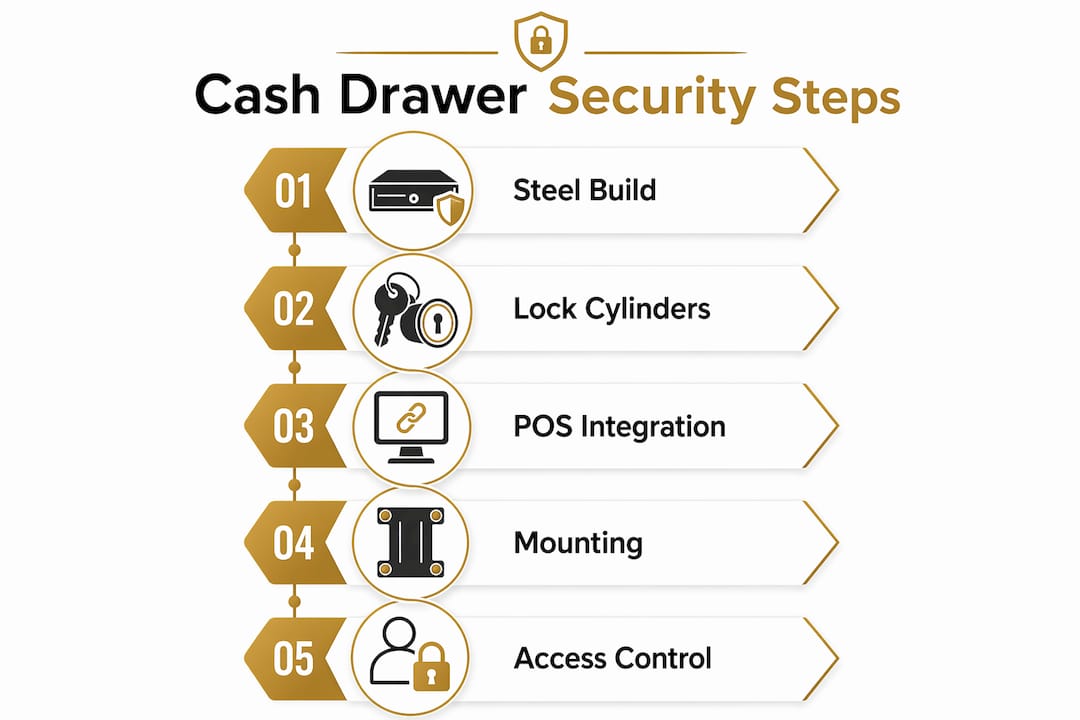
Lock cylinders are where many retailers make a costly mistake. Many manufacturers ship drawers with common default key codes, meaning the same key that opens your drawer may open dozens of others from the same production run. Rekey the cylinder or order a custom lock before the drawer goes into service.
Multi-position lock systems offer three states: locked, manual open via key, and electronic open triggered by the POS. Some higher-volume setups add a dual-lock configuration for an extra layer of control. Optional till covers and locking lids protect cash even if the drawer body is somehow forced open.
Pro Tip: Order custom-keyed cylinders when you purchase, not after. Retrofitting a lock after installation is more expensive and often overlooked until a theft incident prompts it.
Mounting also affects security. Under-counter brackets keep the drawer out of plain sight and prevent removal. Where counter mounting is not possible, security cables anchor the drawer to the counter structure and deter grab-and-run theft.
How does POS integration strengthen cash drawer access control?
A POS-integrated drawer opens only when the system sends a signal, typically through the receipt printer or directly from the terminal. Every opening is logged with a timestamp, employee ID, and transaction type. That record is what turns a cash discrepancy from a mystery into a traceable event.
The practical controls this enables go well beyond simple open/close logging:
- Drawer opens only for completed sales, authorized returns, or manager-approved no-sale events
- Manager authorization required for voids, refunds, and no-sale opens
- Role-based access that gives cashiers transaction access while reserving override functions for supervisors
- Real-time alerts when the drawer opens without a corresponding sale
- Unique hardware IDs linked to POS register software to prevent drawer swapping in multi-lane environments
That last point is underappreciated in busy retail settings. When a cashier swaps a drawer between registers, the transaction record and the physical cash become misaligned. Linking each drawer’s hardware ID to a specific POS lane blocks that gap entirely.
Pro Tip: Set your POS to require a manager swipe or PIN for every no-sale open, not just voids. Unrestricted no-sale access is one of the most common vectors for internal cash theft.
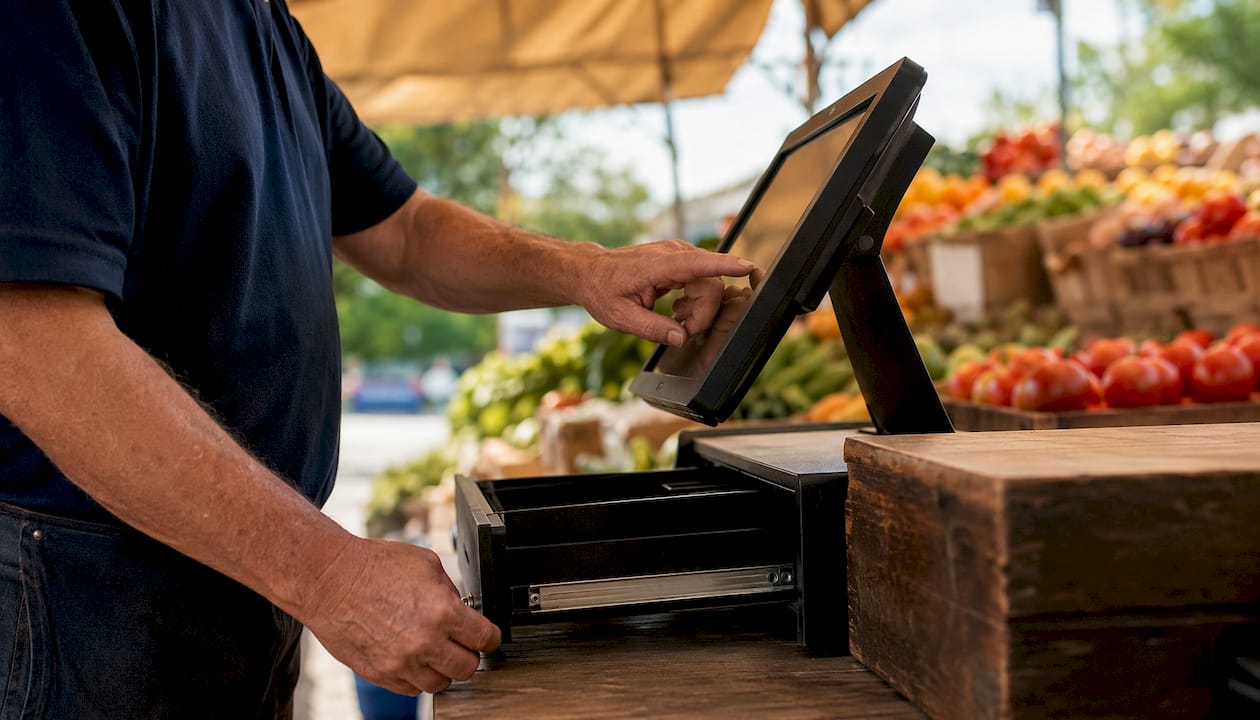
Manual key-only drawers offer none of this. They open whenever someone turns the key, with no record and no system check. For any business handling meaningful cash volume, POS-triggered access is the baseline, not a premium feature.
What types of cash drawer theft should you watch for?
Cash theft in retail splits into two categories, and each requires a different response. Internal theft, carried out by employees, drives the majority of cash loss. External theft, including smash-and-grab attacks and distraction theft, is more visible but statistically less frequent.
Internal theft takes several forms:
- Voiding a completed sale after collecting cash, then pocketing the difference
- Using the no-sale function to open the drawer and remove cash when no one is watching
- Under-ringing items and keeping the price difference
- Allowing the register tape to run out, then skipping entries to pocket cash with no record
- Counting out their own drawer at shift end, which creates an opportunity to remove funds that were set aside during the shift
External theft patterns include:
- Smash-and-grab attacks where a robber forces the drawer open and takes cash quickly
- Counter snatching when a cashier opens the drawer during a transaction
- Distraction theft during busy periods or shift changes
- Nighttime break-ins targeting unlocked or poorly anchored drawers
Operational vulnerabilities amplify both risks. Overfilled drawers attract attention and increase the value of a successful theft. Multiple cashiers sharing a single till make it nearly impossible to assign responsibility for a shortage. Delayed cash drops leave excess cash sitting in the lane far longer than necessary.
Best practices to prevent cash drawer theft in your store
The most effective cash handling security measures combine hardware controls with operational discipline. Neither works well without the other.
- Set a maximum cash limit per drawer lane and perform regular cash lifts to move excess to a secure drop safe when the limit is reached
- Assign one till per cashier so every dollar in that till has a single accountable owner
- Require manager approval for all voids, refunds, and no-sale drawer opens
- Lock the drawer any time it is not actively in use for a transaction
- Position surveillance cameras to capture a clear, unobstructed view of the POS area and the bills being handled
- Enforce a “we don’t make change” policy to reduce no-sale opens
- Give each incoming cashier a fresh, verified till rather than passing a drawer between shifts
- Require cashiers to give every customer a receipt, which forces each sale to be entered into the register
- Store large bills under the till insert rather than in the standard bill slots
- Conduct till counts at the start and end of every shift, documented in the POS or on paper
Pro Tip: Periodically place an extra bill in a cashier’s drawer before their shift and see whether they report the overage. It is a simple, low-cost integrity check that also confirms the opening count is being done properly.
Blind balancing during shift handovers, where cashiers count their till without seeing the expected total first, catches discrepancies before they are explained away. It also removes the temptation to adjust a count to match an expected figure.
Advanced security solutions for cash management
Basic POS integration and steel construction cover most retail environments. For higher-volume or higher-risk operations, several technologies push protection further.
Biometric and PIN-based electronic locks with role-based access replace physical keys entirely. Because access is tied to a fingerprint or a unique PIN, there is no key to copy, lose, or hand off informally. The system logs every access event with the employee’s identity, which creates a far more useful audit trail than a key log.
Smart safes take cash management a step further. They count and verify every bill deposited, create an instant record, and restrict access to authorized personnel. Some models integrate with cash recyclers that validate, store, and dispense cash for future transactions, reducing the number of times staff handle loose bills. The American Security CashWizard smart safe is one example of a professional-grade solution built for retail environments that need both security and accountability.
Media slots and one-way note acceptors let cashiers deposit high-value bills into a secure compartment without opening the full drawer. The bill goes in; nothing comes out. This keeps large denominations out of the till during the shift and reduces the value of any single theft event.
Dual-drawer installations with unique hardware IDs linked to POS software prevent fraud from drawer swapping in high-volume, multi-lane environments. Each drawer is registered to a specific lane, and the POS blocks transactions from any unassigned unit.
For counters where permanent mounting is not feasible, high-strength steel security cables anchor the drawer to the counter structure and deter removal. They are not a substitute for proper mounting, but they add a meaningful layer of deterrence where bolting is not an option.
Legal and compliance considerations for cash handling
Cash handling in retail carries real legal and regulatory obligations that go beyond simply keeping the drawer locked. Businesses in the United States must comply with IRS cash reporting requirements, including filing Form 8300 for cash transactions exceeding $10,000. Failing to report or structuring transactions to avoid the threshold carries serious federal penalties.
State and local regulations vary, but most jurisdictions require businesses to maintain accurate transaction records. A POS-integrated cash drawer that logs every opening, every void, and every refund creates exactly the kind of documentation that satisfies an audit or a regulatory inquiry. A manual key-only drawer with no transaction log does not.
For businesses in regulated industries such as cannabis retail, the compliance stakes are higher still. Many state cannabis regulators require detailed cash handling logs, secure storage standards, and documented reconciliation procedures as conditions of licensure. The physical and software controls described throughout this guide align directly with those requirements.
Employee theft also carries legal dimensions. Documented discrepancies, POS logs, and surveillance footage are the evidence base for termination and, where warranted, criminal prosecution. Without that documentation, even a clear pattern of theft is difficult to act on legally.
How to run cash audits and reconciliation that actually catch problems
A cash audit is only useful if it is structured to surface exceptions, not just confirm totals. Totals can be manipulated. Exceptions, such as an unusual number of voids from one cashier or a drawer that is consistently over by small amounts, tell the real story.
A solid audit protocol covers these checkpoints:
- Start-of-shift count: Verify the opening float before the first transaction and document it in the POS or on a signed register tape.
- Mid-shift skims: Move excess cash to a secure safe when the drawer reaches its limit. Log the transfer.
- Spot checks: Audit drawers during the day, particularly during high-volume periods when theft is easier to conceal.
- End-of-shift count: Compare actual cash to expected amounts based on POS transaction records before clearing the drawer.
- Exception review: Pull reports on voids, refunds, no-sale opens, manual price changes, and cash drops. Patterns matter more than individual events.
- Bank deposit reconciliation: Match store records, safe records, and bank adjustments promptly after each deposit.
Reconciliation in a secure back office, away from the POS area, prevents cashiers from adjusting counts based on what they know the register shows. That separation of duties is a basic internal control that many small retailers skip, and it is one of the most exploited gaps in cash handling.
How to control employee access to cash drawers
Access control starts with a clear policy: every person who touches the drawer is identified, and every opening is recorded. That principle applies whether you use physical keys, PIN codes, or biometric locks.
Physical keys should be signed out at the start of each shift and returned to secured storage at shift end. No cashier should hold a key overnight or take one off-site. The number of people with key access should be as small as operationally practical.
Electronic access controls go further. Biometric or PIN-based locks let you assign role-based permissions so cashiers can process sales while managers retain exclusive access to voids, refunds, and no-sale functions. If an employee leaves, their access is revoked immediately with no key to recover.
The one-till-per-cashier rule is the single most effective accountability measure available. When each cashier is responsible for a specific, removable till from the start of their shift to the end, there is no ambiguity about who was in the drawer when a shortage appears. Tills can be stored in a business-grade cash safe between shifts rather than left in the drawer overnight.
POS passwords and manager-level report access should be kept strictly separate from cashier credentials. A cashier who can run end-of-shift reports can learn their sales totals before counting, which undermines blind balancing and creates an opportunity to adjust the count.
Staff training programs that reduce cash theft
Training is where policy becomes behavior. A written cash handling policy that no one has read does nothing. A 30-minute onboarding session that walks every new hire through the exact steps for each transaction type, and the consequences for violations, changes how people act at the register.
Effective training covers:
- The specific steps for every transaction type: sales, refunds, voids, no-sale opens, and cash drops
- How to identify counterfeit bills using the tools available at the POS
- What constitutes suspicious behavior from coworkers, including unusual void patterns or frequent no-sale opens
- The reporting process for suspected theft, including who to tell and how
- The consequences of theft, stated plainly: documented theft is grounds for immediate termination and potential criminal referral
Refresher training matters as much as onboarding. Proper cash handling policies combined with secure hardware and employee training reduce loss risks from internal theft more effectively than any single measure alone. Schedule a brief review whenever you change a procedure, add new hardware, or see an uptick in discrepancies.
Transparency reinforces accountability. When staff know that every drawer opening is logged, that voids require manager approval, and that mid-shift audits happen at unpredictable times, the opportunity cost of theft rises sharply. Most internal theft is opportunistic. Remove the opportunity, and you remove most of the risk.
Key Takeaways
Cash drawer security requires physical durability, POS-integrated access controls, and consistent operational policies working together to prevent theft and maintain accountability at every transaction.
| Point | Details |
|---|---|
| Steel construction matters | 18–20 gauge all-steel drawers resist forced entry and hold up under high daily open/close volumes. |
| Rekey default lock cylinders | Manufacturers ship drawers with common key codes; custom cylinders prevent unauthorized access from day one. |
| POS integration is the baseline | Drawers that open only on POS authorization log every access event and tie each opening to a transaction. |
| One till per cashier | Assigning a single removable till per cashier creates clear accountability and simplifies shift reconciliation. |
| Training closes the gap | Hardware controls and written policies only work when every staff member understands the procedures and the consequences. |
Recommended
- Why Use a Cash Drop Safe: Essential for Retail Security – Safes and Security Direct
- Why Protect Retail Property: A 2026 Owner’s Guide – Safes and Security Direct
- Business security checklist 2026: protect your SME assets – Safes and Security Direct
- Business Money Safety: Use Money Drop Safes – Safes and Security Direct