

Match UL RSC Level to Your Home, Gun, or Small Business Risk
RSC stands for Residential Security Container, the burglary rating UL assigns under its UL 1037 standard. An RSC-rated safe has passed a timed hand-tool attack test, which means it resists a quick, opportunistic break-in attempt. It does not mean the safe can hold off a professional crew with power tools and time to work, and it says nothing at all about fire protection.
TL;DR:
- RSC ratings assess resistance against short, opportunistic break-ins with hand tools, not for attacks using power tools or long-duration efforts.
- The 2016 revision introduced three attack levels, with Level I lasting five minutes and Level III allowing smaller openings and more aggressive tools.
- An RSC safe can lack fire or water protection; separate standards and ratings are necessary if those features are needed.
- Proper installation, including anchoring and high-quality locks, is crucial for maximizing RSC protection rather than relying on steel gauge or weight.
- Matching the RSC level to realistic threats and verifying UL listing details outweigh generic marketing claims or superficial specifications.
Table of Contents
- What Is a UL RSC Rating, and What Does UL 1037 Cover?
- RSC Attack Levels Explained: Level I, II, and III
- What an RSC Rating Protects Against and Its Real Limits
- Locks, Drop Test, and Installation: The Trust Signals That Matter
- How to Choose an RSC-Rated Safe: A Buyer’s Checklist
- Publisher Perspective: Safes and Security Solutions’ Practical Take
- Where an RSC Rating Actually Gets Used
- How UL Certifies and Updates the RSC Standard
- How UL RSC Compares to Other Security Standards
- Common Misconceptions About the UL RSC Rating
- Why We Think Buyers Overrate Steel Gauge and Underrate the Lock
- How Our Safes Meet RSC Expectations
- Sources
What Is a UL RSC Rating, and What Does UL 1037 Cover?
UL 1037 is the burglary-resistance standard that governs how a safe earns the RSC label. UL built the standard to answer one practical question: can this container resist a determined but time-limited attack using tools a burglar could realistically carry into a home or small office? The test is destructive. UL technicians attack a sample unit with hand tools and time how long it takes to force an opening large enough to reach inside.
For decades, RSC was a single pass/fail label. That changed in 2016, when UL revised the standard to create three graduated attack levels instead of one flat bar. The revision matched the label to reality: not every safe buyer faces the same threat, so not every RSC-rated product should have to clear the same test. A homeowner protecting a pistol and some paperwork has a different risk profile than a jewelry store owner with a display case’s worth of inventory in the back room.
One separation matters more than almost anything else in this standard: UL 1037 measures burglary resistance only. Fire resistance is tested under a completely different standard, UL 72, with its own time and temperature thresholds. A safe can carry an RSC label and have zero fire protection, and plenty do. If you need both, look for a safe explicitly rated under both standards, not one that just implies fire protection through marketing language.
RSC Attack Levels Explained: Level I, II, and III
The 2016 revision split RSC into three tiers, each defined by how long the attack lasts, how many technicians perform it, what tools they use, and how big an opening they’re allowed to create before the safe fails the test. Here’s how the three levels break down:
| Attack Level | Duration | Technicians | Tools Allowed | Maximum Opening |
|---|---|---|---|---|
| RSC Level I | a short time | 1 | Common hand tools | Any opening large enough to reach in |
| RSC Level II | a longer time | 2 | Carbide drills, pressure devices | a moderate opening |
| RSC Level III | same extended time | 2 | More aggressive tools than Level II | a smaller opening |
Level I is the baseline. One technician, five minutes, tools you could buy at any hardware store: screwdrivers, pry bars, hammers. Level II doubles the crew, doubles the time, and adds carbide drill bits and hydraulic pressure devices to the mix, while shrinking the acceptable opening to 6 square inches. Level III keeps the same time and crew size as Level II but tightens the allowed opening down to just 2 square inches, forcing the container to resist more aggressive tool work without giving up meaningful access.
The detail buyers miss most often is “net working time.” UL doesn’t count the clock the way a stopwatch would at a track meet. Net working time only accumulates while a tool is actively in contact with the safe. A technician who stops to switch drill bits, catch a breath, or reposition isn’t burning down the five or ten minute allowance during that pause. That makes the test tougher than it sounds on paper. A real burglar working under time pressure, with no idea if a neighbor heard something, rarely gets the uninterrupted, focused effort UL’s technicians are given.
What an RSC Rating Protects Against and Its Real Limits
RSC exists to model one specific threat: the opportunistic burglar. Think smash-and-grab entries, a break-in during a short window when a house is empty, or someone already inside a business after hours who has minutes, not hours, to work before running the risk of getting caught. That’s the scenario UL built the test around, and it’s a good match for what most homeowners and small business operators actually face.
It is not a match for a patient, well-equipped attacker. An RSC rating does not simulate an angle grinder, an abrasive cutoff wheel, or a torch, and none of those tools are part of the UL 1037 test protocol. If someone brings that kind of equipment and enough time, an RSC-rated container is not the right defense.
What can realistically defeat an RSC-rated safe:
- Angle grinders or cutting wheels, which aren’t part of any RSC test scenario
- Extended, uninterrupted time (an hour or more) rather than the 5 or 10 minute test windows
- Coordinated multi-person attacks beyond the one or two technicians UL tests against
- Removal of the entire unit for attack elsewhere, if it isn’t properly secured in place
It’s also worth repeating because it trips up so many buyers: RSC has nothing to do with fire, smoke, water, or humidity. A container can be an excellent RSC Level II performer and offer no more fire protection than a filing cabinet. If you’re storing anything irreplaceable, documents, hard drives, family photos, treat burglary resistance and fire resistance as two separate purchasing decisions, because UL treats them as two separate tests.
Locks, Drop Test, and Installation: The Trust Signals That Matter
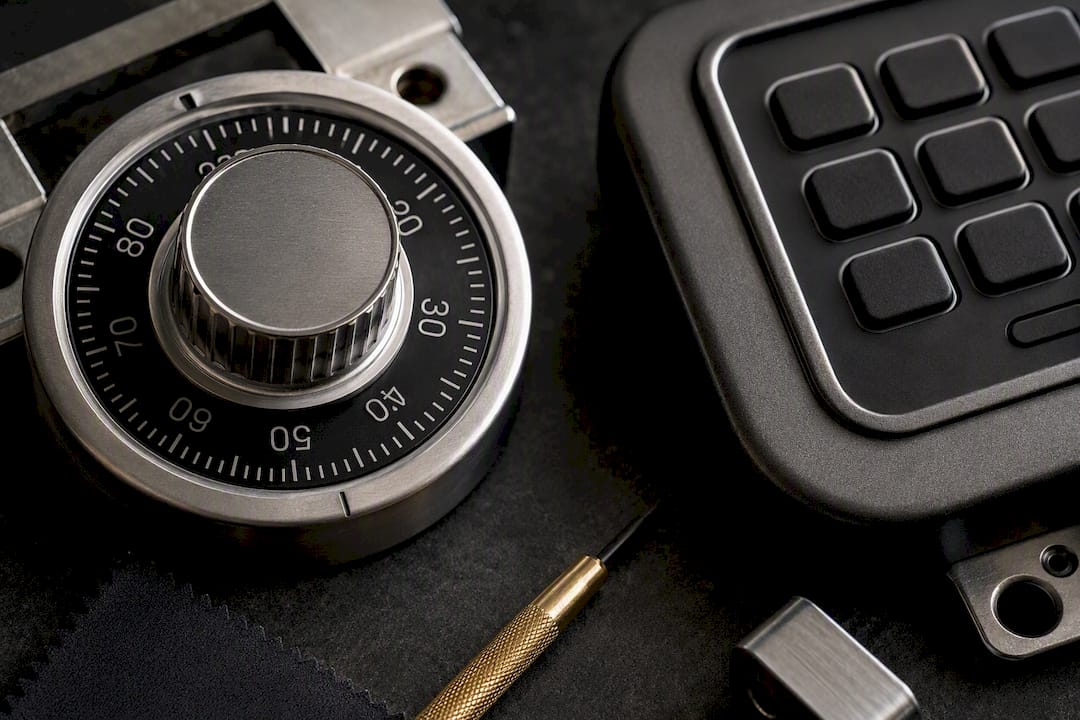
The RSC rating covers the box. It says much less about the lock, and a weak lock undermines everything the steel and testing are supposed to buy you. UL assigns locks to their own groups based on manipulation resistance, meaning how hard the lock is to pick, bypass, or force open without the correct code or key. When you’re comparing safes, checking that the lock itself carries a UL listing appropriate to the container’s attack level matters just as much as the gauge of steel in the door.
Two other checks matter before you buy or install:
- Drop test compliance: containers weighing 750 pounds or less must survive a drop test as part of certification, since a lightweight safe that isn’t anchored can simply be carried off and attacked somewhere quiet.
- Bolt-down provisions: pre-drilled anchor holes, and the hardware to use them, turn a “grab it and go” target into a fixed, immovable one, which is often a bigger practical upgrade than jumping a level.
A quick installation checklist worth following: use the bolt holes the manufacturer provides, anchor into concrete or a wood subfloor with lag bolts rather than drywall alone, and place the unit somewhere it isn’t visible from a window or an easy pry point near an exterior door.
Pro Tip: If you’re deciding between a mechanical dial and an electronic keypad, know the tradeoffs going in. Mechanical combination locks tend to last decades with basic service and give you a consistent paper trail for insurance documentation. Quality electronic locks commonly run 10 to 20 years, but budget electronics fail sooner, so plan on at least one replacement over a safe’s working life.
How to Choose an RSC-Rated Safe: A Buyer’s Checklist
Matching the right RSC level to your actual risk, rather than buying on price or size alone, is where most people either overspend or under-protect. Work through this in order:
- Estimate your realistic threat. A homeowner storing firearms and documents usually fits RSC Level I; a business holding cash or higher value inventory should look at Level II or III.
- Match the lock to the box. Confirm the lock carries a UL group listing appropriate to the safe’s attack level. A Level II body with a bargain lock is a mismatch.
- Confirm bolt-down hardware and ask for documentation. Request the UL test certificate or the visible UL mark, not just a manufacturer’s marketing claim about steel thickness.
- Add fire protection separately if you need it. If you’re storing paper, media, or electronics, look for a combined UL 1037 and UL 72 rating rather than assuming one implies the other.
- Watch for red flags. Skip anything with no visible UL mark, vague phrases like “military grade” with no standard cited, or a lightweight unit with no anchor points.
For a deeper walk-through of how the three RSC levels map onto different rooms and risk profiles, see this breakdown of burglary safe ratings.
Publisher Perspective: Safes and Security Solutions’ Practical Take
For most homeowners and gun owners, an RSC Level I safe fits the actual threat: a short window, a hand tool, and a burglar who wants to be gone in minutes. Small business operators holding cash drawers or higher value inventory are usually better served stepping up to RSC Level II, since the extra crew and tool allowance in that test reflects a more determined attacker profile. Safes and Security Solutions stocks entry-level RSC units for residential use, RSC II containers for higher theft exposure, and combined burglary and fire models for anyone storing documents alongside valuables.
Where an RSC Rating Actually Gets Used
RSC ratings show up anywhere a moderate but real burglary threat meets a budget that doesn’t stretch to commercial-grade vault steel. Home gun safes are the most common example. UL’s own materials note that RSCs are commonly marketed and sold as gun safes, which makes sense given the profile: firearms stored in a residence, at risk during a home burglary, needing protection for minutes rather than hours.
Retail operations use RSC-rated cash boxes and small floor safes for a similar reason. A convenience store or salon doesn’t need a bank vault, it needs a container that survives the brief window between closing time and the alarm response, or that resists an employee or customer with five unsupervised minutes. Pharmacies and medical offices lean on RSC-rated storage for controlled substances, often paired with additional access logging required by state regulation.
Small offices use RSC safes for petty cash, employee records, and backup drives. Property managers sometimes install them in unit closets for tenant document storage. In every one of these cases, the buyer isn’t defending against a coordinated professional crew. They’re defending against the same opportunistic scenario UL built the test around: someone with limited time, common tools, and no guarantee they won’t get interrupted.
How UL Certifies and Updates the RSC Standard
Getting an RSC listing isn’t a paperwork exercise. A manufacturer submits sample units to UL, and UL technicians run the actual timed attack described in the standard: the right number of technicians, the specified tool set, against the clock for that attack level. If the sample resists past the required net working time without producing an opening larger than the standard allows, the model earns the listing. UL then authorizes the manufacturer to apply the UL mark to that specific model, and ongoing factory inspections check that production units keep matching the tested sample rather than drifting on materials or construction.
The standard itself isn’t frozen. UL revisits UL 1037 periodically to reflect new attack methods and materials, which is exactly why the graduated three-level system replaced the old single-tier RSC label in the first place. That 2016 change didn’t happen because the old test got easier. It happened because a single pass/fail bar couldn’t communicate the real difference between a safe that barely survives five minutes of screwdriver work and one built to resist carbide drills for twice as long.
For buyers, this matters in one concrete way: always check that a listing is current and tied to the specific model you’re buying, not an older version of a product line that was tested under different parameters years earlier.
How UL RSC Compares to Other Security Standards
UL 1037 is the standard in the United States, but it isn’t the only burglary-resistance framework in the world, and the labels aren’t interchangeable even when they sound similar. European manufacturers commonly test to EN 1143-1, which uses its own resistance unit system rather than UL’s time-and-tool-based tiers. A safe rated under EN 1143-1 hasn’t automatically passed UL 1037, and vice versa, because the attack methods and scoring aren’t built the same way.
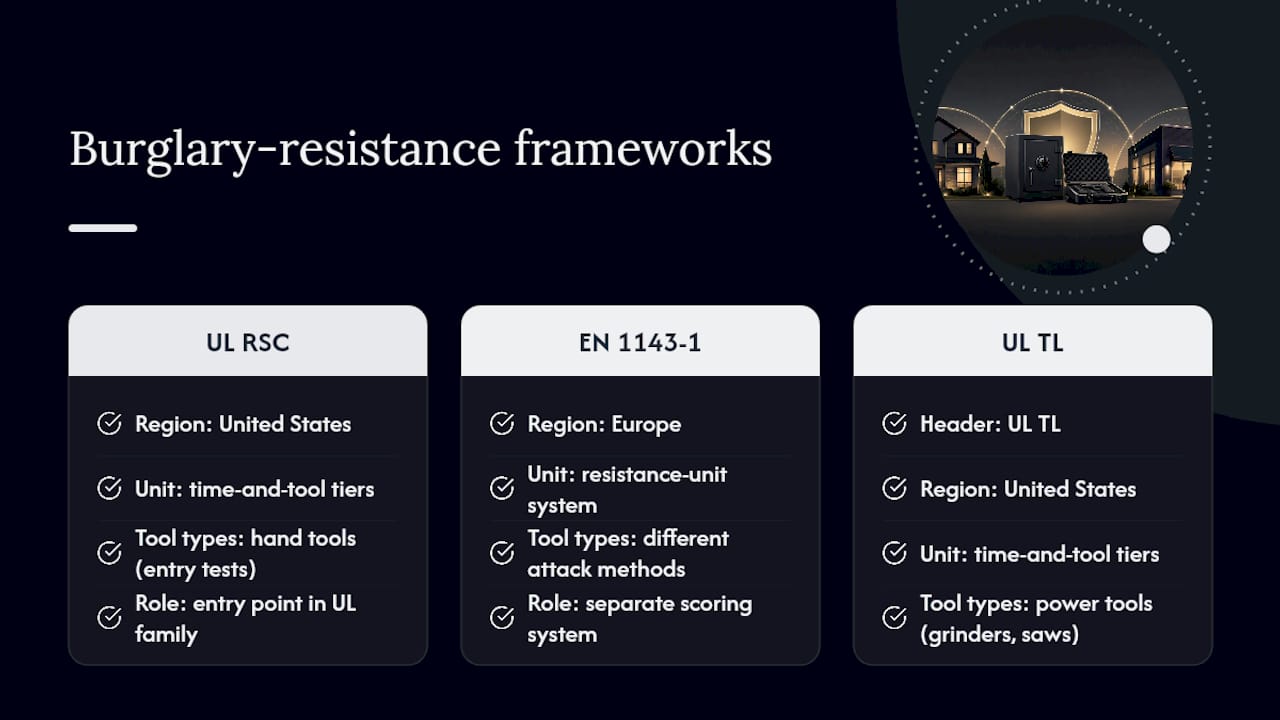
Within the UL family itself, RSC is the entry point, not the ceiling. TL-rated safes (Tool Resistant) sit well above RSC and are tested against much longer attack windows using power tools, not just hand tools. A TL-15 rated safe, for example, must resist a 15-minute attack using an expanded tool list including grinders and power saws, a meaningfully tougher test than any RSC tier. That gap is exactly why comparing RSC to TL is a comparison of different weight classes, not a simple upgrade path. If your risk profile genuinely calls for TL-level protection, buying up to that class matters more than stacking multiple RSC units.
The practical lesson for a buyer: match your comparison shopping to the standard, not the sticker. Two safes both labeled “burglary resistant” can mean very different things depending on which standard, and which tier within that standard, actually backs the claim.
Common Misconceptions About the UL RSC Rating
The biggest misunderstanding is treating RSC as a general security score rather than a specific, bounded test result. RSC tells you how a container performed against a defined attack for a defined time. It doesn’t tell you the safe is fireproof, waterproof, or immune to a patient thief with unlimited time.
A second common mistake is assuming steel gauge alone determines the rating. UL 1037 does set minimum steel specifications for Level I and Level II containers, but manufacturers routinely add relockers, hardened plates, and composite panels that push actual performance well past the bare minimum. Two safes can share the same advertised gauge and perform very differently in a real attack, which is exactly why the test certificate matters more than a spec sheet number.
Third, buyers often assume a higher RSC tier automatically means better fire performance too. It doesn’t. Burglary and fire testing run on entirely separate standards, and a Level III RSC container can have no fire rating at all.
Finally, some shoppers assume any safe advertised as a “gun safe” carries an RSC listing. Plenty of budget gun safes on the market were never submitted for UL testing at all. The only way to confirm the rating is real is to look for the actual UL mark and, when it matters, ask the seller for the certificate behind it.
Why We Think Buyers Overrate Steel Gauge and Underrate the Lock
The conventional safe-shopping advice fixates on steel thickness and overall weight, as if a heavier box is automatically a safer one. Our read of the actual UL 1037 test parameters says otherwise. The attack levels are defined by time, tool access, and opening size, not by how many pounds a safe weighs sitting in a showroom. A properly bolted-down RSC Level I safe with a UL-listed lock will outperform an unanchored, unbolted “heavy duty” unit with a bargain lock every time a real burglar shows up, because the thief who can’t move the safe and can’t manipulate the lock has already lost most of the minutes they came with.
Buyers should prioritize three things in this order: matching the attack level to their actual risk, verifying the lock’s UL group, and confirming bolt-down hardware gets used. Steel gauge and brand marketing come after those three, not before them. Get the fundamentals right first, and the rest of the spec sheet stops mattering nearly as much as retailers want you to think it does.
— Safes and Security Solutions
How Our Safes Meet RSC Expectations
Once you know what an RSC rating actually promises, the next step is matching that standard to a real product, not a marketing claim. Safes and Security Solutions carries burglary and fire combination safes built to documented UL specifications, along with installation guidance so the bolt-down hardware you just read about actually gets used correctly.
Our lineup includes the American Security BFS2214 Burglary and Fire Safe for buyers who want burglary resistance and fire protection in one unit, the compact American Security BFS912 Burglary and Fire Safe for tighter spaces with the same dual protection, and the American Security UL1511 UL Listed 2 Hour Home Fire Safe for households prioritizing document and media protection. Each listing includes the specific certifications behind it, so you’re buying against documented test data rather than a vague “heavy duty” label. If you’re still weighing which attack level fits your risk, our guide on choosing the right certified safe walks through the decision in more detail. Browse the current lineup or reach out to our team with your specific storage needs, and we’ll help you match a model to the actual threat you’re protecting against.
Sources
- Residential Security Container Standard Revised | UL Solutions
- UL RSC Rating: Residential Security Container Standard Explained - LegalClarity
- Electronic vs Dial Safe Locks: Honest Tradeoffs | Tim’s Locksmith Service