

350°F Limit: How UL Tests Class 350 and What Buyers Must Verify
UL Class 350 means the interior of a certified safe stays at or below 350°F (about 177°C) for the entire rated fire-test duration. That ceiling exists because 350°F is roughly where paper starts to scorch and crumble, so a “Class 350” label is the industry’s way of saying: your documents survive, but don’t expect the same protection for a hard drive or backup tape.
TL;DR:
- Fire ratings depend on the duration and external furnace temperature, with longer rated safes exposed to higher external heat levels.
- Certify UL approval through official marks and certificate numbers, avoiding reliance on manufacturer claims alone.
- Protecting digital media requires a stricter classification, typically Class 125, while paper documents are adequately protected by Class 350 if properly verified.
- Real fire endurance testing involves continuous internal temperature monitoring and post-test inspection of locking mechanisms and structure.
- Confirm that the safe’s certification is independently verified and that the label specifies both protection class and duration for accurate assessment.
Table of Contents
- What Is a UL Fire Rating 350 Certification, Exactly?
- How UL Tests Record-Protection Safes
- Furnace Temperatures and Durations Behind Class 350
- What a Class 350 Safe Will and Won’t Save
- How to Verify a Class 350 Label and Certificate
- Buying Checklist for a Class 350-Rated Safe
- Where Safes and Security Solutions Fits Into UL Class 350 Compliance
- A Note on Common Buying Mistakes
- Find a Class 350 Safe Built for Real Protection
- Sources
What Is a UL Fire Rating 350 Certification, Exactly?
The “350” isn’t a time. It’s a temperature ceiling. A safe stamped Class 350 has passed a test showing its interior never climbed past 350°F while a furnace outside blasted it for a set duration. That duration gets listed separately, so a full label reads something like “Class 350 — 1 Hr” or “Class 350 — 2 Hr.” Miss that distinction and you’ll misjudge what you’re buying: two safes can both say “350” and protect for completely different lengths of time.
Converted to Celsius, 350°F lands at roughly 177°C, a threshold UL 72 sets specifically because paper begins to char and become illegible above it. Class 350 was built around paper, not electronics.
Typical contents a Class 350 safe is designed to protect:
- Paper documents, contracts, and legal files
- Passports and birth certificates
- Cash and paper currency
- Photographs (with some degradation risk at the upper temperature range)
Contents Class 350 will not reliably protect unless you step up to a stricter rating:
- Hard drives and SSDs (need Class 125 or specialized data-media protection)
- Magnetic tape and film backups (typically need Class 150)
- Anything sensitive below roughly 125°F to 150°F internal exposure
How UL Tests Record-Protection Safes
UL doesn’t take a manufacturer’s word for any of this. Testing under UL 72, the standard governing record-protection equipment, follows a defined sequence:
- Fire endurance test. The loaded safe goes into a furnace built to standardized specifications, with thermocouples placed inside to log temperature continuously through both the burn and the cooling period that follows.
- Explosion hazard test. A separate unit is exposed to rapid, high-heat conditions to confirm it won’t rupture or explode as trapped moisture turns to steam.
- Fire and impact test (where applicable). Some safes also get dropped from height after the burn to simulate a floor collapsing during an actual building fire, then checked for continued protection.
The pass condition is simple to state and hard to achieve: interior temperature must never exceed 350°F at any point during the rated time, including the cooling phase, when residual heat can still climb before it falls. UL relies on the same family of standardized testing methods, including UL 263 and ASTM E119, to keep these exposures consistent and comparable across labs.
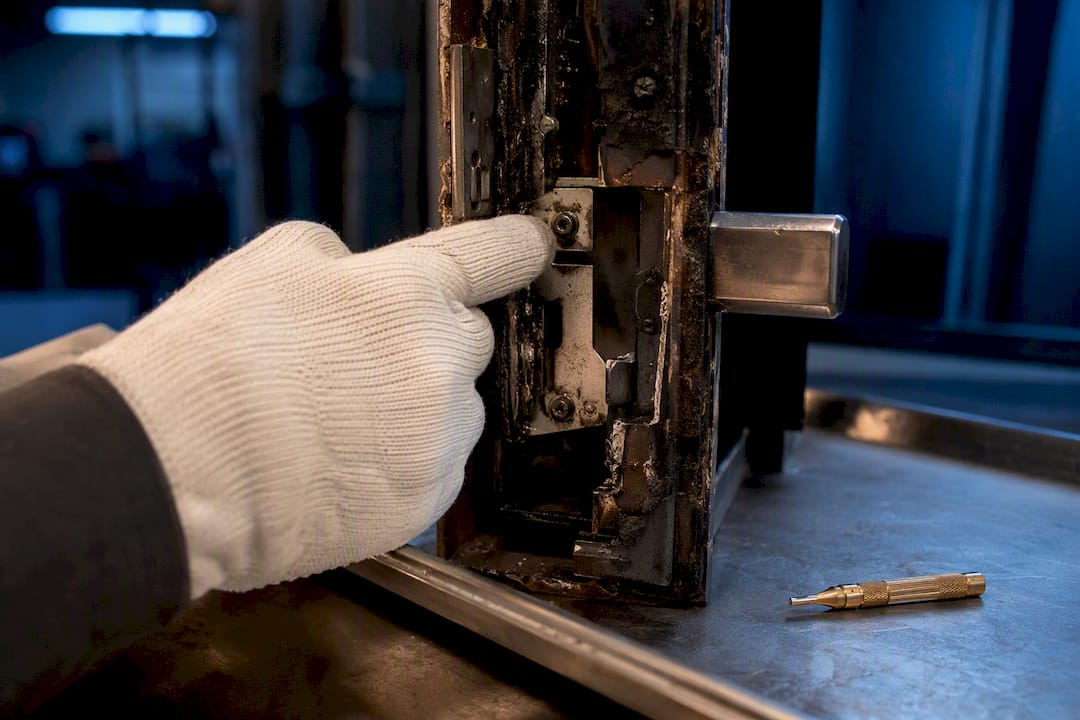
Testing checkpoint: after the fire exposure, inspectors open the unit and examine locking mechanisms, fastenings, and internal condition to confirm the safe still functions and the contents weren’t crushed or otherwise compromised. A safe that hits the temperature target but jams its lock or buckles its door doesn’t pass.
Furnace Temperatures and Durations Behind Class 350
The 350°F figure describes what happens inside the safe. What happens outside, in the test furnace, is a different number entirely, and it scales with how long the rating claims to hold.
Common external furnace benchmarks used across Class 350 testing:
- 30-minute rating: furnace temperatures around 1,550°F
- 1-hour rating: furnace temperatures around 1,700°F
- 2-hour rating: furnace temperatures around 1,850°F
- 4-hour rating: furnace temperatures approaching 2,000°F
Why the furnace gets hotter for longer ratings: a real structure fire tends to burn hotter the longer it’s sustained, so a 2-hour Class 350 test pushes external temperatures well past what a 1-hour test uses, while the safe still has to hold its interior under 350°F the whole time. Lab conditions are also controlled and repeatable in a way an actual house fire never is. Standardized testing gives you a comparable number, not a guarantee that matches every real-world blaze.
What a Class 350 Safe Will and Won’t Save
Paper ignites around 450°F but starts becoming brittle and illegible well before that, which is exactly why UL drew the protective line at 350°F rather than waiting until the point of combustion. Give paper margin, and it survives; push it closer to ignition, and you’re gambling.
The three common classes break down by what they’re built to protect:
- Class 350 protects paper and similar low-sensitivity records.
- Class 150 protects magnetic media like tape and older backup formats, holding interior temps below 150°F.
- Class 125 protects modern digital media, including hard drives and flash storage, at a stricter 125°F ceiling.
Pro Tip: If you’re storing paper alongside a backup drive or flash storage in the same safe, don’t split the difference and go with a Class 350 rating hoping it covers both. Pick the stricter class your most sensitive item requires. A Class 125 safe still protects your paper just fine, since colder is always safer for documents too.
How to Verify a Class 350 Label and Certificate
Anyone can print “Class 350” on a spec sheet. Confirming it’s real takes a few extra minutes.
- Look for the UL mark and a certificate number on the product page or the physical label riveted inside the door, not just in marketing copy.
- Separate independent certification from factory claims. A manufacturer’s in-house fire test is not the same as a UL or ETL listing, and reputable sellers will make that distinction obvious.
- Request the actual documentation before you buy: the certificate number and, ideally, the test report itself. Both let you verify the claim directly with UL rather than trusting a product description.
Buying Checklist for a Class 350-Rated Safe
Before you add anything to a cart, run through this list.
- Inventory what you’re storing first. If it’s purely paper, Class 350 is likely sufficient. If digital media is in the mix, move to Class 125 and treat 350 as a floor, not a target.
- Confirm independent lab verification. UL or ETL listing, not a vendor’s internal claim, is what separates a genuine rating from marketing language.
- Check the full label notation, including both class and duration, since “Class 350” alone tells you nothing about how long that protection lasts.
- Inspect construction details that affect real fire performance: door seals that expand under heat, composite fire-lining thickness, and hinge placement.
- Think about burglary protection separately. Fire rating and burglary rating are two different tests; a safe can excel at one and be mediocre at the other.
- Plan installation with fire exposure in mind. A safe bolted in an interior closet away from flammable materials tends to fare better than one against an exterior wall near a kitchen.
Pro Tip: Ask the seller directly for the test report PDF and certificate number before you buy, not after. A legitimate retailer will hand that over without hesitation, and hesitation is itself useful information.
If you want a closer look at document-specific storage before you commit, our guide on choosing a fire resistant filing cabinet walks through the same class distinctions for office-style storage.
Where Safes and Security Solutions Fits Into UL Class 350 Compliance
Safes and Security Solutions carries safes built to UL 72 standards, with independent certification behind the Class 350 and higher ratings listed on each product page. That matters because a spec sheet claim and a verified UL listing are not the same thing, and buyers who skip verification often find that out the hard way.
Every fire-rated model we carry lists its class, time rating, and certification details directly on the product page. If you need the underlying test documentation or certificate number for insurance or compliance purposes, our team can help you track it down from the manufacturer.
For a deeper primer before you compare models, our home safe fire rating explained guide covers how these ratings interact with burglary protection.
A Note on Common Buying Mistakes
The most common mistake we see isn’t picking the wrong class. It’s trusting a factory claim without asking for the certificate that backs it up. A safe that “should” hold 350°F under fire and one that’s independently verified to hold it are not equally trustworthy purchases, even when the price tag looks similar. If you’re unsure how to read a spec sheet or want help cross-checking a certificate number, reach out. It’s a five-minute conversation that prevents a very expensive mistake.
— Safes and Security Solutions
Find a Class 350 Safe Built for Real Protection
Matching your documents to the right fire class only matters if the safe you buy actually delivers on its label. Safes and Security Solutions stocks fire-rated models with independent UL certification already documented, so you’re not stuck chasing down test reports after the sale.
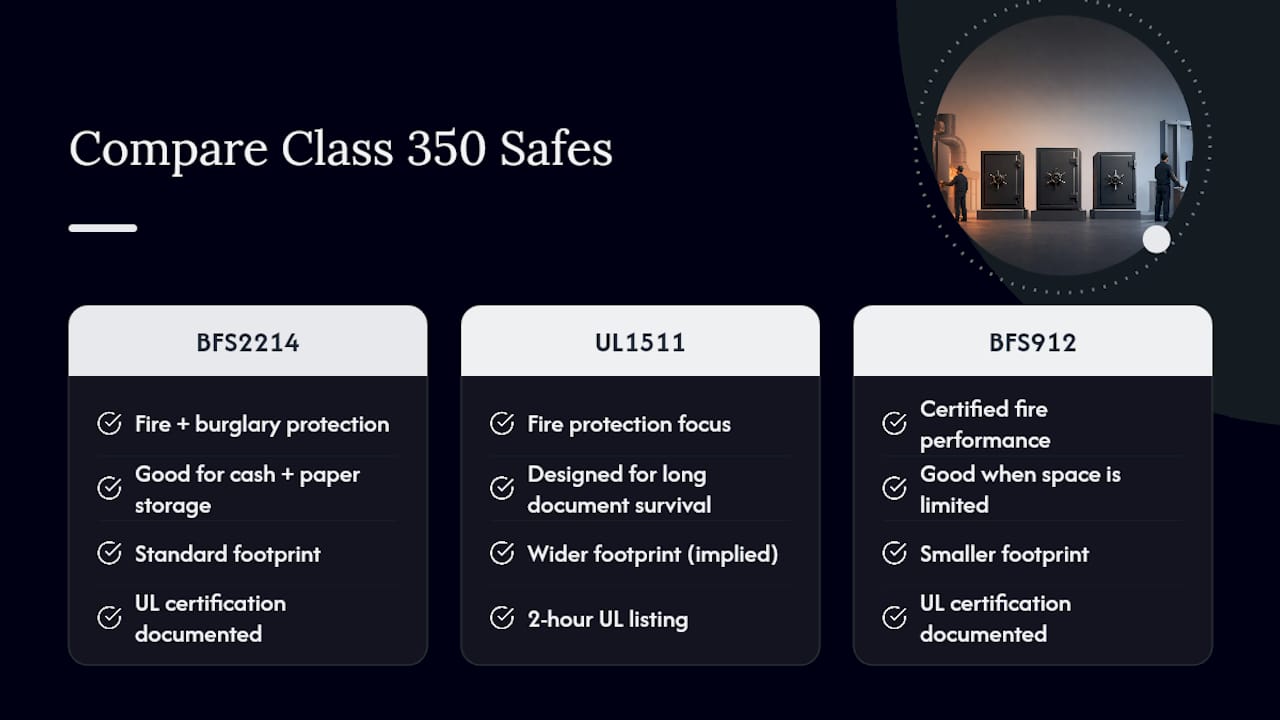
The American Security BFS2214 Burglary and Fire Safe combines fire protection with burglary resistance in one unit, a smart pick if you’re storing cash alongside paper records. For buyers focused purely on document survival over a longer burn, the American Security UL1511 UL Listed 2 Hour Home Fire Safe carries a 2-hour UL listing, giving you margin most 1-hour models don’t offer. If floor space is tight, the American Security BFS912 Burglary and Fire Safe delivers the same certified fire performance in a smaller footprint.
Every listing includes the certification details you need for insurance documentation. Browse the current lineup and check a model’s UL listing before you check out.
Sources
For readers who want to go straight to the source, UL Solutions’ page on fire-resistance testing explains the methods behind hourly ratings, and ShopULStandards sells the actual UL standard documents, including UL 263, for anyone who wants the full test protocol in writing.
- UL 72 Fire Ratings Explained: Class 350, 150, and 125 - TIGERKING
- Fire Ratings Explained - American Security