

Traveling with Firearm Safe Storage: Your Travel Checklist
When you travel with a firearm in the U.S., keep it unloaded and secured in a locked, hard-sided container that meets both the TSA checked-baggage rules and the interstate vehicle transport standard set by 18 U.S.C. § 926A. That single sentence covers the core of firearm travel safety in the United States. The details below fill in what “locked,” “hard-sided,” and “not readily accessible” actually mean in practice, and which container type fits your trip.
The four authorities every traveling gun owner should know:
- 18 U.S.C. § 926A governs interstate vehicle transport: unloaded, not accessible from the passenger compartment, locked container if no separate trunk.
- TSA sets the air-travel standard: checked baggage only, locked hard-sided case, declaration at the ticket counter.
- ATF provides guidance on international travel and trafficking cautions.
- NSSF and Project ChildSafe publish best-practice checklists aligned with federal rules.
Follow the checklist below and choose a travel-rated hard case or lockbox from Safes and Security Solutions for the best balance of legal compliance and portability.
Table of Contents
- What should you do before, during, and after traveling with a firearm?
- What do the law and major carriers require by travel mode?
- Which storage option is right for your trip?
- How do you pack and store ammunition while traveling?
- How do you choose the right travel storage solution?
- Practical packing, documentation, and hotel tips
- What are the authoritative sources to check before you travel?
- Key Takeaways
- Why the “just lock it up” mindset misses the point
- Secure travel cases and lockboxes from Safes and Security Solutions
- Useful sources to bookmark before your trip
What should you do before, during, and after traveling with a firearm?
Before you leave:
- Unload the firearm completely and verify the chamber is clear.
- Store ammunition in its original factory packaging or a purpose-built ammo container, separate from the firearm.
- Place the firearm in a locked, hard-sided case. Retain the only key or combination yourself.
- Confirm state laws at your origin and destination. Use NSSF’s state law resources as a starting point.
- Review your airline’s specific firearm and ammunition policies before you pack.
At departure:
- For air travel: declare the firearm at the airline ticket counter, not at the security checkpoint. Bring a government-issued ID and any relevant permits.
- For vehicle travel: confirm the firearm is unloaded and inaccessible before you pull out of the driveway.
During travel:
- Air: the locked case goes into checked baggage. Do not touch it again until baggage claim.
- Car: keep the case in the trunk or a locked container out of the passenger compartment for any interstate leg.
- Hotel stops: use the hotel safe if available, or keep the locked case secured in the trunk, never visible.
After arrival:
- Confirm the firearm is still locked before moving it from the case.
- Report any theft or loss immediately to local law enforcement and your airline or carrier.
What do the law and major carriers require by travel mode?
Interstate car travel
18 U.S.C. § 926A protects lawful interstate transport under specific conditions: the firearm must be unloaded and not readily accessible from the passenger compartment. If the vehicle has a separate trunk, the trunk qualifies. If it does not (think SUVs, hatchbacks, or minivans), the firearm must be in a locked container other than the glove box or center console. That last part catches a lot of travelers off guard.
Federal law is a floor, not a ceiling. States like California, New York, and New Jersey impose stricter rules on top of 18 U.S.C. § 926A. Passing through a state does not automatically shield you from its laws. Check state-specific storage requirements before any multi-state drive.
Air travel
- Firearms go in checked baggage only. Carry-on is never permitted, no exceptions.
- The case must be hard-sided and locked. You retain the key or combination; TSA may ask you to open it in your presence if screening flags it.
- Declare at the ticket counter before your bag is tagged. The agent will provide a declaration card to place inside the case.
- Ammunition must be in original factory packaging or a purpose-built container. Loose rounds in checked bags are prohibited.
- Confirm your carrier’s specific ammunition weight limit. American Airlines caps passenger ammunition at a commonly cited airline guideline weight; other carriers use similar guidelines but the exact figure varies.
Statistic callout: American Airlines’ guidance lists approximately 11 lb as the per-passenger ammunition allowance in checked baggage. Confirm your carrier’s limit before you pack.
Buses, trains, rideshares, and rental cars
Amtrak prohibits firearms in carry-on and checked baggage on most routes. Greyhound and most intercity bus lines ban them outright. For rideshares, check the platform’s terms of service before booking; most prohibit firearms in the vehicle regardless of state law. Rental car companies generally do not prohibit firearms, but the firearm must remain inaccessible and secured per 18 U.S.C. § 926A during any interstate leg.
International travel
ATF explicitly warns that declaring a firearm to a U.S. airline does not grant permission to bring it into another country. Many countries ban civilian firearm possession entirely. Check destination laws through the U.S. Embassy or that country’s customs authority before you book.
Which storage option is right for your trip?
| Storage Type | Pros | Cons | Best For |
|---|---|---|---|
| Hard-sided travel case | Airline-compliant, durable, locks securely | Bulky; adds checked-bag weight | Air travel, checked baggage |
| Compact lockbox / pistol safe | Portable, fits in luggage or vehicle | Smaller capacity; verify pry resistance | Short trips, hotel stays, vehicle use |
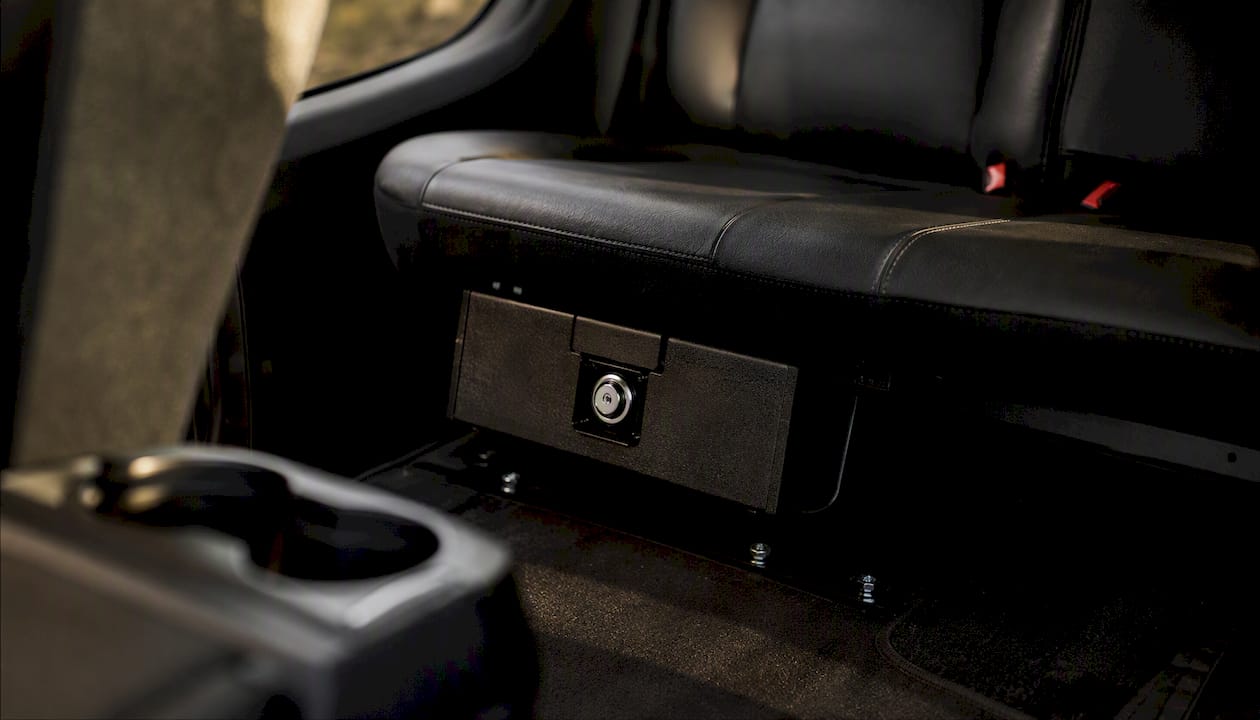
| Vehicle bolt-in safe | Stays fixed in car; deters smash-and-grab | Not portable; installation required | Road trips, leaving firearm in vehicle |
| Cable lock | Inexpensive, lightweight secondary layer | Not sufficient alone for airline compliance | Redundant security layer only |
| Trigger lock | Prevents unauthorized firing | Does not secure the firearm itself | Secondary layer, storage at destination |
Hard-sided travel cases are the go-to for anyone flying. They satisfy TSA’s locked hard-sided container requirement and hold up to baggage handling. For road trips with overnight stops, a compact lockbox bolted or cable-secured inside the vehicle adds meaningful protection without requiring you to haul a full-size case into a hotel room. A vehicle bolt-in safe is the strongest option when you regularly leave a firearm in your car, though it does not replace the interstate-transport rules above.
Cable and trigger locks work well as a redundant layer. They are not a substitute for a locked hard-sided case on any flight.
Safes and Security Solutions carries hard-sided travel cases, compact lockboxes, and vehicle safes. See the buyer criteria for gun cases to match a case to your firearm and trip type.
How do you pack and store ammunition while traveling?
Ammunition rules are where travelers most often make costly mistakes.
- Keep ammo in its original factory box or a purpose-built plastic ammo container. Loose rounds in any bag, checked or carry-on, are prohibited.
- Loaded magazines count as ammunition for airline purposes. They must be packaged to prevent contact between cartridge primers.
- American Airlines limits passengers to a commonly referenced ammunition weight guideline in checked baggage. Verify your carrier’s limit before you pack, since policies differ.
- Do not store ammo in pockets, accessible compartments, or loose inside the firearm case unless your airline explicitly permits it. Many carriers require ammo in a separate locked container from the firearm.
- Never put ammunition in carry-on luggage under any circumstances.
Statistic callout: The ~11 lb ammunition limit is a common airline guideline, not a federal maximum. Your carrier may set a lower threshold. Always confirm directly with the airline.
How do you choose the right travel storage solution?
- Lock type and owner-only access. Key locks, combination locks, and electronic locks all satisfy TSA requirements. The critical point: only you hold the key or know the combination. TSA may request access during screening but must do so in your presence.
- Construction and pry resistance. Hard-sided means hard-sided. Soft cases with padlocks do not meet the airline standard. Look for reinforced latches and steel or aluminum construction that resists prying.
- Internal fit. The firearm should fit without shifting. Foam inserts that hold the gun in place reduce wear and prevent the firearm from moving against the lock mechanism.
- Size and weight. Airline checked-bag weight limits apply to the whole bag, case included. A heavy steel case can eat into your allowance quickly. Balance security with portability.
- Documentation. Keep a copy of your firearm’s serial number, registration, and any applicable permits in a separate bag, not inside the case. Record the case’s serial number too.
- Verify product specs match airline and interstate rules. Ask whether the case meets hard-sided airline requirements and whether the lock is owner-retained. Safes and Security Solutions product pages include specifications that answer both questions. Browse secure gun storage options to compare by lock type and construction.
For compact pistol storage specifically, the pistol lockbox guide from Safes and Security Solutions covers size, lock type, and mounting options worth reviewing before you buy.
Practical packing, documentation, and hotel tips
Pack this every time:
- Firearm unloaded, chamber verified clear.
- Hard-sided case locked, key on your person.
- Ammo boxed separately, weight confirmed against carrier limit.
- Copies of permit, registration, and any carry license in a separate bag.
- Photos of firearm serial numbers saved to a secure cloud folder.
At the hotel: Use the in-room safe for overnight storage when it fits. If it does not, keep the locked case in the trunk, out of sight. Never leave a firearm in a visible bag on a seat. A compact lockbox that cables to a fixed point in the room adds a layer of security without requiring a full-size safe.
Traffic stops: Know your state’s disclosure laws before you drive. Some states require you to inform an officer immediately; others do not. Either way, stay calm, keep hands visible, and do not reach for the firearm. The firearm should already be unloaded and inaccessible per 18 U.S.C. § 926A, which is your best protection in any stop.
Pro Tip: Take a photo of your firearm, serial number, and case before every trip. Store it in a password-protected cloud folder. If the firearm is lost or stolen, you can provide law enforcement with exact details immediately, which speeds up recovery and protects you from liability.
Leaving firearms unsecured in vehicles is one of the most common mistakes that leads to arrests and theft. Practical vehicle transport guidance reinforces that planning before departure is far less costly than explaining a violation after the fact.
What are the authoritative sources to check before you travel?
Every trip starts with a source check. Here is where to go and what each one answers:
- 18 USC 926A: Interstate transportation of firearms
- Transporting Firearms and Ammunition | Transportation Security Administration
- Traveling with firearms (ATF)
- Firearms and ammunition − Travel information − American Airlines
- The Definitive Guide To Flying With Guns | Active Response Training
- Project ChildSafe
- NSSF
- Traveling With a Firearm (private vehicles) | US Concealed Carry
| Source | What it answers |
|---|---|
| 18 U.S.C. § 926A | Interstate vehicle transport rules |
| TSA firearms page | Air travel case and declaration requirements |
| ATF travel guidance | International restrictions and trafficking cautions |
| Airline firearm page | Carrier-specific ammo limits and retrieval procedures |
| NSSF | State laws, reciprocity, and industry best practices |
| Project ChildSafe | Safe-storage checklists and community resources |
State laws are not covered by any single federal source. Your origin state, every transit state, and your destination state may each impose different rules. Use NSSF’s state law pages and, when in doubt, consult a firearms attorney familiar with your route.
Key Takeaways
Traveling with firearm safe storage requires an unloaded firearm in a locked, hard-sided container, a declaration to your airline, and a state-law check before every trip.
| Point | Details |
|---|---|
| Unload and lock first | Verify the chamber is clear and lock the firearm in a hard-sided case before any travel begins. |
| Declare to your airline | Announce the firearm at the ticket counter; never at the security checkpoint. |
| Check state laws on every route | Federal law sets a floor; states like California and New York impose stricter rules on transit. |
| Pack ammo correctly | Use original factory packaging; confirm your carrier’s weight limit before you pack. |
| Safes and Security Solutions | Offers travel-rated hard cases, compact lockboxes, and vehicle safes built to meet airline and interstate requirements. |
Why the “just lock it up” mindset misses the point
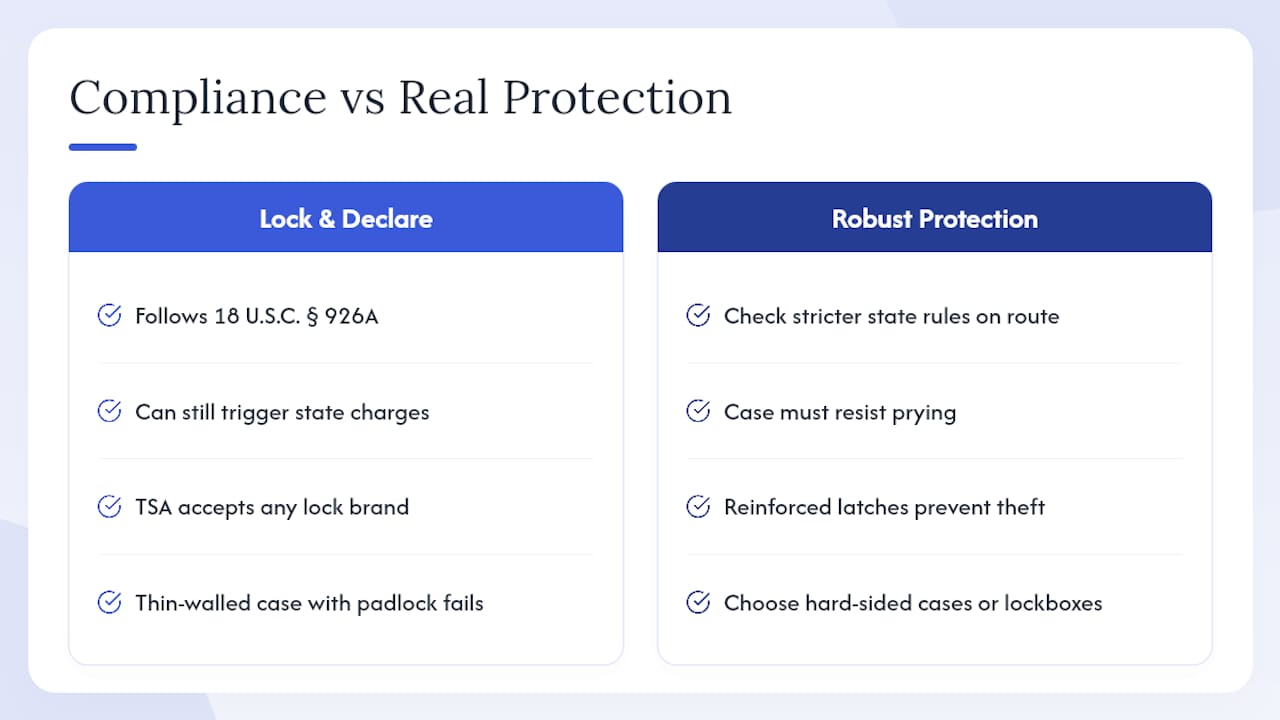
Most firearm travel advice stops at “lock it and declare it.” That is necessary, but it is not sufficient. The real risk for responsible owners is the gap between federal minimums and state-level requirements on multi-state routes. A traveler who follows 18 U.S.C. § 926A perfectly can still face charges in a transit state with stricter rules if they have not done the homework.
The second gap is container quality. TSA allows any brand of lock, but the case itself must resist prying. A thin-walled case with a padlock satisfies the letter of the rule while failing the spirit of it. Pry resistance and reinforced latches are what actually protect the firearm from theft during baggage handling or a vehicle break-in.
Buying a travel case that genuinely meets airline and interstate standards, rather than one that merely looks compliant, is where the decision matters most. That is why Safes and Security Solutions focuses on hard-sided cases and lockboxes with verifiable construction specs, not just a padlock hole.
Secure travel cases and lockboxes from Safes and Security Solutions
Responsible firearm owners who travel need storage that satisfies TSA’s hard-sided, locked-container standard and the interstate-transport rules of 18 U.S.C. § 926A simultaneously. Safes and Security Solutions carries travel-rated hard cases, compact pistol lockboxes, and bolt-in vehicle safes with the construction specs to do both.
Every product listing includes lock type, internal dimensions, and construction materials so you can confirm compliance before you buy, not after you arrive at the airport. Browse the full range at Safes and Security Solutions and match a case to your firearm, your trip, and your carrier’s requirements today.
Useful sources to bookmark before your trip
- 18 U.S.C. § 926A: The federal statute for interstate vehicle transport. Read the “not readily accessible” language carefully.
- TSA: Transporting Firearms and Ammunition: Covers every air-travel requirement from case type to declaration procedure.
- ATF: Traveling with Firearms: International travel warnings; check before any cross-border trip.
- American Airlines Firearms Page: Carrier-specific ammo limits and case handling. Use as a template; check your own airline’s equivalent page.
- NSSF: State law references, reciprocity guides, and downloadable safety toolkits.
- Project ChildSafe: Safe-storage checklists and community resources for responsible owners.
- Active Response Training: Flying with Guns: Step-by-step check-in and screening procedures from a traveler’s perspective.
- US Concealed Carry: Traveling with a Firearm in Private Vehicles: Applied examples of how 18 U.S.C. § 926A works in real road-trip scenarios.
This article provides general information about U.S. firearm travel rules and is not legal advice. Laws vary by state and change over time. Confirm current requirements with the relevant federal and state authorities or a qualified firearms attorney before you travel.
Recommended
- Best Practices for Safe Firearm Storage: Top Gun Cases – Safes and Security Direct
- Secure Your Firearm with a Car Gun Safe: Essential Benefits – Safes and Security Direct
- Secure Hand Pistol Storage: Safe & Innovative Solutions – Safes and Security Direct
- Secure Gun Storage: Legal Compliance & Best Cases – Safes and Security Direct