

Shooting Range Firearm Storage Setup: What to Know Before You Rent
Most staffed shooting ranges rent lockers for unloaded firearms, magazines, and range gear, and a smaller share allows ammunition storage under stricter rules. A proper shooting range firearm storage setup means knowing what’s included before you sign anything: controlled facility access, a membership or day-pass requirement, and locker sizes and fees that vary widely from one range to the next.
Here’s what to expect walking in the door:
- Access: most ranges require a membership, waiver, or verified day pass before you can rent storage.
- Size: small personal lockers commonly run in the 12 by 12 by 24 inch range; long-gun lockers run taller, often 48 to 60 inches.
- Cost: annual locker fees at many facilities vary depending on size and whether it’s key or keypad access.
- Rules: unloaded storage only is close to universal; ammunition storage is the exception, not the default.
Quick facts: a locker rental is not a substitute for a home gun safe. It’s a convenience for people who shoot regularly at one facility, not a long-term security solution for a firearm collection. Treat it as parking, not as a vault.
Key Takeaways
A shooting range firearm storage setup works when you verify the range’s written policy, confirm real security controls, and prepare the firearm correctly before it goes into the locker.
| Point | Details |
|---|---|
| Confirm the written policy | Get locker size, fees, billing period, and ammo rules in writing before signing anything. |
| Verify security controls | Check for controlled entry, bolted-down lockers, and a clear master-key policy. |
| Prepare the firearm properly | Unload, lock the action, and log the serial number before it goes into storage. |
| Control locker humidity | Use desiccant packs or a small dehumidifier and breathable cases, not sealed leather. |
| Know your emergency access | Ask how retrieval works outside normal hours before you need it, not after. |
| Consider a private safe for long-term needs | For year-round or larger collections, a home safe like Safes and Security Solutions’ BFS2214 gives more control than any rented locker. |
Call the range with your prepared question list before you visit. A facility with clear, written answers to every question above is one worth renting from.
Table of Contents
- Typical Locker Types, Dimensions, and Sample Pricing
- What Ranges Commonly Allow and Prohibit
- Security Controls a Range Should Have in Place
- How to Prepare a Firearm for Storage in a Range Locker
- Setting Up the Locker Interior to Prevent Rust and Damage
- Questions to Ask the Range and Red Flags to Avoid
- Industry Resources Worth Consulting
- A Publisher’s Note on Range Lockers vs. Private Storage
- When a Private Safe Makes More Sense Than a Locker
- Sources
Typical Locker Types, Dimensions, and Sample Pricing
Ranges generally offer three tiers of storage, and knowing the difference before you call saves you a wasted trip.
Small personal lockers work for a single handgun, a cleaning kit, and spare magazines. Long-gun vertical lockers are built for rifles and shotguns and need enough interior height to stand a firearm upright without the barrel pressing against the door. Shared gear lockers, less common, hold range bags, ear protection, and ammo cans for members who don’t need dedicated firearm storage.
Pricing structures differ by facility, but the pattern below reflects what’s typical across staffed indoor and outdoor ranges.
A few things to confirm before you assume a locker fits your setup:
- Whether the fee is billed annually up front or monthly with auto-renewal.
- Whether access is a physical key (you’re responsible for replacement) or an electronic keypad tied to your membership.
- Whether a security deposit is refundable if you cancel mid-term.
- Whether locker size is measured by exterior footprint or usable interior space, since those numbers can differ by a few inches that matter once a rifle case is inside.
Measure more than the locker’s listed footprint. Confirm the door swing, keypad reach, and whether anything nearby blocks full access once the locker’s actually loaded with gear.
What Ranges Commonly Allow and Prohibit
Every range writes its own locker policy, but a few rules show up almost everywhere. Firearms must be stored unloaded, full stop. Most facilities also prohibit ammunition storage inside firearm lockers entirely, or require it in a separate, clearly labeled container away from the firearm itself. Live-fire testing, cleaning solvents, and loaded magazines left in the gun are common violations that get lockers revoked.
Membership and documentation requirements vary more than the storage rules themselves:
- Photo ID and an active membership or day-pass are near-universal requirements.
- Some ranges require a signed liability waiver specific to locker use, separate from the general range waiver.
- Background checks for locker rental itself are uncommon, though the range’s overall membership process may include one.
- A few facilities carry supplemental insurance for stored property; most explicitly disclaim liability for theft or damage, so ask directly.
Local and state law can affect what a range is legally permitted to store on-site, particularly around ammunition quantities and any firearm restricted under jurisdiction-specific rules. A range’s written policy should reflect its local law, but that policy is not a substitute for you confirming your own jurisdiction’s requirements.
If a range can’t produce a written locker policy on request, that’s a signal to keep looking before you hand over a deposit.
Security Controls a Range Should Have in Place
A locker is only as secure as the facility around it. Before renting, look at what the range itself does to control who gets near the storage area at all.
Controlled entry is the baseline: a locked door, a sign-in log for visitors, and staff who actually check membership before letting someone into the locker room. CCTV coverage of the storage area, and either staff presence or scheduled patrols during open hours, are the next layer. Ranges that skip these basics are relying entirely on the locker hardware itself, which is a weaker setup than it sounds.
At the locker level, look for:
- Bolt-down construction, lockers anchored to floor or wall, not freestanding units that can be tipped or carried out.
- Heavy-duty hasps and hinges rather than lightweight sheet-metal doors.
- Electronic keypad access with individual codes, or a keyed system with a documented master-key policy.
- A clear range policy on whether you can add your own supplemental lock on top of the facility’s.
Pro Tip: Ask who holds the master key and under what circumstances they’ll open your locker without you present. A vague answer here is the single biggest red flag in the whole rental process.
Ask about the range’s insurance coverage for stored property directly, and get the answer in writing if you can. Most ranges disclaim liability for theft, which means your homeowner’s or renter’s policy, not the range, is what actually covers a loss.
How to Prepare a Firearm for Storage in a Range Locker
Getting this part right matters more than picking the right locker size. A firearm going into storage, even short-term, should go through the same sequence every time.
- Unload the firearm completely, remove the magazine, and open the action to visually and physically confirm it’s clear.
- Apply a cable lock or trigger lock if the range requires one for stored firearms, which many do regardless of your own preference.
- Wipe down the firearm to remove fingerprint oils and range residue before it sits in an enclosed space for days or weeks.
- Tag or log the firearm according to the range’s intake procedure, if one exists.
- Store magazines and any permitted ammunition separately from the firearm itself, never touching or stacked against it.
Documentation takes five extra minutes and matters if anything ever goes wrong:
- Record the serial number somewhere outside the locker, not just on a tag inside it.
- Take a photograph of the firearm and any accessories being stored.
- Keep your own inventory list separate from whatever the range keeps on file.
Before you hand over keys or set an access code, ask the range exactly how emergency access works if you need the firearm outside normal hours, and get their pickup procedure in writing. A facility that can’t clearly explain either one hasn’t thought through its own policy.
Setting Up the Locker Interior to Prevent Rust and Damage
Moisture is the real threat to anything stored in a range locker, more than theft in most cases. Indoor ranges especially can trap humidity from cleaning solvents, foot traffic, and inconsistent airflow, and a sealed metal locker with no ventilation makes that worse, not better.
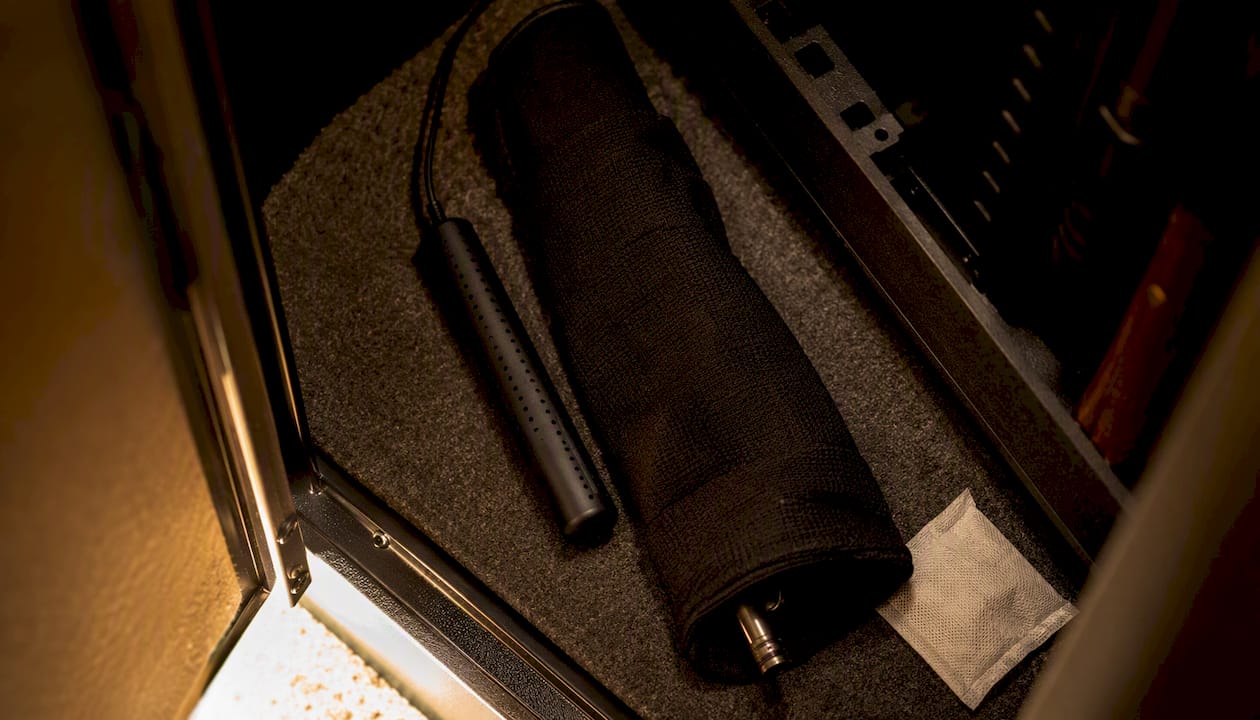
A small dehumidifier rod or a rotation of silica gel desiccant packs inside the locker keeps relative humidity low enough to prevent surface corrosion on blued steel. Recharge or replace desiccant packs on a set schedule rather than waiting until you notice moisture damage, since by then the firearm’s already affected.
Skip sealed leather or heavy fabric cases for anything stored longer than a single visit. Those materials trap ambient moisture against the metal instead of letting it evaporate, which accelerates rust rather than preventing it. Silicone-treated gun socks or open foam inserts that allow airflow around the firearm do the job better.
Keep ammunition segregated per the range’s rules, and never let a loaded magazine or ammo can sit in direct contact with the firearm itself, both for corrosion reasons and because most range policies explicitly prohibit it.
Locker moisture check: Action Target’s home range planning guidance notes that engineered ventilation, downrange airflow and negative-pressure filtration, is fundamentally different from ordinary household HVAC, which is exactly why an indoor range’s ambient humidity can run higher than a home safe room without anyone noticing. For a deeper walkthrough of dehumidifiers and desiccant options, see this guide on protecting firearms from humidity.
Questions to Ask the Range and Red Flags to Avoid
A short phone call before you visit saves you from signing a year-long locker agreement at a facility that isn’t actually a good fit.
Ask directly: what’s permitted inside the locker, how is billing structured, what’s the cancellation policy, what hours can I access my locker, and what happens if I need my firearm at 2 a.m. on a Sunday? Also ask who’s liable if a locker is broken into, and whether the range carries any insurance covering stored property, versus you relying entirely on your own policy.
Watch for these red flags:
- No written locker policy, only a verbal explanation that changes depending on who you ask.
- Vague or nonexistent answers about emergency access outside business hours.
- No visible controlled entry, a locker room anyone can walk into unsupervised.
- Lockers that are visibly dented, poorly maintained, or not actually bolted down.
- Reluctance to state fees and cancellation terms in writing before you commit.
A fast way to compare two or three ranges is a simple scorecard: rate each on security (access control, cameras, locker construction), rules clarity (written policy, ammo rules spelled out), and price transparency (fees and cancellation terms in writing). A range that scores well on all three is worth the membership; one that dodges any of them isn’t.
Industry Resources Worth Consulting
A few organizations set the standards that well-run ranges actually follow, and they’re useful if you want to go deeper than a single facility’s policy.
The NSSF’s range resources cover range management, safety training, and directories of consultants who help operators build out facilities properly, including storage and security planning. Their aggregated operator survey data also gives a sense of what’s typical across indoor, outdoor, and combination ranges nationally.
Action Target publishes detailed technical guidance for range operators, covering both security equipment and controlled-access design and the ventilation systems that keep indoor facilities from becoming humidity traps.
For finding a range in the first place, or confirming what amenities one actually offers:
- WhereToShoot, the NSSF-managed directory, is the fastest way to locate ranges by state and filter by facility type.
- State associations, like the Oregon Association of Shooting Ranges, publish region-specific guidance on design, membership rules, and environmental compliance that a national resource won’t cover.
A Publisher’s Note on Range Lockers vs. Private Storage
A range locker earns its keep for someone who shoots weekly at one facility and doesn’t want to haul a rifle case through a parking lot every time. It’s convenience storage, not security storage, and treating it as a replacement for a real safe at home is where people get burned.
If you own more than one or two firearms, keep them long-term, or you’re storing anything you can’t afford to have exposed to a facility’s insurance disclaimer, a private safe at home does a job a rented locker was never built for. Safes and Security Solutions publishes this guide because we see that confusion constantly. Choose the range locker for convenience during an active shooting season. Choose a private safe when the firearm needs to live somewhere secure year-round.
When a Private Safe Makes More Sense Than a Locker
A range locker solves a parking problem. It doesn’t solve a security problem the way a dedicated safe does, and that distinction gets lost until something goes wrong.
If your firearm collection is growing, or you’re storing something you’d rather not leave under a facility’s liability disclaimer, a burglary-and-fire-rated safe at home gives you control the range simply can’t offer. The American Security BFS2214 Burglary and Fire Safe is built for exactly this middle ground: enough capacity for multiple long guns or a stacked handgun collection, fire protection a locker doesn’t have, and full control over who holds the key or the code.
Before buying, check four things: interior capacity against what you actually own, built-in humidity control or room for a dehumidifier rod, anchoring hardware so the safe can’t be removed from the property, and a lock type (electronic keypad or dial) that fits how often you’ll need access. If fire rating matters more than burglary resistance for your situation, the American Security UL1511 UL Listed 2 Hour Home Fire Safe is worth comparing directly against it. Browse the current lineup or reach out to Safes and Security Direct to talk through which capacity and lock type fits your collection.
Sources
- How to build a home shooting range: plans, safety, and setup – Action Target
- Ranges • NSSF
- Where To Shoot®
- Oregon Association of Shooting Ranges (OASR)
Recommended
- Home Gun Storage: Safe & Secure Solutions for Every Household – Safes and Security Solutions
- Secure Storage for Firearms and Ammunition: A Complete Guide – Safes and Security Solutions
- Best Practices for Safe Firearm Storage: Top Gun Cases – Safes and Security Direct
- Gun Safe Organizer Ideas: 7 Smart Ways to Maximize Space – Safes and Security Solutions