

Securing High-Value Art Collections: A Collector's Guide
TL;DR:
- Secure your collection with object-specific sensors, layered physical protections, and current appraisals.
- Use specialist shippers with climate control, confidential routing, and documented handling to minimize transit risks.
Every serious collector needs six baseline measures in place before anything else: a current inventory with professional appraisals, object-specific physical protection, layered surveillance and alarms, hardened perimeter and access control, climate and fire protection, and specialized fine-art insurance with documented transit protocols. Together, these address the two ways collections are lost: theft and preventable damage. Neither risk is theoretical. The global art market transacts roughly $65 billion annually, and criminal networks specifically target concentrated events, transit windows, and under-secured residential collections.
Your six-point baseline checklist:
- Complete a professional inventory and appraisal for every significant work
- Install object-specific protection (sensors, mounts, anchors) on each high-value piece
- Deploy layered surveillance cameras and alarm sensors with monitored response
- Harden perimeter entry points and implement credentialed access control
- Maintain stable climate, UV-filtered lighting, and art-appropriate fire suppression
- Secure specialized fine-art insurance with agreed-value wording and transit coverage
The sections below give you the practical depth to implement each one.
Table of Contents
- How do you secure high-value art collections with surveillance and alarms?
- What physical hardening does a collection space actually need?
- Why object-level protection matters more than room-level security
- How do climate, lighting, and fire suppression protect your collection?
- What records does a collector need to protect and recover their collection?
- Transit is the riskiest moment — what do specialist shippers actually do differently?
- What insurance does a high-value art collection actually require?
- How should you vet staff and respond when something goes wrong?
- How do you choose the right safes, cameras, and alarms for a collection?
- Key Takeaways
- The part of art security most collectors get wrong
- What Safes and Security Solutions offers collectors
How do you secure high-value art collections with surveillance and alarms?
Object-aware, redundant detection is the baseline. A single motion sensor in a gallery room is not a security system; it is a starting point. The standard for high-value art protection combines video surveillance, object-level alarms, and direct monitoring with a verified response workflow.
Camera specifications that matter for collection spaces:
- Minimum 4K resolution with wide dynamic range for mixed natural and artificial lighting
- Low-light or IR performance rated for after-hours operation without supplemental lighting
- Tamper-resistant housings and vandal-proof mounting brackets
- Overlapping fields of view so no blind spots exist between adjacent works
- Cloud-backed storage with local redundancy so footage survives a physical attack on the recorder
Placement matters as much as specs. Cameras should cover entry and exit points, storage room doors, and individual display zones for the highest-value works. Angling a camera to capture a work’s face and its immediate surroundings gives investigators usable footage if a piece is moved or damaged.
Pair cameras with the right sensor types. Door and window contacts catch forced entry. Vibration sensors on walls and cases detect drilling or impact. Seismic sensors and tilt/orientation sensors mounted directly to frames or pedestals detect the moment a work is touched. That last category is where most residential and smaller institutional systems fall short.
Verification and response workflow:
- Local guard response for staffed institutional settings
- Central station monitoring with sub-60-second verification for residential and unstaffed spaces
- Private security response for collections where law-enforcement response times are long
- Mobile push alerts with live video clips so the owner or curator can verify remotely before dispatching response
Pro Tip: Deploy object-mounted sensors on a separate, high-priority alarm zone. When a tilt sensor on a painting triggers, it should escalate differently than a general motion event in the same room. Fewer false alarms, faster real response.
What physical hardening does a collection space actually need?
Reinforce access points and control movement with layered physical barriers before investing in electronics. A sophisticated camera system protecting a door with a standard residential lock is a documentation tool, not a deterrent.
A layered approach integrating physical security, staff preparedness, and tailored insurance consistently outperforms any single measure. For physical hardening, that means:
- Steel-reinforced door frames and solid-core or steel doors on all collection access points
- Laminated or security glazing on windows and display cases (laminated glass holds in place under impact; standard tempered glass shatters into an opening)
- Commercial-grade deadbolts and strike plates with 3-inch screws into the structural frame
- Access-control vestibules or mantrap entries for high-value storage rooms, requiring two-factor authentication before the inner door opens
Visitor and contractor management is where many private collections have the most exposure. Every non-staff person entering a collection space should sign in with photo ID, receive a badge, and be escorted. Contractors working in or near storage areas need background checks on file before they arrive. Biometric or credentialed access for storage rooms means the log is automatic and auditable.
Integrate access control with your camera and alarm system. An access event at a storage door should automatically pull up the corresponding camera feed and timestamp it. If the badge used is not on the approved list for that time window, it should trigger an alert, not just log a denial. That correlation between access events and video is what turns a collection of separate systems into an actual security posture.
Cost and scale vary considerably. A residential collector hardening a dedicated art room can accomplish a lot with reinforced doors, laminated glazing, and a credentialed lock for under $5,000. Institutional-scale hardening with mantrap entries, biometric readers, and integrated alarm correlation runs significantly higher. The asset protection methods appropriate for a 2,000-square-foot private gallery differ from those for a 20,000-square-foot institutional space, but the principle is the same: every layer a thief has to defeat buys time for detection and response.
Why object-level protection matters more than room-level security
Perimeter systems alone often fail to detect the removal of valuable objects. A thief who bypasses or defeats a room alarm still has unobstructed access to every work in that space. Object-specific protection closes that gap by monitoring the item itself.
Display and mounting options:
- Laminated or anti-blast glazed display cases with sealed interiors for works on paper, small sculptures, and decorative objects
- Security bolts and internal fastenings for pedestals and plinths
- Anti-grab picture hooks and security-hanging systems for paintings that require a tool to remove
- Concealed cable anchors for sculptures that cannot be bolted
Sensor options by object type:
- Tilt and orientation sensors for framed paintings: detect any angular change from the hanging position
- Acoustic and seismic contact sensors for sculptures and ceramics: detect vibration from touch or attempted movement
- Wearable tether sensors for objects that move between display and storage
- Pressure-sensitive pads under pedestals for heavy works
Prioritize by value and vulnerability. A $50,000 painting in a residential living room is more exposed than a $500,000 sculpture in a monitored institutional vault. Start with the works most accessible to visitors or contractors, then work down the value list. When works travel on loan, object-level sensors should travel with them or be specified as a condition of the loan agreement.
Pro Tip: Use tamper-evident fittings and sensors that route to a dedicated escalation path, separate from the general perimeter alarm. A tilt sensor triggering on a Basquiat should not share a zone with the motion detector in the hallway.
How do climate, lighting, and fire suppression protect your collection?
Stable temperature and relative humidity, proper lighting, and art-appropriate fire suppression are the primary defenses against irreversible damage. Daily environmental conditions determine long-term integrity far more than isolated incidents. A single flood or fire is catastrophic, but slow deterioration from fluctuating humidity destroys more art over time.
| Medium | Recommended RH | Recommended Temp | Max Lux | Conservation Trigger |
|---|---|---|---|---|
| Oil paintings | 45% | 65°F | 200 lux | RH swing >5% in 24 hrs |
| Works on paper | 45% | 60–65°F | 50 lux | Any direct sunlight |
| Photographs | 30–40% | 60–65°F | 50 lux | RH above 50% |
| Sculpture (stone/bronze) | 45% | 65°F | — | Condensation on surface |
| Textiles | 45% | 60–65°F | 50 lux | RH swing >3% in 24 hrs |
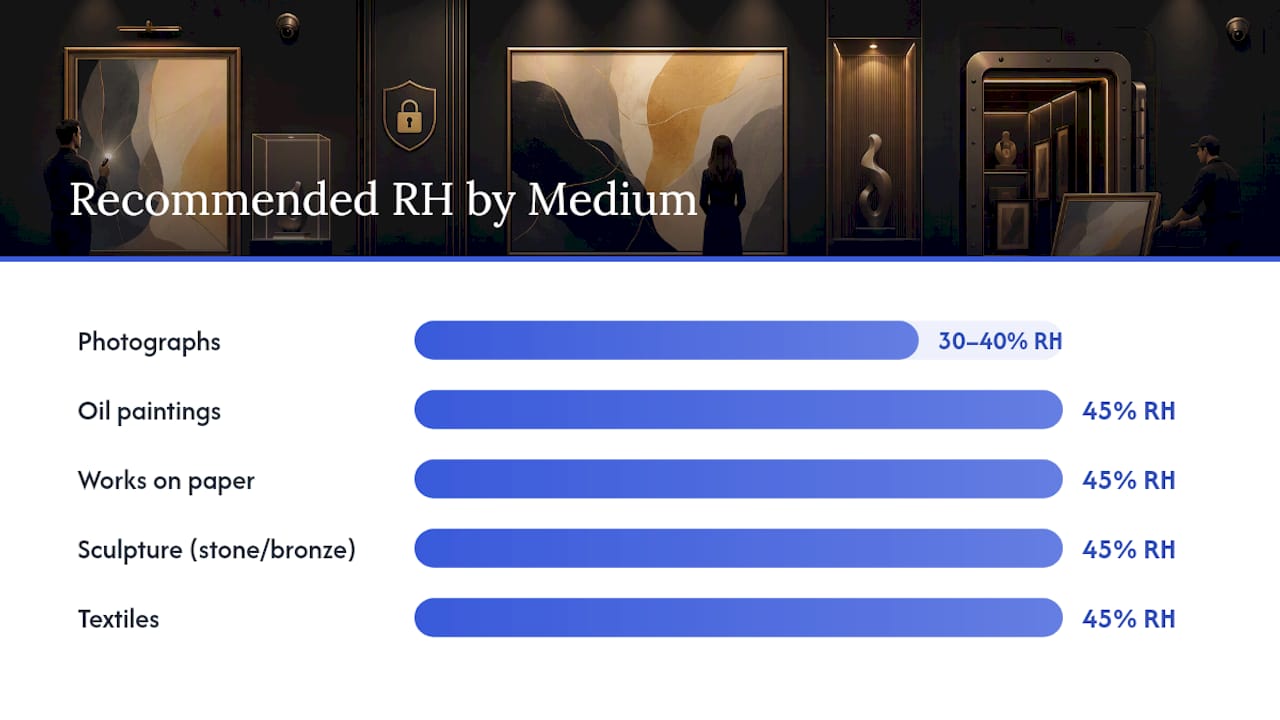
Lighting choices compound over years. UV filtration on all windows and display fixtures is non-negotiable for works on paper and textiles. LED sources with a UV output below 75 μW/lm are the current standard. Rotate works on paper and textiles out of display periodically to limit cumulative lux exposure; a conservation schedule tied to the inventory system makes this automatic rather than ad hoc.
Fire suppression for collection spaces requires a different calculus than standard residential or commercial systems. Wet-pipe sprinklers save buildings but can destroy works. The preferred options for collection spaces are VESDA (Very Early Smoke Detection Apparatus) systems that detect combustion particles before visible smoke, pre-action sprinkler systems that require two triggers before water releases, and inert-gas suppression (argon or nitrogen) for enclosed storage vaults. Residential collectors often cannot justify inert-gas systems, but a pre-action system in a dedicated art room is achievable and meaningfully reduces water damage risk.
Pro Tip: Wire environmental sensors into your alarm and condition-report system. When RH drifts outside the target band for more than four hours, it should generate a maintenance alert, not just a log entry. Catching a failing HVAC unit before it causes a week of humidity swings is far cheaper than a conservation treatment.
What records does a collector need to protect and recover their collection?
Rigorous, current documentation is the foundation of both recovery and insurance settlement. Without it, a stolen work is harder to identify, an insurance claim is slower and often lower, and provenance disputes become expensive. The documentation standard for a professionally managed collection includes:
- A unique identifier for each work (catalog number, RFID tag, or UV-pen marking on the frame or base)
- High-resolution photographs from multiple angles, including details of signatures, labels, and condition issues
- A written condition report at acquisition and updated after any move, loan, or treatment
- Provenance documentation: purchase invoices, auction records, exhibition history, and import/export records
- Dimensions, materials, and medium recorded in a standardized format
- Current location history, including loan agreements and transit records
Appraisals drive insurance coverage. An agreed-value policy requires a documented valuation; without one, the insurer settles at market value at the time of loss, which may be lower than replacement cost. Some insurers request formal appraisals only above certain item thresholds. Reappraise significant works every three to five years, or after any major market movement in the artist’s work.
Store records in at least three places: the collection management system, an encrypted off-site digital backup, and physical copies of critical provenance documents in a bank safe-deposit box. For loans, maintain a chain-of-custody log that tracks every person who handled the work and every location it passed through.
Registering works with the Art Loss Register is a low-cost step that materially improves recovery odds. If a stolen work surfaces at auction or through a dealer, the registration triggers an alert. It also strengthens provenance for future sales.
For luxury collectibles of all kinds, the documentation discipline is the same: a watch collection management approach that tracks serial numbers, service history, and condition photos applies directly to fine art. The asset type changes; the record-keeping logic does not.
Transit is the riskiest moment — what do specialist shippers actually do differently?
Moving art is the single highest-risk activity in collection management. Specialist fine-art shippers use climate-controlled vehicles, two-person driver teams, GPS tracking, custom crates, and confidential routing to reduce predictability and exposure. General movers do not. The difference is not price; it is training, equipment, and accountability.
Transit controls that matter:
- Climate-controlled vehicles maintaining the same RH and temperature range as the collection space
- Two-person teams so the vehicle is never left unattended
- GPS tracking with real-time monitoring by the shipper’s operations center
- Secure, vetted overnight storage facilities for multi-day shipments
- Confidential routing with no advance disclosure of departure times or routes
Packing standards:
- Never apply bubble wrap directly to a painted or gilded surface; use glassine or silicone release paper as the first barrier
- Custom crates with interior foam cushioning sized to the specific work, not generic padding
- Shadow boxes or travel frames for works on paper and photographs
- Shock-indicator labels on crates to document rough handling
Vet shippers the way you vet staff. Require proof of background checks on drivers and handlers, documented training in fine-art handling, and transit insurance limits that match the declared value of the shipment. Include contract clauses specifying the required security protocols; if a shipper cannot provide written confirmation of those protocols, that is the answer.
Pro Tip: For high-value shipments, prepare a confidential transit plan with contingency stops and a counter-surveillance protocol. The route, timing, and vehicle description should be known only to the shipper’s operations team and the collection manager. Fairs, hotel arrivals, and loading docks are documented targets for criminal networks.
For context on moving valuable items safely, the same principles apply whether the work is a painting or a sculpture: professional handling, appropriate packing materials, and documented chain of custody from door to door.
What insurance does a high-value art collection actually require?
Specialized fine-art insurance with agreed-value wording, documented appraisals, and transit and exhibition coverage is the standard for collections above a certain threshold. A standard homeowners policy is not designed for this. It caps coverage at a fraction of replacement value, excludes transit, and settles at actual cash value rather than agreed value.
Specialist insurers offer agreed-value settlements, restoration coverage, new-acquisition clauses, and access to conservation and claims specialists. Those features are not marketing language; they are the difference between a claim that restores the collection and one that leaves a gap.
Key policy questions to ask before binding coverage:
- Does the policy use agreed-value or market-value wording? Agreed value pays the scheduled amount; market value pays what the insurer determines at the time of loss.
- Does worldwide transit and exhibition coverage apply automatically, or must each loan be scheduled?
- Is there a new-acquisitions clause that covers works for 30–90 days before formal scheduling?
- What is the deductible structure, and does it apply per item or per occurrence?
- Does restoration coverage allow the collector to choose the conservator, or does the insurer designate one?
- Does the insurer provide access to fine-art loss-prevention resources and claims specialists?
Security measures affect underwriting. Insurers writing high-value limits typically require documented security protocols, professional appraisals, and sometimes a loss-prevention audit before binding. That audit is worth doing regardless of the insurance requirement; it often surfaces vulnerabilities the collector had not considered.
Pro Tip: Maintain a pre-loss relationship with a fine-art broker or specialist insurer, not just a policy number. When a claim happens, the broker who already knows your collection, your appraisals, and your security setup will move faster and negotiate better than one encountering the collection for the first time.
How should you vet staff and respond when something goes wrong?
Tightly controlled personnel access and a clear incident-response process reduce insider risk and speed recovery. Most high-profile thefts involve some degree of inside knowledge, whether from a current employee, a former contractor, or a service provider who observed the collection during routine work.
Staff security basics:
- Background checks before any employee or contractor accesses the collection
- Limited-access credentials: staff should have access only to the areas their role requires
- Confidentiality agreements covering collection contents, security measures, and appraisal values
- Periodic re-screening for anyone with ongoing collection access, particularly after a role change
- Documented handover procedures for keys, access cards, and alarm codes when staff leave
Incident response checklist:
- Contain the scene: restrict access to the affected area immediately
- Do not touch or move anything until law enforcement has documented the scene
- Notify your insurer and conservation specialists within 24 hours
- Contact local law enforcement and provide your inventory documentation, photographs, and appraisals
- File a report with the FBI’s National Stolen Art File and the Art Loss Register
- Preserve chain-of-custody documentation for any works that were moved or handled before the incident was discovered
- Brief staff on what to say and not say to media or outside inquiries
The National Stolen Art File and the Art Loss Register are the two primary databases law enforcement and the art market use to flag stolen works. Registration with both, combined with high-resolution photographs and unique identifiers, gives investigators the documentation they need to act quickly. Recovery rates improve significantly when a work can be positively identified the moment it surfaces.
How do you choose the right safes, cameras, and alarms for a collection?
Choose equipment by asset value, media sensitivity, and operational context. A jewelry safe rated for small valuables serves a different purpose than a vault door protecting a dedicated art storage room. The right specification depends on what you are protecting and where.
Safe selection criteria for art-related use:
- Burglary rating: UL RSC (Residential Security Container) for residential use; UL TL-15 or TL-30 for higher-value storage
- Fire rating: minimum 1-hour at 1,200°F for documents and photographs; 2-hour ratings for irreplaceable works on paper
- Interior dimensions sized to the work, not just the safe’s nominal capacity
- Mounting options: floor-bolted or wall-anchored to prevent removal of the entire unit
- Interior climate control for humidity-sensitive media
For smaller works, prints, and collection documentation, a high-security jewelry safe with a fire rating provides both burglary and environmental protection in a single unit. For dedicated storage rooms, a vault door with a UL-rated frame converts an existing room into a secure vault without full construction.
Equipment comparison by use case:
| Equipment Category | Best For | Key Advantage | Limitation |
|---|---|---|---|
| Jewelry/document safe | Small works, prints, provenance docs | Fire and burglary protection in one unit | Limited interior volume |
| Vault door + room | Dedicated storage, large collections | Scalable interior space, highest security rating | Requires structural room preparation |
| Integrated alarm package | Gallery display, residential installation | Unified monitoring, mobile alerts | Requires professional installation |
| Object alarm modules | Individual works, loans, transit | Travels with the object, immediate tamper alert | Battery maintenance required |
Alarm and camera spec checklist for collection use:
- Cameras: 4K resolution, tamper-resistant housing, cloud and local storage redundancy
- Alarms: dual-zone configuration separating perimeter from object-level sensors
- Integration: access control events correlated with camera timestamps
- Monitoring: UL-listed central station with sub-60-second verification response
Pro Tip: When retrofitting an existing space, prioritize portable object alarms and sensor-anchored mounts first. They protect the work regardless of where it is displayed or stored, and they travel with the piece if it moves to a loan or a new location.
Key Takeaways
Securing high-value art collections requires object-specific protection, documented appraisals, and layered physical and environmental controls working together, not independently.
| Point | Details |
|---|---|
| Object-specific protection first | Mount sensors directly on each high-value work before investing in room-level systems. |
| Agreed-value insurance is non-negotiable | Schedule works with current appraisals and verify your policy uses agreed-value, not market-value, wording. |
| Transit is peak risk | Use specialist fine-art shippers with climate-controlled vehicles, two-person teams, and confidential routing for every significant move. |
| Environmental stability prevents most damage | Maintain RH at 45% and temperature at 65°F for most media; daily swings cause more cumulative damage than isolated incidents. |
| Safes and Security Solutions | Offers burglary and fire-rated safes, surveillance systems, and vault doors suited to residential and institutional collection storage. |
The part of art security most collectors get wrong
The conventional wisdom says start with cameras and alarms. It is not wrong, exactly, but it gets the order backwards. A camera records a theft. An object sensor prevents it, or at least triggers a response while the thief is still in the room. The distinction sounds obvious, but the majority of residential collections are protected by perimeter systems that would document a theft beautifully and do almost nothing to stop it.
The second underestimated area is environmental damage. Collectors who spend $40,000 on a camera system and $200 on a plug-in hygrometer are protecting against the less likely risk while ignoring the one that is quietly degrading their collection every day. A painting that loses 20% of its value to flaking paint from humidity swings does not generate a police report or an insurance claim. It just becomes worth less.
The third gap is documentation. Not because collectors do not know they should document their works, but because most documentation systems are not current. An appraisal from 2019 for a work whose artist has since had a major museum retrospective is not useful for an agreed-value claim. The paperwork has to keep pace with the market.
The good news is that the highest-ROI measures, object-specific sensors, current appraisals, and stable climate control, are not the most expensive ones. They are the ones that get deferred in favor of visible hardware. Get those three right first, then build the rest of the plan around them.
What Safes and Security Solutions offers collectors
Safes and Security Solutions carries the hardware side of this plan: UL-rated burglary and fire-resistant safes sized from document storage to full collection rooms, professional surveillance camera systems with cloud storage and mobile alerts, and vault doors for dedicated art storage spaces. The product range covers residential collectors protecting a focused collection and institutional buyers outfitting a secure storage facility.
For collectors ready to move from plan to purchase, the site offers detailed product specifications, purchase options, and direct support. Whether you need a fire-rated safe for provenance documents, a camera system with tamper-resistant housings, or a vault door for a dedicated art room, the right starting point is a clear specification matched to your collection’s value and media type. Visit Safes and Security Solutions to review product options, request a quote, or get guidance on the right equipment for your specific collection.
Recommended
- How to secure property effectively: A practical guide – Safes and Security Direct
- How to protect valuables at home: strategies for 2026 – Safes and Security Direct
- Jewelry Safes That Fit Real Security Needs – Safes and Security Direct
- Why Invest In a Safe for Valuables: Real Protection – Safes and Security Direct