

How to Secure Guns From Children: A Parent's Guide
The single most effective step you can take is removing firearms from your home entirely. The American Academy of Pediatrics is direct about this: the safest home for a child is one without guns. If you keep firearms, the next best thing is what injury-prevention experts call “triple-safe” storage: firearms unloaded, locked in a burglary-resistant safe or lockbox, with ammunition locked separately. According to the Institute for Firearm Injury Prevention, households that lock both firearms and ammunition see roughly 78% lower risk of self-inflicted youth injuries and about 85% lower risk of unintentional injuries compared to homes where neither is secured. Safes and Security Solutions stocks the rated safes and lockboxes that make triple-safe storage practical.
Do these four things in the next 24 hours:
- Unload every firearm in the house and lock it in a safe, lockbox, or with a cable/trigger lock until a permanent solution is in place.
- Move all ammunition to a separate locked container, away from the firearms.
- Change or remove any combination, key, or code that a child could discover.
- If you don’t yet own a safe, use a cable lock or trigger lock tonight as a temporary layer.
Key Takeaways
Households that lock both firearms and ammunition see roughly 78% lower risk of self-inflicted youth firearm injuries and about 85% lower risk of unintentional injuries, making triple-safe storage the single most evidence-supported step a parent can take.
| Point | Details |
|---|---|
| Safest home has no guns | The AAP’s clearest recommendation: if no firearm is present, no child can access one. |
| Triple-safe is the baseline | Unloaded, locked in a rated safe, with ammunition locked separately in a second container. |
| Biometric or keypad beats keyed | Children find hidden keys; a fingerprint or code-based lock removes that vulnerability. |
| Temporary removal saves lives | During a mental health crisis, moving firearms off-site is a reversible, evidence-backed step. |
| Safes and Security Solutions | Stocks rated gun safes, quick-access pistol safes, lockboxes, and ammo cabinets at safesandsecuritydirect.com. |
Table of Contents
- Why unsecured guns are so dangerous for children
- What “triple safe” storage looks like in practice
- How to choose the right safe or lockbox for your home
- Storing ammunition safely and moving firearms
- How to talk with children about guns and what to ask at playdates
- What to do when someone in the household is at risk
- What U.S. law says about storing guns safely
- How Safes and Security Solutions can help you get this right
- A note from Safes and Security Solutions
- Ready to put triple-safe storage in place?
- Sources
Why unsecured guns are so dangerous for children
Firearms are now among the leading causes of death for children and teenagers in the United States. The Be SMART campaign reports that millions of children live in homes with unsecured firearms, and a significant share of those guns are both loaded and accessible. That combination drives three distinct risks: unintentional shootings, adolescent suicide, and theft that puts guns into the hands of others.
The suicide risk is the one parents most often underestimate. Adolescents in crisis act impulsively, and access to a firearm during that window is often fatal. Secure storage interrupts that access. The Johns Hopkins Center for Gun Violence Solutions notes that locked firearms and locked ammunition are consistently associated with lower rates of youth firearm injury across both self-inflicted and unintentional categories.
Seattle Children’s makes a point parents sometimes dismiss: young children, including toddlers, often have the finger strength to pull a handgun trigger. Hiding a gun on a high shelf or under a mattress is not a safety strategy. Children explore every corner of a home, and they find things. Locking the firearm is the only reliable safeguard.
Three categories of risk secure storage directly reduces:
- Unintentional shootings: Children who find an accessible gun often don’t recognize the danger.
- Adolescent suicide: Temporary removal or locked storage during a mental health crisis can be lifesaving.
- Theft: A locked safe makes it significantly harder for a burglar to walk out with a firearm that could later be used in a crime.
What “triple safe” storage looks like in practice
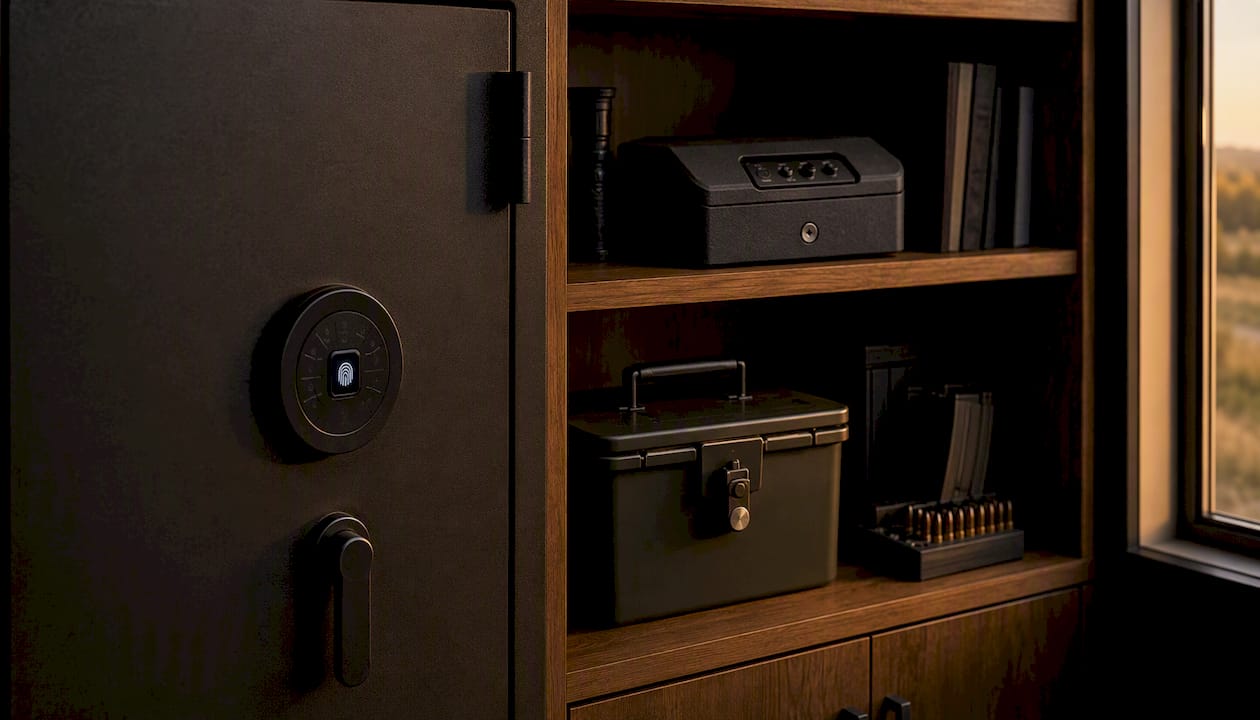
Stanford Children’s Health recommends triple-safe storage as the baseline: unloaded firearm, locked in a burglary-resistant safe or lockbox, with ammunition locked in a separate container. The three elements work together. A loaded gun in a locked safe is still dangerous if a child gets the combination. An unloaded gun with no lock is accessible. All three layers together are what the evidence supports.
Here’s how the main storage categories compare:
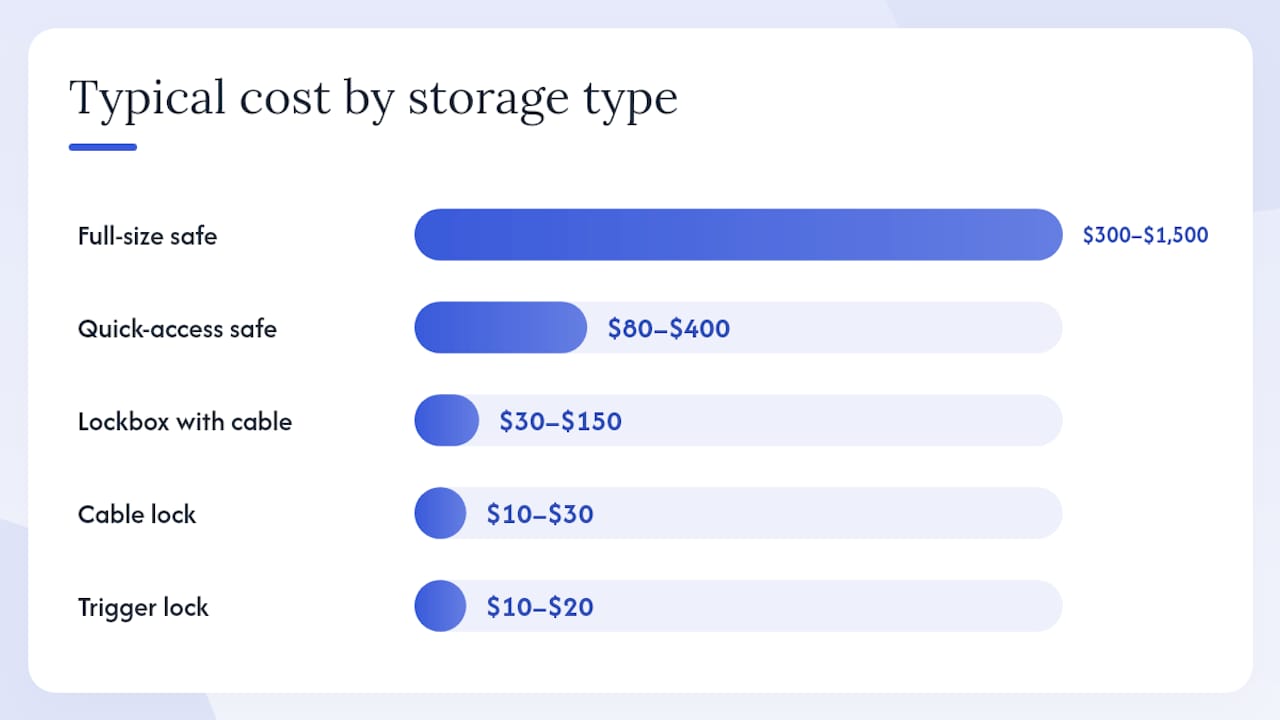
| Storage type | Security level | Access speed | Best for | Typical cost |
|---|---|---|---|---|
| Full-size gun safe (burglary/fire-rated) | Highest | Slower (combination or biometric) | Families with children; multiple firearms | $300–$1,500 |
| Quick-access pistol safe (biometric/keypad) | High | Fast (seconds) | Single handgun; adults needing quick access | $80–$400 |
| Lockbox with cable | Moderate | Moderate | Temporary storage; travel; secondary layer | $30–$150 |
| Cable lock | Low (prevents firing, not removal) | Immediate | Temporary only; no safe available yet | $10–$30 |
| Trigger lock | Low (prevents firing) | Immediate | Temporary only; layered with other storage | $10–$20 |
A few limits worth knowing. Hiding a firearm, even in a “hidden gun shelf,” is not a substitute for locking it. Safe use of hidden gun shelves requires a locking mechanism on the shelf itself; without one, it’s just a creative hiding spot. Leaving a gun in a vehicle is one of the most common sources of theft and child access: a car is not a safe, and a glove compartment lock is not burglary-resistant.
When layering makes sense: a full-size safe plus a trigger lock on each stored firearm adds redundancy. If someone gets the safe open, the trigger lock is a second barrier. Stanford Children’s Health specifically recommends layering for households where the risk level is elevated.
Pro Tip: Choose a combination or biometric lock over a keyed lock. Children and teenagers are remarkably good at finding hidden keys. A keypad or fingerprint reader keeps access tied to knowledge or biology, not a physical object that can be pocketed.
How to choose the right safe or lockbox for your home
The right safe is the one you’ll actually use consistently. A $1,500 safe left open because it’s inconvenient is worse than a $100 lockbox you lock every time.
Features to prioritize:
- Burglary resistance: Look for a UL-listed or independently tested rating. Gauge steel thickness matters; thicker is harder to pry.
- Fire rating: Relevant if you store documents or irreplaceable items alongside firearms. A 30-minute or 60-minute fire rating adds cost but protects against house fires.
- Lock type: Biometric (fingerprint) or electronic keypad for quick access; combination dial for long-term secure storage. Avoid keyed locks as a primary mechanism.
- Interior layout: Adjustable shelving for long guns; pistol racks or door organizers for handguns.
- Mounting options: A safe that can be bolted to a floor or wall is far harder to remove than one sitting loose.
- Warranty: Look for at least a one-year manufacturer warranty; premium safes often carry lifetime coverage.
Sizing by firearm type:
- One or two handguns: a quick-access pistol safe or small lockbox works.
- A rifle or shotgun plus handguns: a long-gun safe with at least 14 inches of interior depth. Check the top long gun safes for capacity specs.
- A growing collection: buy one size larger than you think you need. Safes fill up faster than expected, and overcrowding makes access awkward.
Measure the space before you buy: height, width, and depth of the intended location, plus door swing clearance. A safe that doesn’t fit where you planned often ends up in a garage or basement, which is less convenient and therefore less used.
Pricing reality: Entry-level pistol safes run $80–$150. A solid mid-range home gun safe with a burglary rating and basic fire protection typically costs $400–$800. Premium models with Residential Security Container (RSC) ratings, thicker steel, and longer fire ratings start around $1,000. The how to choose a gun safe guide on Safes and Security Solutions walks through specs in detail.
Pro Tip: Before buying online, confirm the retailer’s delivery and installation policy. Full-size safes can weigh 300–600 pounds. Professional delivery and anchoring is worth the added cost, and some retailers include it.
Storing ammunition safely and moving firearms
Ammunition belongs in its own locked container, separate from the firearms. A locked ammo can, steel ammo box, or a dedicated locked cabinet all work. The point is that even if a child gets into the gun safe, they cannot load the firearm without a second locked barrier. The DOJ Safe Firearm Storage Guide explicitly recommends this separation as a core storage principle.
A few practical notes on ammo storage:
- Keep ammo in its original labeled boxes or clearly marked containers so you always know caliber and quantity.
- Store in a cool, dry location. Humidity degrades primers over time.
- Periodically check that the ammo lock still works and that the key or combination hasn’t migrated somewhere accessible.
Vehicle storage is a separate problem. A firearm left in a car, even in a locked glove compartment, is one of the most common sources of gun theft in the U.S. If you must transport a firearm, use a car gun safe bolted to the vehicle frame, keep the firearm unloaded during transport, and never leave it in an unattended vehicle longer than necessary. State laws on transport vary: some require firearms to be unloaded and in a locked container; others have additional requirements. Check your state’s rules before traveling across state lines.
Pro Tip: Keep a simple written inventory of your stored firearms and ammunition, including serial numbers. Store the inventory separately from the safe. If a firearm is ever stolen, that record speeds up the police report and helps with insurance claims.
How to talk with children about guns and what to ask at playdates
Talking to children about firearms is not a substitute for locking them up. Seattle Children’s is clear that instruction alone is not enough: curious children explore, and even children who know the rules will pick up a gun they find. The conversation matters, but it runs alongside secure storage, not instead of it.
Age-appropriate scripts:
- Toddlers and preschoolers: Keep it simple. “Guns are not toys. If you ever see one, don’t touch it. Come find me right away.” Repeat it often.
- School-age children (6–12): “If you ever find a gun at our house or a friend’s house, stop, don’t touch it, leave the area, and tell an adult immediately. Even if it looks like a toy.” Role-play the scenario so the response becomes automatic.
- Teenagers: Have a direct conversation about the suicide risk. “If you’re ever in a really dark place, I want you to talk to me. And I want you to know that the guns in this house are locked because I love you.” Teens respond better to honesty than to rules alone.
Playdate checklist. Before your child visits another home, ask the hosting parent directly:
- Are all firearms in your home stored unloaded and locked?
- Is ammunition stored separately and locked?
- Who has access to the storage?
The Be SMART campaign and the AAP both recommend asking this question as a routine part of playdate planning, the same way you’d ask about allergies or supervision. If a host is uncertain or dismissive, that’s your answer: host the playdate at your home instead.
Rehearse the “leave it and tell an adult” response with your children at least twice a year. Knowing what to do in theory is different from having a practiced, automatic response.
What to do when someone in the household is at risk
If someone in your home is suicidal, in a mental health crisis, or otherwise at elevated risk of self-harm, the firearm needs to leave the home temporarily. This is the core of what clinicians call lethal means counseling: reducing access to the most lethal method during the period of highest risk. The Institute for Firearm Injury Prevention identifies this as one of the most evidence-supported interventions available.
Temporary removal options:
- Licensed FFL dealer storage: Many gun shops will hold firearms temporarily. Confirm the dealer is licensed, get a written receipt, and document the transfer.
- Shooting range storage: Some ranges offer short-term storage. Confirm they are licensed to hold firearms.
- Law enforcement surrender programs: Some jurisdictions allow voluntary surrender to local police for temporary holding. Check your local department’s policy.
- Transfer to a trusted adult outside the home: In many states, you can transfer a firearm temporarily to another licensed adult. State transfer laws vary; confirm legality before doing this.
The DOJ Safe Firearm Storage Guide recommends documenting any off-site transfer: get a written receipt, confirm the receiving party is licensed where required, and establish a clear plan for return. This protects you legally and ensures chain of custody.
If there is immediate danger:
- Remove firearms from the home now, before any other step.
- Contact the person’s healthcare provider or a crisis line (988 Suicide and Crisis Lifeline).
- Call 911 if there is imminent risk of harm.
Do not wait for a formal diagnosis or a “bad enough” moment. Temporary removal during a crisis period is a practical, reversible step that saves lives.
What U.S. law says about storing guns safely
There is no federal law requiring secure firearm storage in private homes. That said, 26 states plus the District of Columbia have child access prevention (CAP) laws or secure storage requirements, and the standards vary considerably from state to state.
Some state CAP laws impose criminal liability only when a child actually gains access to a firearm. Others create liability the moment a firearm is stored in a way that a child could reasonably access it, regardless of whether an incident occurs. A few states have specific requirements for locking devices or safe types. A JAMA Pediatrics study found that negligence-specific CAP laws were associated with roughly a 13% reduction in pediatric firearm fatalities across homicide and suicide categories, which suggests the laws have real-world effect even when enforcement is inconsistent.
What this means practically:
- Check whether your state has a CAP law and what triggers liability.
- If you store firearms temporarily off-site, confirm that the transfer complies with your state’s transfer and background-check rules.
- Keep records of any temporary transfers.
The State Gun & Drug Storage Laws: Compliance Guide on Safes and Security Solutions is a useful starting point for understanding your state’s requirements. For legal questions specific to your situation, consult an attorney or your state attorney general’s office.
How Safes and Security Solutions can help you get this right
Safes and Security Solutions carries the full range of storage products that meet triple-safe requirements: burglary-rated and fire-rated gun safes, quick-access biometric pistol safes, lockboxes, and dedicated ammo storage cabinets. Every product category is represented, from a $90 cable-locked pistol box for a first-time buyer to a 600-pound UL RSC-rated long-gun safe for a serious collection.
Buying steps that work:
- Use the top 10 gun safes guide to shortlist models by size and rating.
- Measure your intended location before ordering (height, width, depth, door clearance).
- Check the product page for UL or independent burglary/fire ratings and manufacturer warranty terms.
- Confirm delivery and installation options at checkout. Full-size safes require professional delivery; Safes and Security Solutions can walk you through what’s included.
For sizing questions or help matching a product to your household setup, contact the customer service team directly through Safesandsecuritydirect. Getting the right safe the first time is faster than returning one that doesn’t fit.
Pro Tip: Order a firearm storage guide alongside your safe purchase. It covers setup, interior organization, and maintenance steps that extend the life of both the safe and the firearms inside it.
A note from Safes and Security Solutions
Most of the conversation around gun safety focuses on the firearm itself. What gets less attention is the storage decision: not whether to lock up, but which lock, which safe, and whether the setup will actually get used every single time. That last part is where most households fall short. A safe that’s inconvenient gets left open. A combination that’s written on a sticky note defeats the purpose.
The guidance in this article is built around one principle: the best storage solution is the one that fits your household’s real habits, not an ideal version of them. A quick-access biometric safe on a nightstand, used consistently, protects children better than a heavy-duty safe in the basement that gets left unlocked because the combination is hard to remember in the dark.
Safes and Security Solutions exists to help you find that fit, with products that are rated, tested, and sized for real homes. The proven ways to secure firearms aren’t complicated. They just require the right hardware and the habit of using it.
Ready to put triple-safe storage in place?
Locking up a firearm properly takes the right hardware. Safes and Security Solutions offers burglary-rated and fire-rated gun safes, quick-access biometric pistol safes, and dedicated ammo storage, all available for direct purchase with delivery to your door. Whether you need a single pistol lockbox or a full-size long-gun safe, the product range covers every household setup.
Browse the full selection and get sizing help at Safesandsecuritydirect. If you’re not sure which model fits your space and firearm count, the customer service team can help you narrow it down before you buy.
Sources
These are the primary sources behind this guide. Each one is worth bookmarking.
- What is Secure Storage? | Institute for Firearm Injury Prevention
- Healthychildren
- Child Access Prevention Firearm Laws and Firearm Fatalities Among Children Aged 0 to 14 Years, 1991-2016 - JAMA Pediatrics
- Firearms in the Home - Seattle Children’s
- Firearms safety - Stanford Children’s
- Be SMART | Secure gun storage and community education
- Parents Guide to Safe Storage | Center for Gun Violence Solutions - Johns Hopkins
Recommended
- Safe Use of Hidden Gun Shelves: Essential Tips – Safes and Security Direct
- Maintain Your Gun Cabinet: Top Tips & Tricks – Safes and Security Direct
- Secure Your Firearm with a Car Gun Safe: Essential Benefits – Safes and Security Direct
- How to Choose a Gun Safe That Fits Your Needs – Safes and Security Direct