

Securing Commercial Freezer Rooms: A Practical Guide
TL;DR:
- Securing a commercial freezer room requires low-temperature-rated locks, continuous monitoring, and a sealed envelope to prevent moisture ingress.
- Effective retrofitting involves a thorough site assessment, compatible cold-rated hardware, proper installation, and comprehensive commissioning with documented results.
Securing commercial freezer rooms means combining low-temperature-rated access control, continuous temperature and door monitoring, hardened surveillance, and life-safety egress features — all installed after a site-specific assessment that checks door type, panel thickness, and power infrastructure. Spoilage losses from temperature fluctuations often exceed the value of stolen goods, which means a lock alone is never enough. Three actions to take right now:
- Run a site assessment. Measure panel thickness, identify whether you have a hinged or sliding door, and map your electrical and network access points before buying anything.
- Install a low-temperature-rated electronic or health-timer lock. Standard locks fail in sub-zero environments; cold-rated hardware is non-optional.
- Enable 24/7 remote temperature alerts. A door left ajar or a failed seal triggers an alarm before inventory is lost. OSHA, NSF, and HACCP audits all expect documented monitoring. Safes and Security Solutions carries hardware that satisfies all three steps.
Table of Contents
- What does a secure freezer room actually need?
- How do you retrofit security into an existing freezer room?
- What specs should you demand from locks, sensors, and cameras?
- What life-safety and code requirements apply to freezer rooms?
- What does a freezer room security retrofit cost and how long does it take?
- What mistakes do most retrofit projects make?
- How should you maintain and test the system over time?
- When should you hire a professional installer?
- Key Takeaways
- The part most guides skip
- Freezer room security products from Safes and Security Solutions
- Useful sources and next steps
What does a secure freezer room actually need?
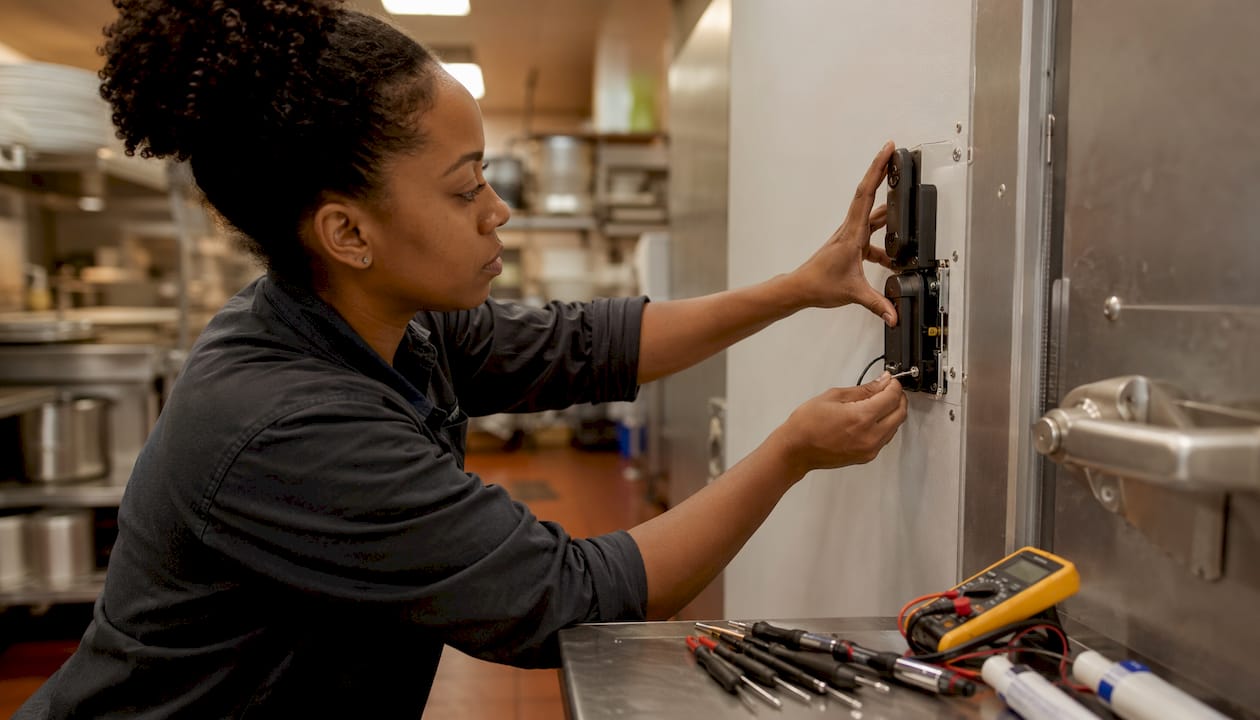
Every secure cold storage setup shares the same core components. Use this as a pre-purchase checklist:
- Low-temperature electronic lock or health-timer lock rated for sub-zero operation
- Internal emergency release with a phosphorescent handle so occupants can exit in darkness or a power outage
- Temperature probe and alarm with remote alerts and a timestamped log
- Door position sensors that trigger an alarm when the door is left open
- Low-temperature surveillance cameras with appropriate IP and IK ratings
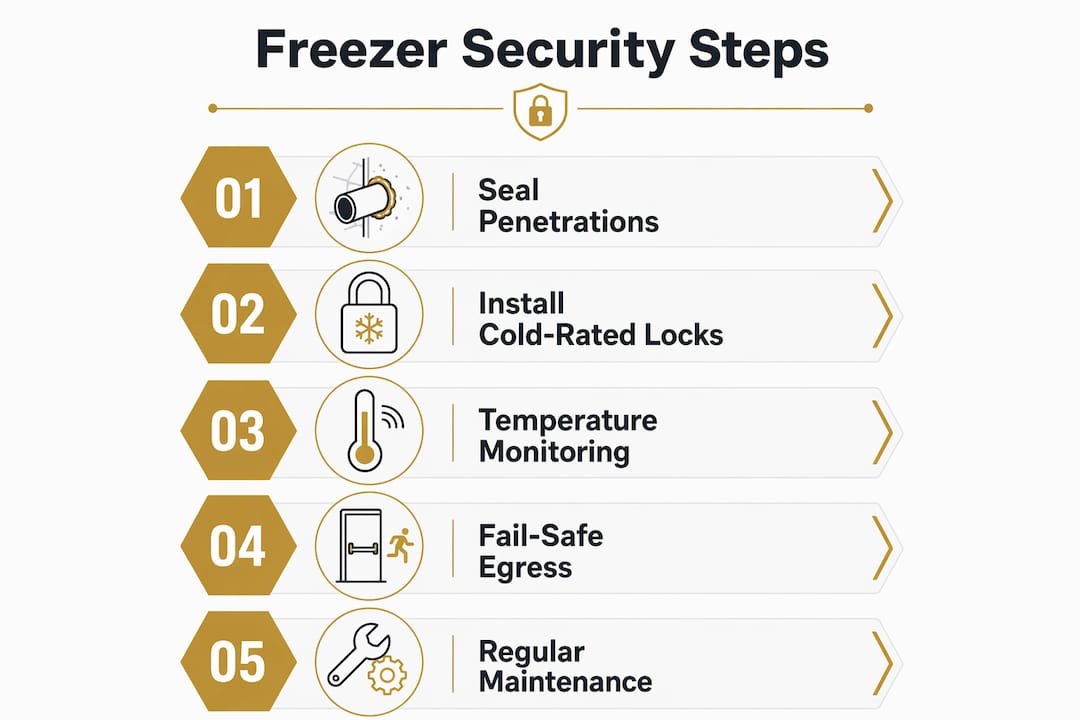
- Sealed conduit and vapor-barrier penetrations at every cable entry point
- UPS or generator backup to keep locks and monitoring online during outages
Pro Tip: Seal every penetration before you add electronics. A single unsealed conduit entry can cause moisture migration that destroys hardware within months.
How do you retrofit security into an existing freezer room?
A retrofit follows a clear sequence. Skipping steps costs money later.
- Site assessment. Measure panel thickness (most commercial panels are in the typical commercial range), confirm door type (hinged vs. sliding), inspect gaskets and frame heaters, and map electrical and network drops. Door type directly affects the lock and strike arrangement you need.
- Hardware selection. Choose locks and sensors rated for your room’s operating temperature. Decide between local standalone monitoring and a networked system. Size your UPS for the lock, probe, and camera load. For hinged doors, a latch-style lock like the Kason SecureGuard or a kit-based solution works well; sliding doors need a different strike geometry.
- Installation. Minimize penetrations. Route cables in sealed conduit and seal every panel entry with foam backer and vapor-barrier tape. Mount sensors on heated frame areas when possible to reduce condensation. Verify door seals close fully after hardware is installed — poorly matched hardware causes frost around the door and degrades the insulated envelope.
- Commissioning. Run a temperature pull-down test, cycle the door open and closed to confirm the alarm triggers, test remote notifications, verify the emergency release is functional and the phosphorescent handle is visible in darkness, and log 30 days of temperature data.
Comprehensive commissioning validates the entire system and produces the documentation required for HACCP audits and health inspections. A commissioning report with pull-down test results, door-seal inspection notes, and a signed user handover is the minimum you should accept from any installer.
What specs should you demand from locks, sensors, and cameras?
Generic hardware fails in freezers. Every component needs a minimum specification.
| Component | Minimum Spec | Why It Matters |
|---|---|---|
| Electronic lock | Rated to -30°C, cold-rated motor | Standard motors seize; lubricants freeze |
| Health-timer lock | Locks/alarms cold-rated for freezer operation | Enforces door behavior and creates audit trail |
| Door position sensor | IP65 or higher, operating temp to -22°F | Condensation and ice destroy unrated sensors |
| Surveillance camera | IP66/IK10, rated to -40°F | Mechanical brittleness and lens fogging at sub-zero temps |
| Temperature probe | High-accuracy, NIST-traceable calibration | Regulatory audits require traceable accuracy |
| Conduit/cable sealing | Vapor-barrier foam + sealed fittings | Unsealed penetrations cause moisture migration and ice buildup |
Additional features worth requiring:
- Health-timer logic that automatically locks or alarms when a door is left open or temperatures exceed thresholds, with a timestamped audit trail
- Tamper detection on the lock body
- Remote alarm escalation to a phone or BMS dashboard
- Corrosion-resistant materials — stainless steel or composite housings only
- For electronic lock advantages beyond basic keying, look for audit-trail logging and credential management
What life-safety and code requirements apply to freezer rooms?
Security upgrades must never create an entrapment risk. OSHA and NSF standards require internal safety release mechanisms, emergency lighting, and documented procedures for walk-in units.
Required life-safety features:
- Internal emergency release operable from inside without a key
- Phosphorescent (glow-in-the-dark) handle or strip on the internal release — specifically cited as a design requirement for cold room locks
- Audible and visual alarms triggered by door-ajar or temperature exceedance
- Emergency lighting inside the unit
- Clearly marked exit path visible at floor level
Any electronic lock must be fail-safe: it must allow immediate egress from inside regardless of power state. Confirm compliance with OSHA 29 CFR 1910, NSF/ANSI 7, USDA cold storage guidelines, and your local building and fire codes. Code variances exist by jurisdiction, so verify with your authority having jurisdiction (AHJ) before commissioning.
What does a freezer room security retrofit cost and how long does it take?
Budget and timeline vary by scope, but these ranges give you a realistic starting point:
- Basic retrofit (low-temp lock + temperature alarm + probe): $800–$2,500 in materials, 1–2 days of labor
- Full upgrade (low-temp lock, camera, networked monitoring, UPS, sealed conduit): $3,500–$10,000+ depending on room size and integration complexity
- Site assessment: 1–3 days
- Procurement: 1–3 weeks for specialty cold-rated hardware
- Installation: 1–3 days for a single small room; up to 2 weeks for multi-room or BMS-integrated projects
- Commissioning and validation: 1–3 days
Build in contingency time for envelope repairs. If frost or air infiltration appears during commissioning, panel remediation and HVAC rebalancing add days and cost. Budget 15%–20% above your initial estimate for any room showing existing seal damage.
What mistakes do most retrofit projects make?
The most common errors are hardware mismatches and skipped sealing steps.
- Incompatible lock hardware that pinches or misaligns the door gasket, creating frost leaks that quietly destroy refrigeration efficiency
- Unsealed cable penetrations that allow moisture migration and ice buildup inside the panel
- Sensors mounted in condensation zones rather than on heated frame areas
- Non-cold-rated batteries or lubricants that fail within weeks of installation
- Cameras without IP66 or IK10 ratings that fog, freeze, or shatter
To troubleshoot: check for frost around the door frame first — it almost always points to a gasket or penetration issue, not a hardware failure. Test door seal integrity with a dollar-bill drag test. For power or sensor failures, isolate the UPS circuit before replacing components. Run a temperature-recovery test after any forced-entry event to confirm the room reaches setpoint within the expected window.
Pro Tip: If locks or sensors show repeated failures, inspect the vapor barrier and panel joints before replacing hardware. Repairing the envelope often resolves what looks like an electronics problem.
How should you maintain and test the system over time?
Consistent maintenance keeps the system audit-ready and catches failures before they become losses.
- Daily: Check door-ajar alarm status and review temperature logs for exceedances.
- Weekly: Inspect door gaskets for tears or frost buildup; clear drain lines.
- Quarterly: Clean evaporator coils, test defrost cycle, verify UPS battery charge, and cycle the emergency release.
- Annually: Recalibrate temperature probes, test all alarm escalation paths, and perform a full pull-down validation.
For your log, record: timestamp, alarm type, corrective action taken, technician name, and next scheduled service. Retain records for at least three years to satisfy HACCP and health inspection requirements. A reliable maintenance schedule is what separates a system that works on day one from one that works on day 1,000.
When should you hire a professional installer?
Some projects are straightforward enough for a capable in-house team. Others are not.
Hire a specialist when:
- The envelope shows existing frost, panel damage, or moisture infiltration
- The room stores regulated products (pharmaceuticals, vaccines, controlled substances)
- You need integration with a building management system (BMS)
- You lack in-house refrigeration or low-voltage security expertise
When evaluating vendors, ask:
- Can you provide references for freezer-specific security installations?
- How do you handle sealed penetrations and vapor-barrier repairs?
- What is your commissioning process, and does it include a pull-down test?
- What warranty do you offer on the installation itself, separate from the hardware?
- Do you provide a maintenance schedule with pricing after handover?
Request a written site assessment report, full part numbers and specs, a commissioning plan, and a maintenance schedule before signing anything. For guidance on commercial door hardware compatibility, that’s a useful starting point when briefing a contractor.
Key Takeaways
A secure commercial freezer room requires cold-rated locks, continuous temperature monitoring, sealed penetrations, and life-safety egress features — all validated through proper commissioning and maintained on a documented schedule.
| Point | Details |
|---|---|
| Envelope first | Seal all penetrations and verify gaskets before installing any electronics. |
| Cold-rated hardware only | Locks, sensors, and cameras must be rated for sub-zero operation and carry at least IP66 ratings. |
| Life-safety is non-negotiable | Every lock must allow immediate inside egress; phosphorescent handles are a code-level requirement. |
| Monitor continuously | Temperature probes with remote alerts protect inventory value beyond what any lock alone can do. |
| Safes and Security Solutions | Carries cold-rated locks, surveillance cameras, and monitoring hardware suited for freezer room retrofits. |
The part most guides skip
The security industry tends to frame freezer room protection as a lock problem. It is not. The lock is the last line of defense. The real risk is a door left ajar for 40 minutes, a probe that drifted out of calibration three months ago, or a cable penetration that has been slowly wicking moisture into the panel since installation day.
What that means practically: the most expensive lock on the market does nothing for a room whose vapor barrier is compromised. Cold-chain security only works when the physical envelope, the monitoring system, and the access hardware are treated as one integrated system. Prioritize the envelope. Then the monitoring. Then the lock. That sequence is counterintuitive for anyone coming from a traditional security background, but it is the right order.
Freezer room security products from Safes and Security Solutions
Cold-rated locks, temperature probes, IP-rated surveillance cameras, and UPS backup units are available as individual components or as part of a coordinated bundle through Safes and Security Solutions. The product range covers the full retrofit stack: from the lock and strike assembly at the door to the remote monitoring dashboard that alerts you at 2 AM when a temperature exceedance occurs.
If you are scoping a retrofit, the most useful next step is a site assessment. Browse the product catalog, identify the components that match your panel thickness and door type, and contact the team to confirm compatibility before you order. Getting the spec right before purchase saves the cost of a return and, more importantly, the cost of a failed installation.
Useful sources and next steps
Authoritative references:
- OSHA 29 CFR 1910 — General Industry Standards for egress and entrapment requirements
- NSF/ANSI 7 for commercial refrigeration equipment standards
- USDA cold storage guidelines for regulated product storage
- Health and safety standards for walk-in refrigeration — practical overview of code touchpoints
- Walk-in freezer design guide — door type and panel thickness reference
- Commercial walk-in freezer construction and envelope standards — vapor barrier and penetration best practices
Three actions before you commission:
- Run a door-seal smoke test or dollar-bill drag test to confirm gasket integrity
- Schedule a temperature pull-down validation with your installer and document the results
- Request a sealed-penetration plan in writing from any contractor before work begins
Recommended
- Commercial Safe Buying Guide for Business Use – Safes and Security Direct
- How to Secure Commercial Premises for Maximum Protection – Safes and Security Direct
- Choosing a Commercial Vault Room Door – Safes and Security Direct
- Why Use Commercial Safes: Protecting Business Assets – Safes and Security Direct