

Secure Payment Processing Guide for Small Businesses
TL;DR:
- Secure payment processing involves protecting customer data during every transaction to prevent fraud and breaches. Small and medium-sized businesses should follow PCI DSS 4.0, use tokenization, encryption, and risk-based authentication to safeguard payment workflows. Ongoing staff training, regular security reviews, and vendor vetting are essential to maintaining long-term payment security.
Secure payment processing is the practice of protecting customer payment data during every transaction to prevent fraud, unauthorized access, and data breaches. For small to medium-sized businesses, this means applying industry standards like PCI DSS 4.0, combined with techniques such as tokenization and multi-factor authentication, to keep every transaction safe. The stakes are real: a single breach can destroy customer trust and trigger significant financial penalties. This secure payment processing guide gives you the practical steps to protect your business and your customers right now.

What are the core technologies behind secure payment processing?
Payment security now covers the entire customer transaction, not just the moment a card is swiped. Every layer of the process requires its own protection, from data entry to settlement.
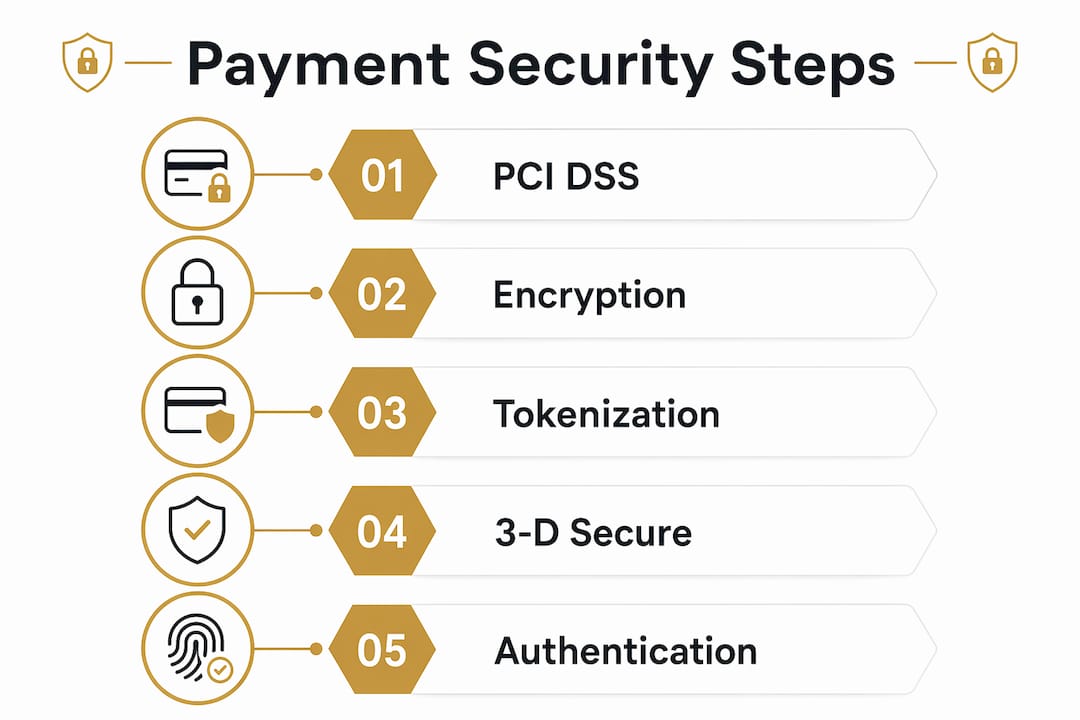
PCI DSS 4.0 is the global baseline. Any business that processes, stores, or transmits credit card data must comply with PCI DSS 4.0 to avoid penalties and reputational damage. The standard covers network security, access controls, encryption, and continuous monitoring. Non-compliance is not a technical failure. It is a business liability.
Encryption with TLS and SSL protects payment data while it travels between your customer’s browser and your server. TLS and SSL encrypt payment data in transit to prevent interception and tampering. Without active TLS, any data sent over a network is readable by anyone who intercepts it.
Tokenization replaces a customer’s real card number with a randomly generated token. Network tokenization reduces online fraud by approximately 30% and improves transaction approval rates by 3–4% compared to handling raw Primary Account Numbers. That means fewer lost sales and fewer fraud disputes at the same time.
3-D Secure 2.3.1 adds a risk-based authentication layer at checkout. 3-D Secure 2.3.1 applies challenges only to high-risk or large transactions, so low-risk purchases go through without friction. This keeps your checkout fast for trusted customers while blocking suspicious activity. When 3-D Secure authentication succeeds, liability for fraud shifts to the card issuer, which directly reduces your financial exposure.
NIST SP 800-63-4 provides the identity verification framework that underpins strong authentication design. It defines assurance levels for digital identity and guides how businesses should implement multi-factor authentication across payment workflows.
| Technology | Primary function | Key benefit |
|---|---|---|
| PCI DSS 4.0 | Compliance framework | Defines minimum security requirements |
| TLS/SSL encryption | Data-in-transit protection | Prevents interception |
| Tokenization | Card data replacement | Reduces PCI scope and fraud |
| 3-D Secure 2.3.1 | Risk-based authentication | Shifts fraud liability to issuers |
| NIST SP 800-63-4 | Identity assurance | Guides MFA implementation |
Pro Tip: Use a payment gateway that supports hosted payment fields. These fields load directly from the gateway’s server, so raw card data never touches your systems and your PCI scope shrinks dramatically.
How can small to medium businesses implement secure payment processing?
Implementation does not require an enterprise IT team. It requires the right choices made in the right order.
-
Choose a PCI DSS-compliant payment service provider. Your gateway or processor must carry current PCI DSS 4.0 certification. Ask for their Attestation of Compliance before signing any contract. A provider without one transfers risk directly to you.
-
Use hosted payment fields or tokenized checkout components. Businesses using hosted payment fields or tokenized checkout components reduce PCI scope and data breach risks. This single step removes your servers from the most dangerous part of the payment flow.
-
Enable end-to-end encryption from the point of entry. Activate TLS 1.2 or higher on every page of your checkout, not just the payment step. Customers enter personal data on address and account pages too. Every page is a potential interception point.
-
Set up adaptive, risk-based authentication. Configure your gateway or fraud tool to apply strong customer authentication only when signals indicate elevated risk, such as a new device, an unusual location, or a high transaction value. Strong customer authentication using MFA and 3-D Secure decreases chargebacks and unauthorized usage. Blanket friction on every transaction drives cart abandonment without improving security.
-
Establish logging, monitoring, and access controls. PCI DSS compliance requires continuous monitoring, logging, and software lifecycle controls to maintain a secure infrastructure. Set up alerts for unusual transaction volumes, failed authentication attempts, and after-hours access. Limit payment system access to staff who genuinely need it, and review those permissions quarterly.
-
Train your team on payment data handling. Human error is a major source of security risk, and payment data leaks through internal workflows and untrained staff behaviors. Run a short training session when staff join and refresh it every six months. Cover what data they can and cannot store, how to spot phishing, and what to do if they suspect a breach.
Pro Tip: Vet every third-party vendor that touches your payment workflow. Ask for their security certifications and review their data handling policies. A weak vendor is a direct vulnerability in your own system.
Understanding two-factor authentication and how it applies to payment access controls is one of the fastest ways to close a common gap in SMB security setups.
What are common payment security threats and how do you stop them?
Card testing is one of the most frequent attacks on small business payment systems. Fraudsters use bots to run hundreds of small test transactions against your checkout to find valid card numbers. The transactions are tiny, so they often go unnoticed until your chargeback rate spikes.
The most effective defenses against common threats include:
- Rate limiting and CAPTCHA on your checkout page to block automated card testing bots before they complete a transaction.
- Real-time transaction monitoring to flag unusual patterns, such as multiple small purchases from the same IP address within minutes.
- Device fingerprinting combined with layered risk evaluation. Device fingerprinting combined with layered risk evaluation improves fraud detection without blocking legitimate customers.
- Clear billing descriptors on customer statements. Clear billing descriptors reduce chargebacks caused by customer confusion. A customer who does not recognize your business name on their statement will dispute the charge, even if the purchase was legitimate.
- Strict access controls to prevent unauthorized internal access to payment records or transaction histories.
“A secure checkout balances fraud prevention with smooth user experience by using layered, adaptive authentication rather than blunt blocking rules. Businesses that apply a single rigid rule to all transactions end up blocking good customers while sophisticated fraud still slips through.”
Human error remains a persistent threat that technology alone cannot fix. Staff who email card numbers, write PINs on sticky notes, or click phishing links create vulnerabilities that no firewall can close. Organizations must train employees specifically to avoid payment data mishandling in day-to-day workflows. That training needs to be specific, not generic security awareness content.
Which tools and policies maximize payment security long term?
Maintaining payment security is not a one-time project. It is an ongoing practice that requires the right tools and regular review cycles.
Core tools every SMB should have in place:
- A web application firewall (WAF) to filter malicious traffic before it reaches your payment pages.
- Intrusion detection and prevention systems (IDPS) to identify and block suspicious network activity in real time.
- Fraud screening software that scores transactions based on behavioral signals, device data, and transaction history.
- Vulnerability scanning tools to identify outdated software, misconfigured servers, and unpatched systems before attackers do.
Policies that close the gaps tools cannot:
| Policy | Frequency | Purpose |
|---|---|---|
| PCI DSS compliance gap analysis | Annually, at minimum | Identify control failures before audits |
| Employee payment security training | Every 6 months | Reduce human error risk |
| Third-party vendor security review | Annually | Confirm vendor compliance |
| Penetration testing | Annually or after major changes | Find exploitable weaknesses |
| Access permission audit | Quarterly | Remove unnecessary system access |
Penetration testing and red-team exercises deserve special attention. Many SMBs skip them because they seem like an enterprise-level expense. A targeted pen test focused on your payment flow is far less costly than a breach investigation. It also satisfies PCI DSS requirements for testing security controls.
Building layered security protocols into your payment environment means no single failure point can compromise the whole system. That principle applies to physical security, digital access, and vendor relationships equally.
Pro Tip: Run a tabletop exercise with your team once a year. Walk through what you would do if a breach happened today. Who calls the bank? Who notifies customers? Who contacts your payment processor? Having a written plan before a crisis is the difference between a managed incident and a disaster.
Key Takeaways
Secure payment processing for small to medium-sized businesses requires PCI DSS 4.0 compliance, tokenization, encryption, risk-based authentication, and consistent employee training working together as a system, not as isolated fixes.
| Point | Details |
|---|---|
| PCI DSS 4.0 is non-negotiable | Every business handling card data must comply to avoid penalties and breaches. |
| Tokenization cuts fraud significantly | Network tokenization reduces online fraud by approximately 30% and lifts approval rates. |
| Risk-based authentication protects without friction | 3-D Secure 2.3.1 challenges only high-risk transactions, keeping checkout smooth for trusted customers. |
| Human error is a top threat | Regular, specific staff training on payment data handling closes the gap technology cannot. |
| Long-term security requires ongoing review | Annual pen testing, quarterly access audits, and vendor reviews keep defenses current. |
What I’ve learned about payment security that most guides skip
Most payment security advice focuses on technology and stops there. After working with businesses across the security industry, the pattern is clear: the businesses that get breached are rarely missing a firewall. They are missing a culture.
The uncomfortable truth is that a perfectly configured payment gateway means nothing if a staff member emails a customer’s card details to the wrong address, or if a vendor you trusted quietly stops maintaining their security certifications. Third-party payment vendors must be strictly vetted to avoid weak links in your payment ecosystem. That vetting cannot happen once at onboarding and never again.
The other thing most guides underplay is the tension between security and convenience. Businesses that apply maximum friction to every transaction see cart abandonment rates climb. The answer is not to choose between security and experience. It is to use adaptive controls that apply pressure where the risk actually is. That requires better tools and smarter configuration, not just more rules.
Safes and Security Solutions has seen firsthand how businesses that treat security as a living practice, rather than a compliance checkbox, handle incidents faster and recover more completely. The businesses that struggle are the ones who set up their payment security once and assumed it would hold. It does not hold. Threats evolve, standards update, and staff turn over. Your security practice has to keep pace with all three.
— Safes and Security Solutions
Safes and Security Solutions: your partner in payment protection
Protecting your customers’ payment data is one part of a broader commitment to security that every business needs to make.
Safes and Security Solutions specializes in security products and guidance for businesses that take protection seriously. From physical asset security to the principles behind secure payment systems, the focus is always on practical, reliable solutions that work in real business environments. Whether you are reviewing your current setup or building a security program from scratch, Safes and Security Solutions offers the expertise and products to support every layer of your defense. Visit safesandsecuritydirect.com to see the full range of security solutions available for your business.
FAQ
What is PCI DSS 4.0 and does my small business need it?
PCI DSS 4.0 is the current global standard for businesses that process, store, or transmit credit card data. If your business accepts card payments in any form, compliance is required to avoid penalties and protect customer data.
How does tokenization protect my customers’ payment data?
Tokenization replaces a customer’s real card number with a random token that has no value outside your payment system. Network tokenization reduces online fraud by approximately 30% and improves transaction approval rates.
What is 3-D Secure and should I use it?
3-D Secure 2.3.1 is an authentication protocol that adds a risk-based verification step at checkout. It applies challenges only to high-risk transactions, reduces chargebacks, and shifts fraud liability to the card issuer when authentication succeeds.
How often should I train staff on payment security?
Train staff when they join and refresh that training every six months. Human error is a leading cause of payment data breaches, and specific training on payment data handling reduces that risk more effectively than general security awareness programs.
What is the fastest way to reduce my PCI compliance scope?
Use hosted payment fields or a tokenized checkout component from your payment provider. This keeps raw card data off your servers entirely, which dramatically reduces the number of PCI DSS requirements that apply to your business.
Recommended
- Upgrade business security: a systematic guide for SMBs – Safes and Security Direct
- Best Safes for Small Business Buyers – Safes and Security Direct
- Business security checklist 2026: protect your SME assets – Safes and Security Direct
- What Is Secure Payment Processing? 2026 Guide – Safes and Security Direct