

Security's Role in Tenant Retention: A 2026 Guide
TL;DR:
- Security improves tenant retention by increasing their sense of safety and reducing turnover costs. Smart locks, cameras, and lighting are highly effective upgrades that attract tenants and lower vacancy days. Treating security as a continuous system driven by planning, communication, and maintenance enhances long-term property value.
Security is a direct, measurable driver of tenant retention. Renters who feel safe stay longer, sign longer leases, and cost far less to replace. According to the 2025 Rently Smart Apartment Trends Report, 57% of renters say they would be more likely to renew if smart locks and smart cameras were added to their unit, according to the 2025 Rently Smart Apartment Trends Report. That single figure reframes security from a cost center into a retention tool with a calculable payback.
36% of renters name smart home security technology as the single most influential factor in their sense of safety, outranking neighbors (28%) and on-site staff (25%). Half say they would feel less safe without it.
Every tenant turnover costs money: vacancy days, cleaning, broker fees, and repairs. Avoiding even one turnover per year on a mid-size property can offset the entire cost of a security upgrade. This guide covers which measures move the needle most, how to prioritize and price them, how to implement without disrupting residents, and how to measure the results.
Table of Contents
- Why does security change tenant behavior and property economics?
- Which security features actually move tenants to renew?
- How do you prioritize upgrades and estimate ROI?
- How do you implement security upgrades without disrupting tenants?
- What are the U.S. privacy and legal rules for property security cameras?
- How do you measure whether security is actually improving retention?
- A realistic example: what a targeted security package looks like
- Key Takeaways
- The case for treating security as a retention system, not a line item
- What Safes and Security Solutions offers property managers and owners
- Selected sources and further reading
Why does security change tenant behavior and property economics?
Property managers tend to attribute non-renewals to factors outside their control, like local rent trends or life changes. Understanding the key signs of pest infestation for London property managers is another crucial factor in overall property stewardship that affects tenant satisfaction. Renters tell a different story. The 2026 Zego Resident Experience Management Report shows that renters consistently cite controllable issues, including rent pricing, poor maintenance, and safety concerns, as their top reasons to leave. That gap between manager perception and resident reality is where retention dollars get lost.
| Tenant-cited non-renewal driver | Manager’s perceived importance | Reality check |
|---|---|---|
| Rent pricing | High | Matches |
| Poor maintenance response | Low | Underestimated |
| Safety and security concerns | Low | Underestimated |
| Life changes (job, family) | High | Overestimated |
Security improvements make buildings “sticky.” Tenants who feel safe are less likely to weigh the disruption of moving against a marginal rent difference. As Gerst Property Management notes, reducing turnover directly preserves rental income and cuts vacancy-related costs, stabilizing net operating income over time.
Parks Associates research of 8,000 U.S. internet households found that roughly half of apartment residents worry about community safety and actively want smart amenities, including access control, cameras, and smart door locks.
Which security features actually move tenants to renew?
Not all security measures carry equal weight with renters. Here is what the research supports, ranked from highest to lower retention impact:
- Smart locks and app-based access top the list. 77% of renters would consider signing a two-year or longer lease when smart security and energy-saving devices are included. Deploy at unit entry doors and building entrances. See how smart locks enhance security and control for selection guidance.
- Monitored security cameras are now a baseline expectation: More than half of renters expect smart cameras in modern rentals. Cover parking areas, lobbies, package rooms, and building perimeters.
- Controlled common-area access (keycard, fob, or mobile credential) reduces unauthorized entry and gives tenants visible evidence that management takes safety seriously.
- Exterior and parking lighting is low-cost, high-visibility, and directly reduces after-hours anxiety, a common driver of non-renewal among families and solo renters.
- Professional-grade in-unit or commercial safes address a specific but growing demand, particularly from commercial tenants, home-office renters, and regulated professionals who need on-site asset protection. Explore security solutions for urban homeowners for in-unit options.
- Visible on-site staff or concierge still matters for larger properties. Proactive presence and active monitoring reduce perceived vulnerability, especially after hours.
Pro Tip: Match your security package to your tenant segment. Families prioritize lighting and camera coverage. Young professionals respond most to smart lock convenience and app control. Commercial tenants and regulated professionals often require documented monitoring protocols and secure storage for valuables.
How do you prioritize upgrades and estimate ROI?
Use a simple two-axis framework: impact on renewal probability versus upfront cost.
| Upgrade | Ballpark cost | Renewal impact | Install timeline |
|---|---|---|---|
| Smart locks (per unit) | — | High | 1–2 days |
| Exterior cameras (4-camera system) | — | High | 1–3 days |
| Parking/pathway lighting | — | Medium | 1–2 days |
| Common-area access control | $1,000 | High | 3–7 days |
| In-unit or commercial safe | — | Medium–High (commercial) | Half day |
Sample ROI logic: A single turnover on a $1,800/month unit typically costs $2,400–$3,400 in vacancy, cleaning, and re-leasing fees. A smart lock and camera package for that unit runs $650–$1,900. If the upgrade retains one tenant who would otherwise have left, payback is immediate. Smart security can also cut insurance premiums, adding a secondary financial benefit.
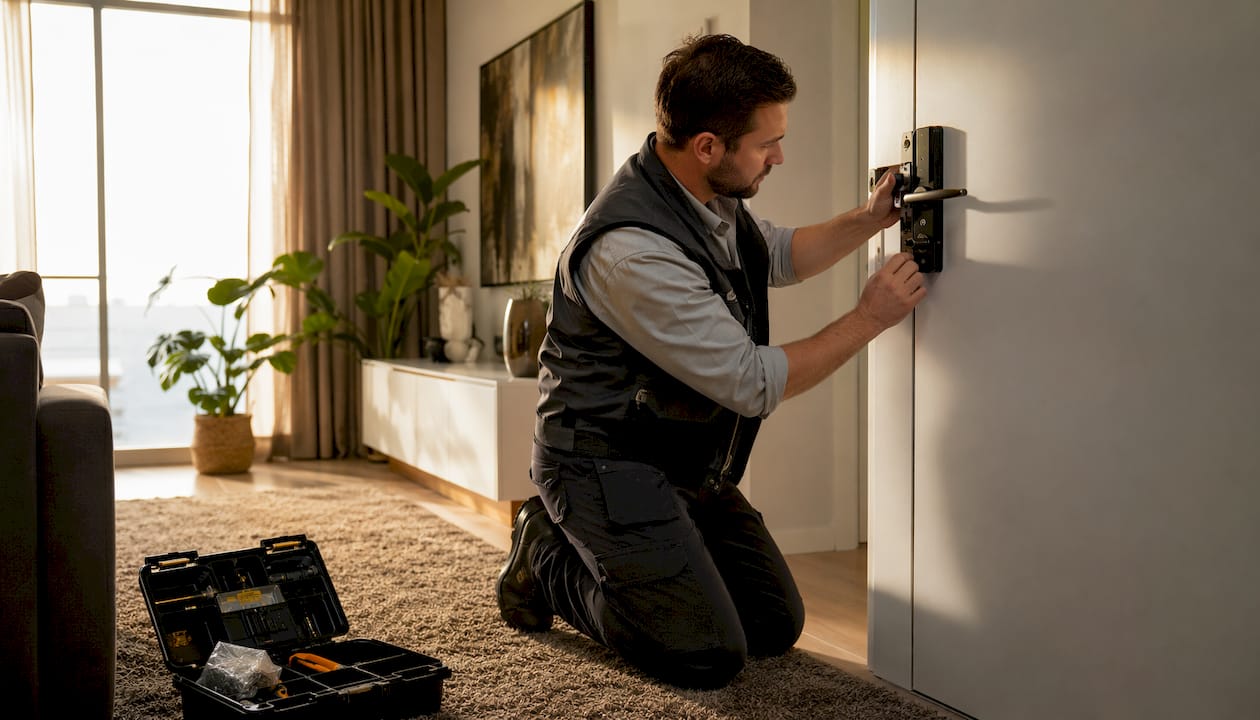
Sequence your investments: start with smart locks and cameras (high impact, moderate cost), then lighting, then access control for common areas. Safes and in-unit storage upgrades make sense once the perimeter is covered, or as a specific add-on for commercial tenants.
How do you implement security upgrades without disrupting tenants?
A phased approach keeps residents informed and minimizes friction.
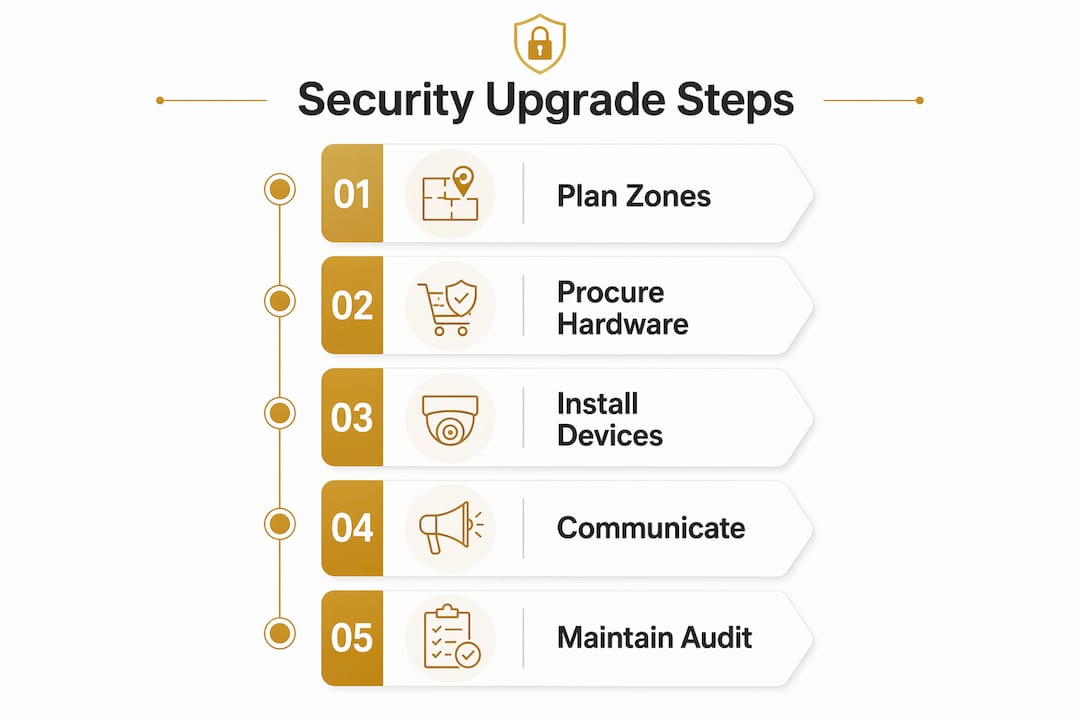
Plan and specify
Define coverage zones before buying anything. Map camera fields of view, identify access control chokepoints, and confirm power and network availability at each location. Check local ordinances on camera placement early.
Procure and contract
Source professional-grade hardware with documented warranties and firmware support. Verify that vendors provide installation documentation, coverage maps, and monitoring contracts, since commercial tenants request 24–36 months of incident history and active monitoring logs during lease renewals.
Install and commission
Stage installations building-by-building or floor-by-floor to limit disruption. After installation, verify camera coverage against your map, confirm active monitoring is live, and test all access credentials. Keep a commissioning log.
Communicate to tenants
Send a written notice before work begins: what is being installed, where, why, and how it affects daily access. Follow up with a brief guide on using new smart lock credentials or access apps. Transparency reduces complaints and builds goodwill.
Maintain and audit
Schedule quarterly firmware updates, annual credential audits, and periodic camera-coverage reviews. Treat smart devices like any other building system: they require lifecycle management to stay effective. Review security best practices for property managers for a full maintenance checklist.
Pro Tip: Run a pilot on one building or one floor before a full rollout. A small-batch trial surfaces installation surprises, credential workflow issues, and tenant questions before they become property-wide problems.
What are the U.S. privacy and legal rules for property security cameras?
Getting the hardware right is only half the job. Deployment that violates tenant privacy or state law creates liability that can cost more than the upgrade itself.
Camera placement rules:
- Cameras are generally permitted in common areas: lobbies, hallways, parking lots, laundry rooms, and building exteriors.
- Never place cameras inside private living spaces, bathrooms, or anywhere with a reasonable expectation of privacy.
- Be cautious with angles that look directly into unit windows or private outdoor spaces.
Lease and operational checklist:
- Disclose all surveillance systems in the lease agreement, including locations and data retention periods.
- State your access control policy: who holds credentials, how they are revoked, and how lost credentials are handled.
- Define data retention limits (30–90 days is common) and document them.
- Establish an incident-reporting procedure and share it with tenants.
- Post visible signage at camera locations.
Cybersecurity hygiene for smart devices:
- Encrypt all device feeds and store footage on a secured, access-controlled system.
- Rotate admin credentials at least annually and immediately after any staff change.
- Keep all device firmware current; run smart devices on a separate IoT network segment.
- Have a breach response plan in writing before you need it.
Per industry guidance on mixed-use security deployments, tenant education on phishing and credential hygiene reduces the risk of smart access systems being compromised from the inside.
This article is general information, not legal advice. Confirm camera placement rules and disclosure requirements with a qualified attorney or your state’s landlord-tenant authority for your specific property.
How do you measure whether security is actually improving retention?
Track these KPIs before and after any upgrade:
- Renewal rate (primary metric): percentage of leases renewed at expiration
- Turnover frequency: number of unit turns per year
- Incident rate: reported security incidents per 1,000 unit-years
- Vacancy days: average days vacant per turn
- Tenant-reported safety score: from a brief survey (see below)
Measurement plan: Establish a baseline for 6 months before the upgrade. If your property is large enough, run a pilot group (upgraded units) against a control group (not yet upgraded) for 6–12 months. Compare renewal rates and vacancy days between groups.
Sample survey questions (3–5, pre- and post-upgrade):
- How safe do you feel in your unit? (1–5 scale)
- How safe do you feel in building common areas? (1–5 scale)
- How satisfied are you with building security overall? (1–5 scale)
- Has building security influenced your decision to renew? (Yes / No / Unsure)
A directional improvement in renewal rate combined with fewer vacancy days is sufficient to estimate ROI without advanced analytics. Divide avoided turnover cost by total upgrade cost for a simple payback ratio.
A realistic example: what a targeted security package looks like
Property: 48-unit mid-rise apartment building, suburban market. Package: Smart locks on all unit doors, 12-camera exterior and lobby system with cloud storage and mobile alerts, upgraded parking lot lighting. Investment: Approximately $28,000 installed. Rollout: 6 weeks from procurement to full commissioning; tenant communication sent 2 weeks before installation. Measured outcome (12 months post-install): Renewal rate increased from 61% to 74%. Average vacancy days per turn dropped from 38 to 22.
ROI summary: At $2,800 per avoided turn and 6 additional renewals, avoided turnover cost totaled roughly $16,800 in year one, with ongoing benefit in subsequent years.
What went well: the pilot on one floor caught a credential-enrollment workflow issue before it hit all 48 units. The tenant communication letter, sent in advance, generated zero complaints during installation.
One lesson learned: two exterior cameras had blind spots in the parking structure. A coverage-map review before final sign-off would have caught this. Documenting camera coverage maps from day one is worth the extra hour.
Key Takeaways
Security upgrades produce measurable retention gains when you prioritize smart locks and monitored cameras, communicate clearly with tenants, and track renewal rate and vacancy days as your primary ROI metrics.
| Point | Details |
|---|---|
| Start with smart locks and cameras | These two upgrades have the highest impact on renewal probability and the fastest payback from avoided turnover costs. |
| Pilot before full rollout | A single-floor or single-building trial surfaces credential and installation issues before they scale. |
| Track renewal rate and vacancy days | These two metrics give you a clear, simple read on whether security investment is paying off. |
| Address the perception gap | Managers underestimate safety as a controllable retention driver; fixing it is a competitive advantage most peers ignore. |
| Safes and Security Solutions | Offers professional-grade safes, surveillance systems, and smart security hardware suited to both residential and commercial property upgrades. |
The case for treating security as a retention system, not a line item
Most property owners think about security reactively: something goes wrong, they add a camera. The 2026 data argues for the opposite approach. Renters are making renewal decisions partly on whether they feel protected, and managers who treat security as a building system, with procurement specs, commissioning standards, maintenance schedules, and tenant communication, consistently outperform those who treat it as a one-time expense.
The other thing worth saying plainly: the perception gap in the Zego data is an opportunity. If your competitors are still attributing churn to uncontrollable factors while you are fixing controllable ones, you will retain more tenants and spend less doing it. Smart locks, monitored cameras, and professional-grade safes for high-value tenants are not luxury amenities at this point. They are table stakes for any property competing for quality, long-term residents.
What Safes and Security Solutions offers property managers and owners
Property managers sourcing hardware for a security upgrade need products that are specified, warrantied, and built for continuous use, not consumer-grade equipment that fails under 24/7 load.
Safes and Security Solutions carries the full range of hardware covered in this guide: professional surveillance camera systems with cloud storage and mobile alerts, burglary and fire-resistant safes for in-unit and commercial use, vault doors for high-value storage applications, and smart security equipment suited to both residential and commercial properties. Product listings include detailed specifications, so you can match hardware to your coverage requirements before purchasing.
If you are ready to move from strategy to procurement, browse the full product catalog at Safes and Security Solutions or contact the team directly for specification support and warranty details.
Selected sources and further reading
- 2025 Rently Smart Apartment Trends Report — Primary source for smart security preference data, renewal likelihood statistics, and lease-length willingness figures cited throughout this article.
- 2026 Resident Experience Management Report, Zego — Source for the manager-resident perception gap and controllable non-renewal drivers.
- Parks Associates: Half of Apartment Residents Worried About Community Safety — U.S. household study on renter demand for smart amenities and access control.
- Multi-Tenant Commercial Real Estate Security: Standards, Liability & Tenant Value, DSP — Covers commercial tenant due diligence, incident documentation standards, and monitoring protocols.
- How Security Helps Keep Commercial Tenants Happy, Gerst Property Management — NOI stability and turnover-cost avoidance framing; visible security and proactive monitoring guidance.
- Improving Tenant Retention with Security Measures in Mixed-Use Developments — Cybersecurity hygiene for IoT devices and tenant education best practices.
- Asset Managers Tie Property Security to Long-term Performance, HousingWire — Industry perspective on security as a long-term asset performance driver; coded entry and video intercom retention data.
Recommended
- Top security best practices for property managers 2026 – Safes and Security Direct
- Why prioritize security in 2026: protect what matters – Safes and Security Direct
- Home security best practices: protect property in 2026 – Safes and Security Direct
- Industry Security Best Practices: Protect Property and Reduce Risk – Safes and Security Direct