

Protecting Physical Financial Ledgers: Home & Business Guide
TL;DR:
- Proper protection of irreplaceable documents involves anchoring fire-rated safes and maintaining off-site encrypted backups. Implementing access controls and regular reviews reduces risks from fire, theft, and aging. These practices form a layered system to safeguard financial ledgers effectively.
Keep irreplaceable originals in a bolted, fire- and water-rated safe, maintain encrypted offline or off-site backups, and apply basic access controls with a written disaster plan. That three-part formula covers the vast majority of risk for U.S. homes and small businesses.
Your highest-priority actions this week:
- Anchor a rated safe. Choose a model with a UL 72 fire rating and bolt it to concrete or a floor joist.
- Scan and encrypt copies. Create encrypted digital scans of every irreplaceable ledger and store them on a drive kept off-site or in a zero-knowledge encrypted cloud.
- Build a grab-and-go folder. Assemble a thin, clearly labeled folder of the most critical originals you might need to evacuate with in an emergency.
These steps align with ISO 22388:2023 guidance on document classification and risk-based physical controls, UL 72 fire-rating standards for document safes, and NFPA fire-safety principles for building and storage design.
Table of Contents
- What you should do this week: a prioritized checklist
- How to assess risk and classify your financial ledgers
- Physical storage options and when each one fits
- Protecting ledgers from humidity, pests, and aging
- Access control and chain of custody for financial records
- Prepare for fire, flood, and theft with a redundancy plan
- Standards and U.S. compliance considerations
- Key specs to compare when buying a safe for ledgers
- Safe installation and maintenance schedule
- When professional vaults or safe-deposit boxes make more sense
- Key Takeaways
- The case for treating your ledgers like infrastructure
- Safes and Security Solutions has the right safe for every document tier
- Useful sources and further reading
What you should do this week: a prioritized checklist
Priority A — Do these now:
- Anchor or purchase a fire- and water-rated safe rated to UL 72 standards; bolt it to the floor or wall.
- Scan every irreplaceable ledger; encrypt the files and store them on a physical drive kept off-site or with a trusted contact.
- Apply the 3-2-1 backup rule: keep originals and copies distributed across local and off-site storage locations.
Priority B — Complete this month:
- Assemble and label a grab-and-go folder with your most critical originals.
- Index the safe’s contents and photograph them for insurance purposes.
- Confirm your homeowner’s or business insurance covers physical document loss and note the claim procedure.
Priority C — Review quarterly:
- Test safe access and verify lock batteries or mechanical function.
- Rotate off-site backups and confirm the encrypted copies are readable.
- Update your emergency contact list for anyone authorized to access documents on your behalf.
How to assess risk and classify your financial ledgers
Start by listing every document category you hold, then score each one on two axes: how likely is it to be threatened (fire, flood, theft, pests, or simple aging), and how badly would losing it disrupt your finances or legal standing?
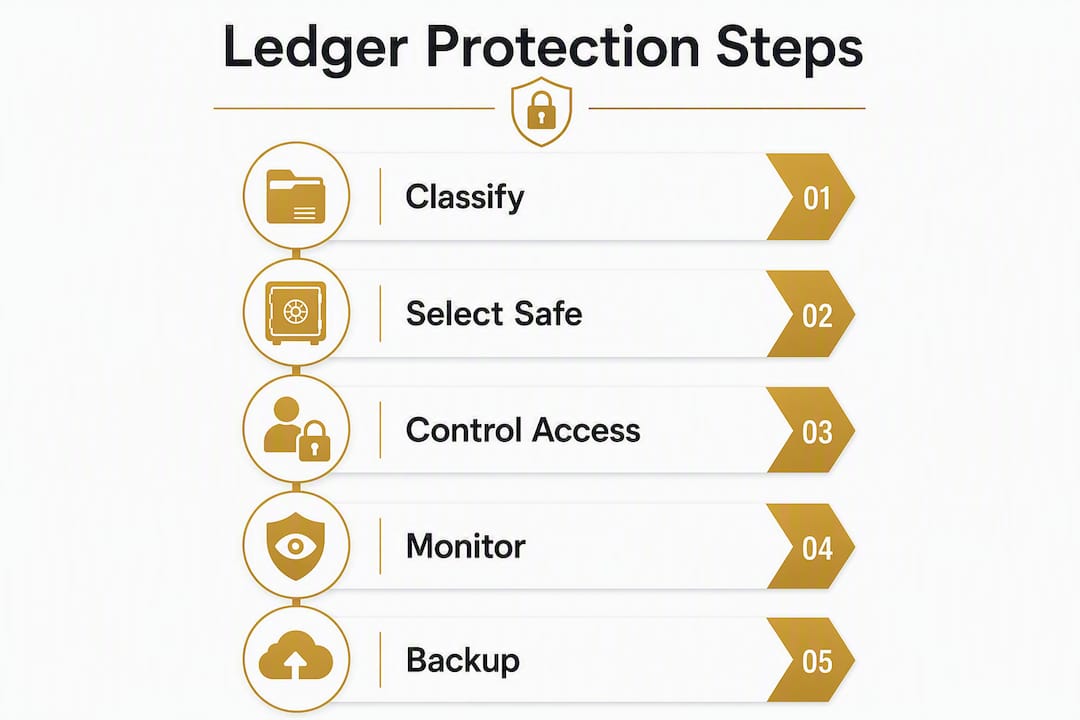
Quick risk-assessment template:
| Asset | Threat | Likelihood | Impact | Mitigation |
|---|---|---|---|---|
| Original tax returns | Fire / flood | Medium | High | Rated safe + encrypted off-site copy |
| Partnership ledger originals | Theft | Medium | Critical | Bolted safe + access log |
| Reconstructible bank statements | Aging | Low | Low | Acid-free folder, archivable copy |
Document sensitivity tiers:
| Tier | Examples | Recommended storage |
|---|---|---|
| Irreplaceable originals | Partnership agreements, estate ledgers, signed originals | Bolted fire/water-rated safe; off-site vault for low-access items |
| Critical operational records | Tax returns (IRS retention), payroll records, contracts | Fire-rated filing cabinet or safe; encrypted off-site backup |
| Reconstructible records | Bank statements, routine invoices | Acid-free folders in a locked cabinet; digital backup sufficient |
The ISO 22388:2023 framework formalizes exactly this kind of tiered classification, pairing each document class with proportionate physical controls and risk-mitigation strategies.
Physical storage options and when each one fits
The right storage depends on how often you need access, how irreplaceable the document is, and whether legal or regulatory requirements apply.
- Bolted fire- and water-rated home safe: Best for irreplaceable originals you may need quickly. Look for UL 72 certification and a water-resistance rating. This is the primary solution for most households and small businesses.
- Fireproof filing cabinets: Practical for high-volume operational records where you need frequent access. Fireproof filing cabinets offer drawer-level organization without sacrificing fire protection.
- In-floor safes: Excellent concealment and burglary resistance; less convenient for daily access and can be vulnerable to flooding if not properly sealed.
- Bank safe-deposit boxes: Useful for low-access originals, but not FDIC-insured and potentially inaccessible during bank hours or administrative holds.
- Professional off-site vaults: Best for high-value corporate ledgers or regulated records requiring audited chain of custody. Some providers store documents on physically disconnected storage for identity-locked retrieval, which eliminates cloud-compromise risk entirely.
For most U.S. households and small businesses, a bolted, fire- and water-rated safe handles day-to-day protection. Bank vaults and professional off-site storage make sense as a complement, not a replacement, for low-access originals.

Protecting ledgers from humidity, pests, and aging
A fire-rated safe keeps paper intact through a blaze, but humidity, insects, and acid degradation can destroy the same documents over years without any dramatic event.
- Acid-free folders and buffered paper: Store paper ledgers in acid-free folders; buffered paper slows chemical degradation significantly.
- Mylar sleeves: Use polyester (Mylar) sleeves for documents you handle frequently. They resist moisture and physical wear without the irreversibility of lamination.
- Silica gel packs: Place desiccant packs inside the safe and replace them every six months. Target internal relative humidity below 50% and temperature below 70°F for paper longevity.
- Lamination caution: Never laminate legal originals that carry signatures, notary seals, or embossing. Lamination is permanent and can render a document legally invalid for re-signing or authentication.
Pro Tip: Store paper ledgers and digital media (USB drives, external hard drives) in separate containers inside the safe. Document safes keep internal temps below roughly 350°F, which protects paper but can destroy digital media that requires temperatures below 125°F to survive.
Access control and chain of custody for financial records
Physical security controls, including locked storage, limited access, and documented custody, are the FTC’s baseline recommendation for preventing data exposure from paper files.
- Need-to-know access: Only individuals with a documented business reason should have the combination or key. Review the list annually.
- Two-person rule: For the most sensitive ledgers, require two authorized people to be present when the safe is opened.
- Access log: Keep a simple written or electronic log: date, time, person, and purpose. This creates an auditable trail and deters casual misuse.
- Tamper evidence: Use numbered tamper-evident bags or seals on envelopes containing critical originals. A broken seal is immediately visible and documents unauthorized access.
- Monitoring: Pair your safe with a camera covering the storage area or integrate with a local alarm system. Electronic locks with audit-capable memory let you review access history without a separate log.
Prepare for fire, flood, and theft with a redundancy plan
Experts recommend a layered approach: rated safe on-site, physically disconnected off-site backups, and separate digital backups. No single container survives every scenario.
Disaster playbook:
- Immediate: Confirm everyone is safe. Do not re-enter a fire-damaged building to retrieve documents.
- Within 24 hours: Contact your insurer and notify your CPA or attorney that originals may be lost.
- Retrieve off-site copies: Access your encrypted off-site drive or cloud backup from a secondary location.
- Prioritize recovery: Start with tax records, legal agreements, and anything with a statutory retention requirement.
- Document the loss: Photograph damage and file a police report if theft is involved.
Off-site options:
- Encrypted cloud storage with zero-knowledge encryption (you hold the only key)
- A trusted relative or attorney holding a sealed, labeled envelope with copies
- A bank safe-deposit box (note the access limitations discussed above)
- A professional vault service using physically disconnected storage
Refresh off-site copies at least quarterly. Test restoration from your encrypted backup at least once a year to confirm the files are readable.
Standards and U.S. compliance considerations
Three standards and frameworks matter most for physical ledger security in the United States.
- ISO 22388:2023: Provides a structured framework for securing physical documents through risk assessment, document classification, and tailored physical controls.
- UL 72: The Underwriters Laboratories standard for fire-rated document safes. Look for a UL 72 Class 350 rating, which means internal temperature stays below 350°F during a rated fire duration.
- NFPA guidance: NFPA codes inform building fire-safety design and storage placement; consult your local fire authority for jurisdiction-specific requirements.
Check with your CPA for document retention schedules (the IRS generally requires tax records for at least three years, and up to seven for certain situations). Confirm with your insurer what documentation they require to process a claim for physical document loss.
Key specs to compare when buying a safe for ledgers
Buying on price alone is the most common mistake. These specs determine whether a safe actually protects your ledgers.
- Fire rating: Minutes of protection and maximum internal temperature. UL 72 Class 350 is the minimum for paper; Class 125 is required if you also store digital media.
- Water resistance: Look for a tested water-resistance rating, not just a marketing claim. Many fire-rated safes are not waterproof.
- Burglary rating: UL TL-15 or TL-30 ratings indicate tool-resistant construction. A basic RSC (Residential Security Container) rating is the minimum for home use.
- Lock type: Electronic locks offer audit trails; mechanical locks have no battery dependency. High-security models offer both.
- Internal capacity: Measure your current document volume and add 30% for growth. Shelving and adjustable dividers matter for organization.
- Anchoring provisions: Confirm the safe has pre-drilled anchor holes and that the weight is appropriate for your floor type.
Insurance considerations: many insurers require a UL-rated safe to honor a claim for document or cash loss. Keep the purchase receipt and the safe’s rating certificate with your policy documents.
Safe installation and maintenance schedule
Installation done wrong negates the rating. A safe that tips over or floods from below offers far less protection than its spec sheet suggests.
- Anchoring: Bolt to a concrete slab with lag anchors or to a timber floor through the subfloor. A safe that isn’t anchored can be carried out in minutes.
- Placement: Keep the safe away from exterior walls prone to flooding and away from areas where a fire would concentrate heat fastest (kitchens, utility rooms). Door swing clearance matters for daily usability.
- Concealment: A safe in a closet or behind furniture is harder to locate quickly during a burglary.
Annual maintenance schedule:
| Task | Frequency | Notes |
|---|---|---|
| Test lock and door seal | Annually | Check for stiffness, corrosion, or seal degradation |
| Replace electronic lock batteries | Every 1–2 years | Don’t wait for a low-battery warning |
| Refresh silica gel desiccant | Every six months | Replace or recharge packs |
| Inspect anchor bolts | Annually | Tighten if loose; check for floor movement |
| Verify tamper-evidence seals | Quarterly | Replace any broken or missing seals |
| Review and update contents index | Annually or after life events | Marriage, new property, business changes |
Call a certified safe technician if the lock mechanism feels stiff, the door no longer seals flush, or the electronic keypad gives inconsistent responses.
When professional vaults or safe-deposit boxes make more sense
On-site safes handle most scenarios, but some situations call for off-site professional storage.
Scenarios where off-site storage is the better call:
- Infrequently accessed irreplaceable originals: Partnership agreements or estate documents you access once a decade belong in a professional vault or safe-deposit box, not a home safe you open weekly.
- Regulated business records: Certain industries (healthcare, legal, financial services) face retention and custody requirements that a professional vault with audited chain-of-custody satisfies more cleanly.
- High-value corporate ledgers: When a ledger’s loss would trigger a legal or financial crisis, audited off-site custody adds a layer of accountability a home safe cannot.
Pros and cons of safe-deposit boxes:
- Pro: Low annual cost, physical bank security, useful for rarely accessed originals.
- Con: Not FDIC-insured. In many states, a box may be temporarily sealed when the sole owner dies, which can delay access to wills or time-sensitive directives. Inaccessible outside bank hours.
Red flags to watch for: A sole-owner safe-deposit box holding a will is a common estate-planning mistake. If the box is sealed at death, the very document needed to open it may be locked inside. Store wills and healthcare directives with your attorney or in a safe for legal documents at home.
Key Takeaways
The most effective strategy for protecting physical financial ledgers combines a bolted, fire- and water-rated safe on-site with encrypted off-site backups and documented access controls.
| Point | Details |
|---|---|
| Tier your documents first | Classify records as irreplaceable, critical, or reconstructible before choosing storage. |
| Anchor a UL 72-rated safe | Fire and water ratings only matter if the safe is bolted down and properly installed. |
| Apply the 3-2-1 backup rule | Keep one original at home, one local digital copy, and one encrypted copy off-site. |
| Check retention and insurance | Confirm IRS retention schedules with your CPA and document-loss coverage with your insurer. |
| Safes and Security Solutions | Offers fire- and water-rated document safes, fireproof filing cabinets, and in-floor safes for every protection tier. |
The case for treating your ledgers like infrastructure
Most people think about document security once, after a loss. The problem with that approach is obvious in hindsight. What gets overlooked is that protecting physical financial ledgers is not a one-time purchase decision. It’s an ongoing system: classification, storage, access control, redundancy, and annual review working together.
The conventional wisdom says “buy a fireproof safe.” That’s not wrong, but it’s incomplete. A safe that isn’t anchored is a portable box. A safe without an off-site backup fails the moment a flood takes out the whole floor. And a safe nobody else can access in an emergency is a liability, not an asset.
The standard worth holding yourself to is ISO 22388:2023: classify first, then match the physical control to the sensitivity of the document. That sequence matters. Most people do it backward, buying a safe and then deciding what goes in it.
Safes and Security Solutions has the right safe for every document tier
When your ledgers are irreplaceable, the safe holding them should be rated, anchored, and chosen with the right specs for paper and media alike. Safes and Security Solutions carries fire- and water-rated document safes, fireproof filing cabinets, in-floor safes, and professional vault doors, all with detailed specifications so you can match the product to your protection tier.
Every product listing includes fire-rating details, burglary-resistance ratings, and capacity specs. Browse the full range at Safes and Security Solutions and find the model that fits your home or business, or contact the team to discuss installation options and get a quote.
Useful sources and further reading
- ISO 22388:2023 — Guidelines for securing physical documents
- UL 72 — Standard for Tests for Fire Resistance of Record Protection Equipment
- NFPA — National Fire Protection Association codes and standards
- FTC Physical Security guidance for small businesses
- IRS Publication 1075 — Federal Tax Information safeguarding requirements
- IRA for Gold — Protecting physical financial records at home
For jurisdiction-specific document retention schedules, insurance claim procedures, and building code requirements, consult your CPA, legal counsel, or local fire authority. Rules vary by state and business type, and the guidance above is general information, not professional advice.
Recommended
- Asset protection checklist 2026: secure home and business – Safes and Security Direct
- Physical Security for SMEs: Protecting Assets and Growth – Safes and Security Direct
- How to secure property effectively: A practical guide – Safes and Security Direct
- Business Money Safety: Use Money Drop Safes – Safes and Security Direct