

Protecting Depositions and Case Files: A Law Firm Playbook
TL;DR:
- Layered security controls, including encryption, MFA, and physical safes, are essential for protecting depositions and case files. Law firms must implement defense-in-depth strategies, vet vendors thoroughly, and follow regulation-driven offline storage practices for highly sensitive materials. Immediate steps include auditing access, enforcing MFA, and using UL/ETL-rated safes to mitigate risks.
The fastest way to protect depositions and case files is to layer six controls in order: designate a single encrypted system of record, enforce MFA and least-privilege access, encrypt all data in transit and at rest (AES-256 minimum), vet every vendor for SOC 2 or ISO 27001 evidence, store physical originals in a UL/ETL-rated fire- and burglary-rated safe, and maintain a written incident response plan with defined notification timelines. ABA Model Rule 1.1 makes digital and physical competence an ethical obligation, not a best practice. NIST SP 800-series frameworks give you the technical baseline. Safes and Security Solutions covers the physical layer.
Start here today:
- Audit who has access to your deposition platform and revoke anyone who no longer needs it.
- Enable MFA on every account that touches case files.
- Confirm your vendor can produce a SOC 2 Type II report on request.
Table of Contents
- 1. Build a defense-in-depth framework for your case files
- 2. How to protect physical transcripts, exhibits, and storage media
- 3. Technical controls every legal team must enforce
- 4. What to require from court reporters and remote-deposition vendors
- 5. Ethical duties and regulatory obligations you cannot ignore
- 6. Incident response when deposition files are compromised
- 7. Rollout plan and cost considerations for your firm
- 8. Recommended physical solutions for law offices
- Key Takeaways
- Why law firms can’t afford to wait on this
- Safes and Security Solutions: physical security for your case files
- Useful sources and standards for further reading
1. Build a defense-in-depth framework for your case files
No single control stops every threat. Defense-in-depth pairs digital and physical protections so that a failure in one layer does not expose everything else. Law firms that focus only on cybersecurity routinely leave physical transcripts, USB drives, and printed exhibits unprotected.
Organize your controls by layer:
Tier 1 (implement this week): Written access policy, MFA on all accounts, single system of record for deposition files, and a fire-rated safe for physical originals.
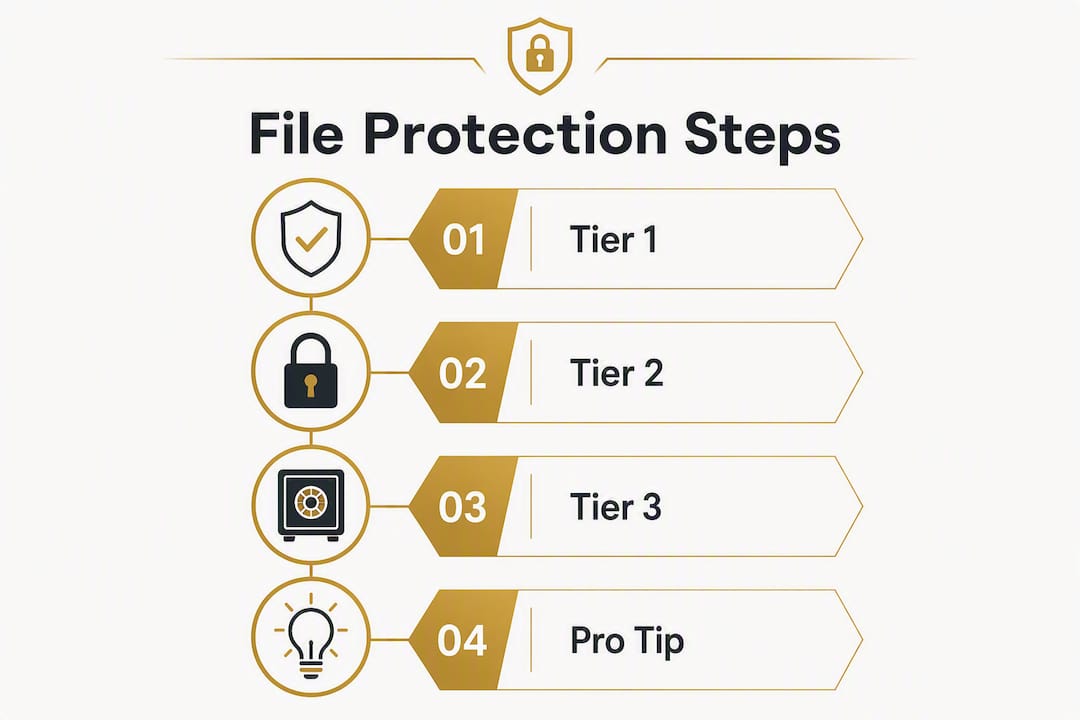
Tier 2 (within a few months): Role-based permissions, audit log exports, encrypted backup drives, vendor security attestations, and tamper-evident storage for removable media.
Tier 3 (ongoing): Annual penetration testing, scheduled vulnerability scans, business continuity drills, and periodic vendor re-vetting.
Pro Tip: The insider threat is where single-layer security collapses fastest. Combining least-privilege access controls with a locked, rated safe means a rogue employee cannot walk out with physical originals even if they have digital access.
2. How to protect physical transcripts, exhibits, and storage media
Original transcripts, printed exhibits, and video drives need fire-rated and burglary-resistant storage. A standard locking cabinet offers no meaningful fire protection; paper ignites at 451°F and most office fires exceed that within minutes.
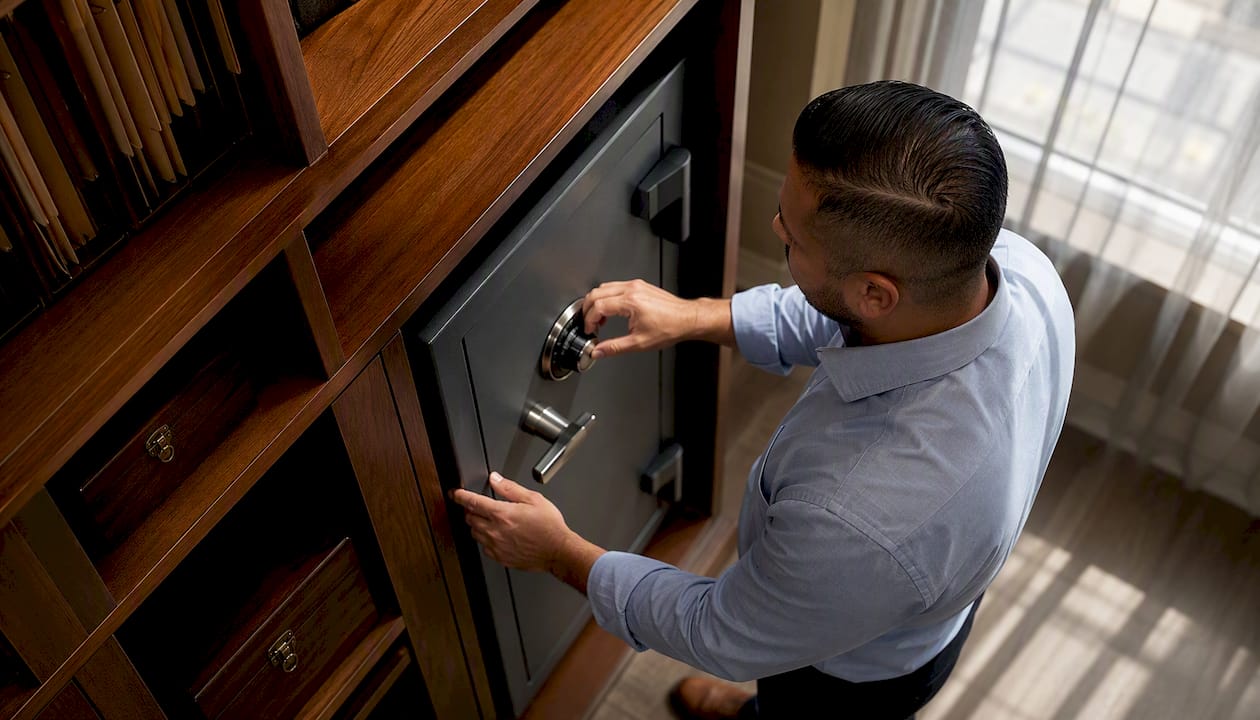
Look for UL or ETL fire ratings with at least a one-hour fire rating for document storage, and UL Residential Security Container (RSC) or higher for burglary resistance. In-floor safes are harder to remove physically; wall safes work for smaller media. A fire-resistant filing cabinet suits high-volume transcript storage where you need frequent access.
| Asset Type | Minimum Protection | Recommended Storage |
|---|---|---|
| Original transcripts | UL/ETL 1-hour fire rating | Fire-resistant filing cabinet or fireproof safe |
| Video/audio drives | UL/ETL 1-hour fire + RSC burglary | Burglary-rated fireproof safe |
| Physical exhibits | UL/ETL 1-hour fire rating | Fireproof safe or locked evidence cabinet |
Chain-of-custody template (copy into vendor instructions):
- Document name / exhibit number
- Date and time of transfer
- Transferring party (name, role)
- Receiving party (name, role)
- Storage location after transfer
- Signature of both parties
For secure transport between offices, use tamper-evident packaging and a tracked courier. Secure document transportation practices recommend sealed, labeled containers with a signed receipt at each handoff.
3. Technical controls every legal team must enforce
Encryption in transit and at rest, MFA, and auditable access logs are the three controls that stop the widest range of attacks. Configure them before anything else.
Minimum configuration checklist:
- encryption standard equivalent to AES-256 for stored files and backups
- MFA on every account: attorneys, paralegals, vendors, and co-counsel
- SSO where your platform supports it
- Least-privilege roles: read-only for experts and co-counsel, edit only for assigned staff
- Time-bound, expiring share links; disable “anyone with link” access
- Legal-hold flags on active matter files
- Device management rules: no deposition files on unmanaged personal devices
For safe sharing workflows, use your system of record rather than email attachments. Send expiring, view-only links to experts and co-counsel. Revoke access the moment a matter closes or a party’s role ends.
For Highly Sensitive Documents, federal court guidance requires offline storage on an air-gapped system. True air-gapping means physical disconnection from all networks, including your office LAN. Transfers use dedicated, encrypted physical media only.
Pro Tip: Export audit logs on a scheduled basis (weekly or monthly) and store them separately from the system they log. If your platform is compromised, you still have an independent record of who accessed what and when.
Numbered implementation steps for secure sharing:
- Upload deposition recordings and transcripts to your designated system of record only.
- Generate an expiring, view-only link for each recipient.
- Log the recipient, link expiration date, and access purpose.
- Revoke the link immediately after the recipient’s task is complete.
- Confirm deletion from any recipient’s local device per your protective order terms.
4. What to require from court reporters and remote-deposition vendors
Vendor vetting must go beyond price. A court reporter or remote-deposition platform that cannot produce a SOC 2 Type II report or equivalent evidence of controls is a liability, regardless of how competitive their rates are.
Demand these before signing any vendor agreement:
- SOC 2 Type II report or ISO 27001 certification (current, not expired)
- Written disclosure of encryption standards (encryption standards equivalent to AES-256)
- MFA enforcement for all vendor-side accounts
- Granular audit logs exportable on request
- Breach history disclosure for the past three years
- Written data destruction confirmation at retention end
- Limits on downstream sharing and sub-processor access
Federal MDL pretrial orders require vendors to implement virtual waiting rooms, disable unauthorized recording, and confirm participant lists in advance. Build those requirements into your vendor contract, not just your deposition checklist.
Pro Tip: Ask vendors for evidence of penetration testing or third-party security audits, not just self-attestation. A vendor who cannot produce a recent audit report has likely not had one.
5. Ethical duties and regulatory obligations you cannot ignore
Lawyers’ ethical duties now explicitly cover digital and physical protections for client materials. ABA Model Rule 1.1’s Duty of Competence requires attorneys to understand the technology they use to handle client data. That means knowing whether your deposition platform encrypts recordings, who can access transcripts, and whether your physical storage meets a reasonable standard of care.
Federal courts have formalized this for the most sensitive materials. HSD guidance from the U.S. Court of International Trade defines Highly Sensitive Documents as materials whose unauthorized disclosure could cause significant consequences, and mandates offline storage outside the court’s electronic filing system. The U.S. Court of Appeals for the D.C. Circuit updated its HSD procedures in April 2024 to require paper filing or encrypted USB submission for qualifying materials.
Minimum compliance actions:
- Classify every matter’s documents at intake (standard, confidential, HSD).
- Document your classification decisions and store that record with the file.
- Retain proof of every migration, transfer, and destruction event.
- Honor protective order terms in your storage and sharing workflows from day one.
- For HSDs, use air-gapped offline storage and encrypted physical media transfers only.
6. Incident response when deposition files are compromised
Contain first, investigate second. The moment you suspect unauthorized access to deposition recordings or case files, isolate the affected system, preserve logs, and revoke access before doing anything else.
| Timeframe | Actions |
|---|---|
| Initial hours | Isolate affected systems; preserve all access logs; revoke credentials; secure physical media; notify lead counsel and firm leadership |
| Several days | Engage IT/security team or outside counsel; assess scope; notify vendor; determine if court notification is required |
| Up to a week | Document findings; prepare client notification if required; review and update IR plan; confirm destruction of any exposed copies |
For physical media compromised by theft or fire, photograph the storage location, document the chain-of-custody gap, and report to firm leadership immediately. If a protective order covers the affected materials, notify opposing counsel and the court per the order’s terms.
7. Rollout plan and cost considerations for your firm
Low-cost policy and configuration changes come first. Hardware purchases and audits follow once the baseline is in place.
- Days 1–30 (low cost): Write and distribute your access control policy; enable MFA on all accounts; designate your system of record; draft vendor security requirements; train staff on secure sharing workflows.
- Days 31–90 (medium cost): Purchase UL/ETL-rated safes and fire-resistant filing cabinets for physical originals; implement role-based permissions; schedule first audit log export; send vendor security questionnaires.
- Days 91–180 (higher investment): Commission a penetration test or vulnerability scan; establish a business continuity drill schedule; re-vet all active vendors; implement surveillance and door sensors for server rooms and file storage areas.
Engage an outside security consultant when your firm handles HSDs, manages large MDL matters, or lacks internal IT capacity to configure and monitor technical controls.
8. Recommended physical solutions for law offices
Choose a safe class based on document sensitivity and your recovery time objective. A one-hour fire rating protects paper transcripts through most office fires; a two-hour rating is worth the added cost for irreplaceable originals or encrypted backup drives.
| Protection Category | Minimum Rating | Best Use in a Law Office |
|---|---|---|
| Fireproof filing cabinet | UL/ETL one-hour fire rating | High-volume transcript and exhibit storage with frequent access |
| Burglary-rated fireproof safe | UL RSC + 1-hour fire | Original transcripts, encrypted backup drives, signed exhibits |
| In-floor safe | UL RSC or higher | Long-term storage of irreplaceable originals; low-frequency access |
| Wall safe | UL RSC | Small media, USB drives, access credentials |
Fireproof filing cabinets suit firms with large transcript volumes. For removable media and backup drives, a burglary-rated fireproof safe is the right call. Bolt floor safes to the subfloor and wall safes to studs; an unanchored safe can be removed in minutes.
Add a door sensor and a basic surveillance camera to any room housing physical case files. Tamper-evident bags for USB drives and portable hard drives give you a visible indicator if media has been accessed between uses.
Key Takeaways
Protecting depositions and case files requires layered controls: encryption and MFA for digital files, UL/ETL-rated safes for physical originals, vetted vendors with SOC 2 evidence, and a written incident response plan tied to ABA Model Rule 1.1 obligations.
| Point | Details |
|---|---|
| Defense-in-depth is mandatory | Combine digital encryption and access controls with physical fire-rated and burglary-resistant storage. |
| Vendor vetting is non-negotiable | Require SOC 2 Type II or ISO 27001 evidence, audit logs, and written destruction confirmation before signing. |
| HSDs require air-gapped storage | Federal court guidance mandates offline, physically disconnected storage for Highly Sensitive Documents. |
| Incident response starts with logs | Preserve audit logs before any other action; they are your chain-of-custody record for the breach itself. |
| Safes and Security Solutions for physical controls | Fire- and burglary-rated safes from Safes and Security Solutions cover the physical layer of your defense-in-depth plan. |
Why law firms can’t afford to wait on this
The gap between what firms think they have covered and what they actually have in place is where most breaches happen. A video drive left in an unlocked drawer, a deposition recording shared via a generic cloud link with no expiration, a vendor who has never been asked for a SOC 2 report: these are not edge cases. They are the norm in practices that treat security as an IT problem rather than a case management problem.
The physical layer gets overlooked most often. Digital controls get attention because vendors market them. Nobody markets the filing cabinet. But a fire that destroys original transcripts or a theft that exposes physical exhibits creates the same client harm as a data breach, and the same ethical exposure under ABA Model Rule 1.1. The firms that get this right treat physical and digital security as one program, not two separate budgets.
Safes and Security Solutions: physical security for your case files
When your defense-in-depth plan calls for fire- and burglary-rated storage, Safes and Security Solutions stocks the hardware to fill that gap. From UL/ETL-rated fireproof safes and burglary-resistant models to fire-resistant filing cabinets built for high-volume document storage, the product range covers every physical protection tier in this playbook.
Browse the full range at Safes and Security Solutions and match your purchase to the ratings and use cases in the selection table above. The team can advise on safe class, fire-hour rating, and placement for law office environments. Every product ships with full specification documentation so you can record the purchase as part of your security program.
What you get:
- Fire- and burglary-rated safes for transcripts, drives, and exhibits
- Fire-resistant filing cabinets for high-volume transcript storage
- Placement and bolting guidance for office environments
- Full product specs for your security program documentation
Useful sources and standards for further reading
The sources below back the specific recommendations in this article. Keep vendor attestation documents and audit log exports alongside these references as part of your case record.
| Source | What it supports |
|---|---|
| HSD Definition and Guidance — U.S. Court of International Trade | Air-gapped offline storage requirement for Highly Sensitive Documents |
| HSD Procedures Update — U.S. Court of Appeals, D.C. Circuit (April 2024) | Paper or encrypted USB filing requirement for HSDs |
| Remote Deposition Guidelines — S.D. Florida Pretrial Order | Vendor security settings, virtual waiting rooms, participant list requirements |
| FRCP Rule 30 — LII / Legal Information Institute | Certification, delivery, and chain-of-custody obligations for depositions |
| Keeping the Record Sealed — Planet Depos | Defense-in-depth, physical safes, vendor transparency, and destruction confirmation |
| Remote Deposition Privacy — GoTranscript | Audit logs, access controls, system-of-record workflows, and vendor checklist items |
Recommended
- How to Protect Office Documents Properly – Safes and Security Direct
- What Safe for Legal Documents Works Best? – Safes and Security Direct
- Asset protection checklist 2026: secure home and business – Safes and Security Direct
- Top asset protection strategies for homeowners & businesses – Safes and Security Direct