

Overnight Document Security Protocol for Offices
The overnight document security protocol comes down to one sequence: clear every desk, lock all paper records and valuables into a rated safe or lockable cabinet, verify the closing checklist, arm the alarm, and log any exception before the last person leaves. The Federal Trade Commission recommends locked storage and limited access as baseline controls for any office handling personal information, and government facilities lean on forms like SF-701 and SF-702 to make that lockup auditable rather than optional. Safes and Security Solutions builds its product guidance around that same discipline.
Run through this tonight:
- Clear desks, in-boxes, and printer trays of anything sensitive.
- Lock removable media and paper files into a designated safe or cabinet.
- Complete a closing checklist modeled on SF-701.
- Log container access on an SF-702-style sheet.
- Arm the intrusion alarm and confirm all doors are secured.
- Note and escalate any exception immediately.
Key Takeaways
An overnight document security protocol works only when rated hardware, closing-hour logging, and staff training operate together every single night.
| Point | Details |
|---|---|
| Run the same checklist nightly | Adapt an SF-701 style closing checklist so the last person out signs off room by room. |
| Match hardware to what you store | Use UL Class 350 fire ratings for paper and B-rate or TL-15/TL-30 burglary ratings for valuables. |
| Log every container | Track safe and cabinet access with an SF-702 style log reviewed weekly by a manager. |
| Control access tightly | Limit keys and combinations to need-to-know staff and change them when someone leaves. |
| Buy hardware built for the job | Safes and Security Direct supplies rated safes, night-deposit boxes, and cabinets sized to this protocol. |
Table of Contents
- How Do You Build an Overnight Closing Checklist?
- Which Hardware Actually Belongs in an Overnight Protocol?
- Who Controls Keys, Combinations, and Closing Logs?
- How Should Documents Travel Overnight?
- How Often Should You Test Locks, Alarms, and Safes?
- Night-Deposit Box, In-Office Safe, or Offsite Storage?
- Physical security is a habit, not a purchase
- Get the Hardware This Protocol Actually Requires
- Frequently Asked Questions
- Sources
How Do You Build an Overnight Closing Checklist?
A written checklist beats memory every time, especially on a Friday when three people are racing to leave. Print it, laminate it, pin it by the exit door employees actually use.
- Clear your workstation. Remove client files, patient records, or cash-handling paperwork from your desk and in/out trays. The UK Ministry of Justice’s guidance on paper security treats an unattended desk as a real exposure, not a minor lapse.
- Secure removable media. Drives, backup tapes, or portable files go into a locked drawer or safe, not a bag left on a chair.
- Lock designated containers. Every safe, filing cabinet, or deposit box gets checked closed and locked, not just “probably fine.”
- Verify night deposit procedures. If cash or checks are involved, confirm the deposit bag is sealed and logged before it leaves the building.
- Complete the closing checklist. Adapt an SF-701 style activity checklist so the last person out signs off on every room, not just their own office.
- Log container activity. Use an SF-702-style sheet to record who opened or closed each safe and when.
- Arm the alarm and confirm perimeter doors. Test that the system actually reports “armed” before walking away.
- Record any exception. A jammed lock or a missing signature gets written down and escalated the same night, not “tomorrow.”
Assign the walkthrough to a designated closer, not “whoever’s still there.” Rotating that job among two or three trained staff members prevents the single point of failure that happens when the one person who knows the routine calls in sick.
Which Hardware Actually Belongs in an Overnight Protocol?
Paper needs a different fire rating than data. A UL Class 350 safe holds internal temperatures below 350°F long enough to keep paper from scorching during a structure fire, while media-rated safes hold a much lower internal temperature because tape and drives ignite at far lower thresholds. Buying a data-rated safe for a filing cabinet full of client contracts is a common, expensive mistake.
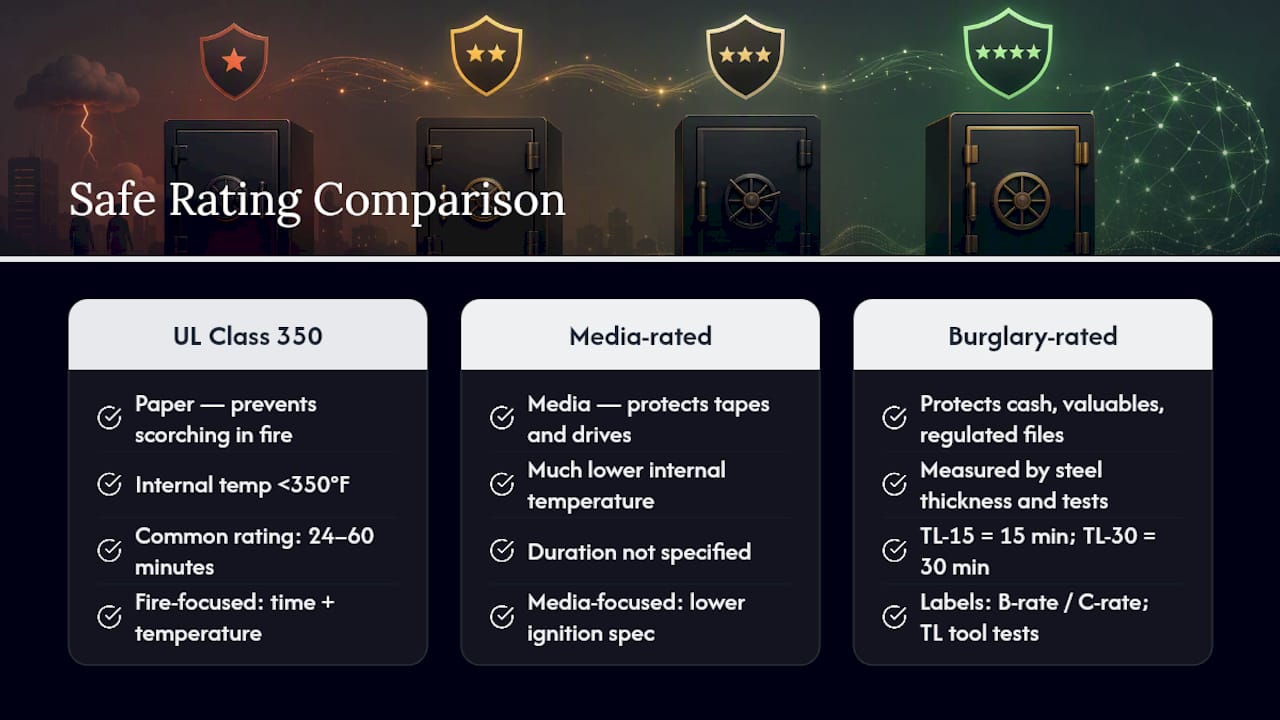
Burglary ratings matter just as much as fire ratings. Commercial-grade safes are often labeled B-rate or C-rate based on steel thickness, and higher-security options carry TL-15 or TL-30 ratings, meaning they resisted specific tool attacks for 15 or 30 minutes in lab testing. A safe with no burglary rating is really just a heavy box. Anchoring matters too: a 300-pound safe that isn’t bolted to the floor can be walked out the door on a hand truck, so check floor load capacity before installing heavy safes on an upper floor.
Access control comes in three flavors. Mechanical combination locks are reliable and need no batteries, but every departing employee who knew the combination is a liability until it’s changed. Electronic keypads solve that with individual audit PINs you can revoke instantly. Biometric locks add a layer for shared offices where multiple people need access without shared codes, though they cost more and need battery backup.
Pro Tip: Position your primary safe near a controlled access point, not in a back corner nobody watches. A safe visible from a supervisor’s desk gets checked far more consistently than one tucked behind the copier.
Quick reference for common office use: a 24 to 60 minute UL Class 350 rating suits most paper records, a B-rate or better commercial body suits cash and valuables, and anything holding regulated client files (legal, medical, pharmacy) should carry both ratings together. A fireproof filing cabinet works well for daily-access paper that doesn’t need burglary-grade protection.
Who Controls Keys, Combinations, and Closing Logs?
Access should run on a need-to-know basis. If four people have a copy of the safe key “just in case,” you don’t have a lock, you have a suggestion.
- Limit combination and key knowledge to staff who need it for their actual job function.
- Change combinations whenever someone with access leaves the company, not on some vague annual schedule.
- Avoid duplicate keys; if one must exist, log where it’s kept and who holds it.
- Assign daily closing-hour inspections to a specific role, and adapt an SF-701-style checklist so that role signs off room by room, per State Department guidance on closing-hour inspections.
- Use an SF-702-style container log for every safe and deposit box, recording time, initials, and any exception.
- Have a manager review logs weekly for patterns, missed signatures, or repeated exceptions.
A clean desk and shredding policy paired with these logs turns overnight security from an occasional scramble into routine behavior. Place shredding consoles where staff naturally pass on their way out, and compliance climbs without anyone needing a reminder email.
How Should Documents Travel Overnight?
Documents that must leave the building overnight need the same rigor as the ones staying locked inside. For daily cash or check deposits, a bank’s night-deposit box with a sealed, logged bag beats carrying funds home in a briefcase. For files going to another office or a client, tracked overnight courier service with signature confirmation creates the chain-of-custody the FTC recommends for sending sensitive information offsite.
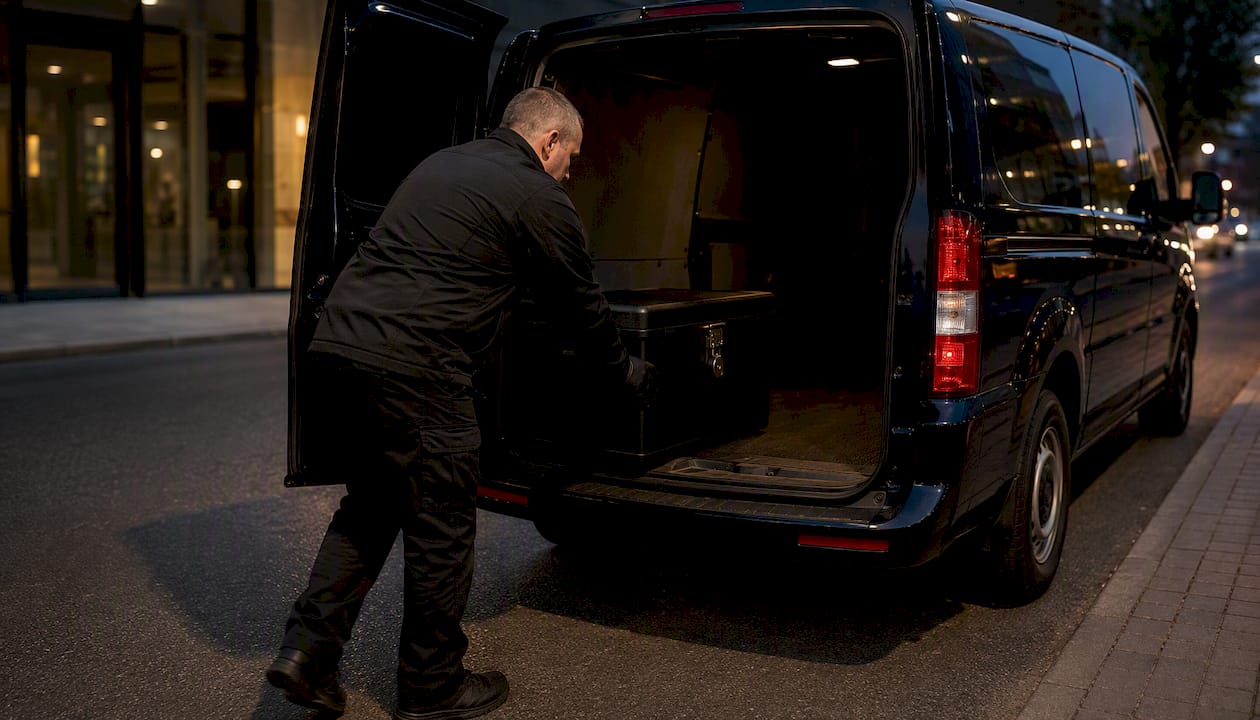
Use unmarked, lockable transport cases rather than a branded tote bag that announces what’s inside. A discreet “Private & Confidential” stamp on the envelope itself, applied with a security-grade stamp, signals handling instructions to whoever receives it without advertising contents to anyone else in transit.
Pro Tip: Keep a simple manifest listing what left the building, who authorized it, and the courier tracking number. Limit shipment authorization to two or three named staff so nobody can improvise an exception at 6 p.m.
How Often Should You Test Locks, Alarms, and Safes?
Hardware fails quietly. A dead alarm battery doesn’t announce itself until the night it matters.
- Nightly: staff run the closing checklist and note anything that felt off, like a lock that stuck.
- Weekly: a supervisor reviews closing logs for skipped steps or recurring exceptions.
- Every 6 to 12 months: have a technician service safe locks, test alarm connectivity, and inspect anchor bolts for tampering or loosening.
- On any failed check: escalate immediately and restrict access to that container until it’s resolved.
Keep maintenance records on file. Insurers and auditors both ask for them eventually.
Night-Deposit Box, In-Office Safe, or Offsite Storage?
The right answer depends on volume, sensitivity, and how often you need access. A law firm holding a handful of active client files overnight needs something different than a retail chain handling nightly cash deposits.
- Low volume, high sensitivity: an in-office safe with SF-702-style logging, like a dedicated safe for legal or client records.
- High volume, daily deposits: a night-deposit box with a sealed bag and manifest, especially for cash-handling retail or medical billing offices.
- Long-term or large-volume storage: offsite secure storage or a vault, once your in-office footprint or floor load can’t support more hardware.
Escalate to offsite storage when the cost of a bigger in-house safe starts to exceed what a contracted vault service charges, or when regulatory retention requirements push volume beyond what any single office safe can hold.
Physical security is a habit, not a purchase
Equipment fails without training behind it. A rated safe with a combination taped to a monitor is not a security protocol, it’s a suggestion. Pair this checklist with periodic audits and a shredding station employees actually use, and the hardware finally does its job.
Get the Hardware This Protocol Actually Requires
You’ve got the checklist. Now you need containers rated for what you’re actually storing, not a generic box from a hardware store aisle. Safes and Security Direct carries the specific product classes this protocol calls for: commercial fireproof safes rated for paper records, night-deposit boxes for daily cash handling, lockable filing cabinets for active client files, and professional CCTV systems that cover your safe and entry points overnight.
If you’re not sure which fire and burglary rating fits your volume of records, start with a fire-resistant filing cabinet for daily-access paper or a dedicated safe for higher-value or regulated files. Browse Safes and Security Direct for full specs, weight and anchoring details, and installation support before you commit to a model.
Frequently Asked Questions
What is the single most important step in an overnight document security protocol? Locking sensitive paper into a rated safe or cabinet before anyone leaves. Everything else, alarms, logs, courier tracking, supports that one action.
Do I need SF-701 and SF-702 if I’m not a government office? No, but adapting their structure works well. They’re free, tested templates for closing checklists and container logs that any office can modify for its own layout.
How often should a commercial safe be serviced? Every 6 to 12 months for lock function, anchor bolts, and signs of tampering, with nightly staff checks and weekly supervisor log reviews in between.
Is a fireproof filing cabinet enough, or do I need a full safe? A fireproof cabinet suits daily-access paper with low burglary risk. Client records, cash, or regulated files usually need a rated safe with both fire and burglary protection.
What happens if an overnight security check reveals a problem? Log the exception immediately, restrict access to the affected container, and escalate to a supervisor that night rather than waiting until morning.
Sources
Adapt these to your own facility rather than copying them wholesale.
- Protecting Personal Information: A Guide for Business | Federal Trade Commission
- 12 FAM 0530 — Security of Classified and Administratively Controlled Material
- The Purge Protocol: How to Implement a Clean Desk and Shredding Policy - MPIGR