

Match 30–120 Minute Fire Ratings to Your Home & Office File Cabinet
A UL Class 350 fire-rated file cabinet is the right call for protecting paper records, rated for 30 minutes, 1 hour, or 2 hours depending on your risk. If you also store flash drives, hard drives, or backup discs, you need a separate UL 125 media rating, since paper and digital media survive fire at very different temperatures. Before buying anything, pull up the spec sheet and confirm both numbers.
TL;DR:
- Most fire-rated cabinets rated for paper need a UL 72 Class 350 certification, which guarantees interior temperatures stay below 350°F during a fire.
- Digital media backups require a separate UL 125 rating, keeping internal temperatures below 125°F to prevent data loss.
- Water resistance claims should be verified by third-party testing like ETL or Intertek, especially since sprinkler and hose exposure are common fire response elements.
- Vertical cabinets save space but limit lateral access; lateral units offer more capacity but require more wall space, while safe-in-a-file combos suit small valuables and irreplaceable documents.
- For accurate protection, match the rating duration and media protection to your actual needs, avoiding overspending on unnecessary commercial-grade solutions.
Table of Contents
- What Fire Ratings Actually Mean (And Why Most Buyers Get Them Wrong)
- Vertical, Lateral, or Safe-in-a-File: Which Format Fits?
- How Do You Choose the Right Fire Safe Cabinet?
- Where You Put It Matters as Much as What You Buy
- Why Safes and Security Solutions Is Worth Checking Before You Buy Elsewhere
- How Much Space Do You Actually Need Inside?
- What Should You Expect to Pay?
- The Fireproof Myths That Cost People Their Records
- Editorial Take: The Rating Question Everyone Skips
- Ready to Buy? Here’s the Fastest Path
- Standards and Resources Worth Bookmarking
- Sources
- FAQ
What Fire Ratings Actually Mean (And Why Most Buyers Get Them Wrong)
The number on a file cabinet’s spec sheet is not marketing fluff. It’s a lab-tested guarantee about internal temperature during a specific fire exposure, and it’s the single most important thing to check before you buy.
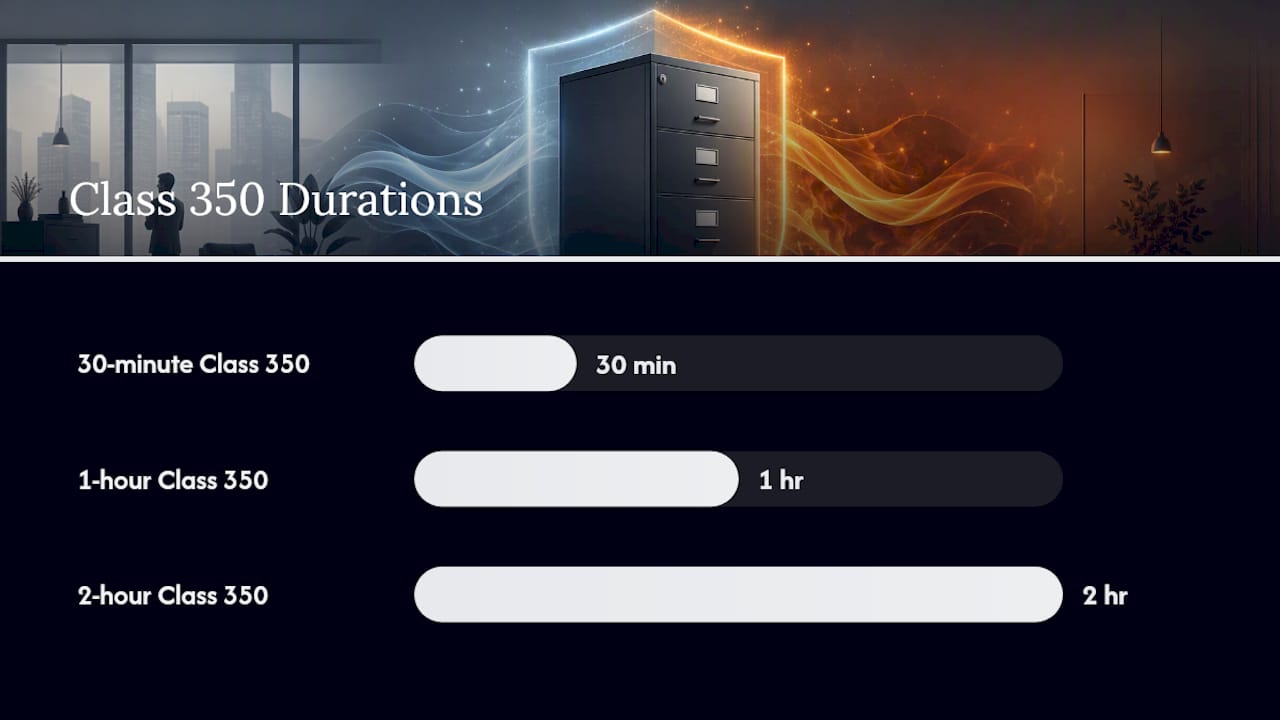
UL 72 Class 350 is the standard most paper-rated file cabinets carry. It means the cabinet’s interior will stay below 350 degrees Fahrenheit during the rated exposure period, which matters because paper starts to char and ignite well above that threshold. Class 350 ratings are commonly sold in 30 minute, 1 hour, and 2 hour durations, and the duration you need depends on how long it would realistically take fire crews to reach your building and knock down a blaze.
Paper tolerates heat that would destroy a flash drive or external hard drive almost instantly. That’s why digital media requires a separate rating, UL 125, which keeps interior temperatures below roughly 125°F instead of the 350°F threshold used for paper. A cabinet can be perfectly rated for your tax records and still cook your backup drives if it only carries a paper rating.
Here’s what each duration typically signals about the level of protection you’re buying:
- 30-minute Class 350: suited to smaller offices with quick fire department response times and lower fire load nearby.
- 1-hour Class 350: the most common choice for small businesses and home offices, balancing cost against realistic response times.
- 2-hour Class 350: built for larger facilities, high-value archives, or locations farther from a fire station.
- UL 125 media rating: required any time the cabinet stores digital backups, not just paper alone.
Water resistance is the other spec worth reading closely. Some models carry ETL or Intertek water-resistance verification confirming the cabinet was tested against sprinkler discharge or fire hose exposure, not just flame. That’s a meaningfully different claim than “fireproof,” and it matters because most structure fires trigger sprinklers or get doused by hose lines long before the fire itself reaches every corner of a building.
Pro Tip: A cabinet’s steel gauge tells you almost nothing about fire performance. The insulation packed between the inner and outer walls does the actual work, and that’s invisible on the showroom floor. Always check the certified rating, never the metal thickness.
Warranty terms and after-fire replacement policies round out the picture. Warranty terms and after-fire replacement policies provide assurance of performance, because a vendor confident enough to replace your cabinet after it does its job in an actual fire is telling you something about how it expects that cabinet to perform.
Vertical, Lateral, or Safe-in-a-File: Which Format Fits?
Form factor decides how a fire-rated cabinet fits your space and how fast you can actually get to your files day to day.
Vertical cabinets stack drawers front to back and take up the smallest floor footprint, which makes them the default pick for tight offices or home studies. The trade-off is drawer depth: you’re reaching farther into a narrower drawer, and lateral access to hanging folders is more limited.
Lateral cabinets run wider and shallower, opening side to side, and generally offer easier browsing and greater document capacity per drawer at the cost of more wall space. If you’re outfitting a records room rather than squeezing a cabinet next to a desk, lateral usually wins.
Safe-in-a-file units build a small lockable safe compartment into one drawer of an otherwise standard fire-rated cabinet. That’s useful for cash, jewelry, or a handful of irreplaceable documents you want under an extra lock, but don’t mistake it for a standalone safe. The compartment is generally lighter-duty on burglary resistance than a dedicated home or commercial safe, so if serious theft protection is the priority, pair a fire-rated cabinet with a proper safe instead of relying on the built-in compartment alone.
For anyone splitting storage between paper and digital backups, a few practical formats stand out:
- Standard paper-only Class 350 cabinets for everyday business files and tax records.
- Dual-rated cabinets carrying both Class 350 and UL 125 in one unit for mixed storage.
- A separate small UL 125 media safe alongside a standard paper cabinet, which is often cheaper than upgrading an entire multi-drawer cabinet to media specification.
Some higher-capacity vertical models add insulated drawer construction and interlocking hardware that only allows one drawer open at a time, which reduces tipping risk and limits heat transfer between drawers during a fire. That detail matters more than it sounds, especially in a busy office where multiple drawers get opened at once.
How Do You Choose the Right Fire Safe Cabinet?
Work through this checklist in order, because each item filters out weaker options before you waste time comparing prices.
- Confirm the rating and duration. Ask directly: is this UL 72 Class 350? For how many minutes or hours? Anything vaguer than a specific number and duration is a red flag.
- Check for a separate media rating. If you store any digital backups, ask whether the unit carries UL 125 specifically, since a paper rating alone won’t protect drives or discs.
- Verify water resistance claims. Ask whether water resistance has been tested and verified by ETL or Intertek, or whether it’s just a manufacturer claim with no third-party check.
- Match the lock type to your risk. Key locks are standard, Medeco high-security cylinders resist picking better, and electronic combination locks add convenience for offices with staff turnover.
- Count drawers against real volume. Don’t buy for today’s paper volume. Buy for three years from now, factoring in whatever records retention schedule applies to your industry.
- Check weight and floor load. A loaded 4-drawer fire-rated cabinet can weigh well over 1,000 pounds. Confirm your floor, especially upper floors, can handle it before delivery day.
- Ask about delivery and installation. Fire-rated cabinets are heavy enough that curbside delivery isn’t always enough. Ask whether white-glove delivery or in-room placement is available.
- Read the warranty and after-fire replacement terms. This is where cheap knock offs quietly fail. A real warranty backs the manufacturer’s confidence in its own rating.
- Compare price against rating, not against other cabinets that look similar. A visually identical cabinet with no certification is not a cheaper version of the same product. It’s a different product.
Pro Tip: Copy this exact question into an email before you buy anything: “Is this UL 72 Class 350? For how many minutes? Is there a separate UL 125 rating for digital media?” A legitimate seller answers in one sentence. A seller who dodges the question is selling you a metal box, not a fire-rated cabinet.
Watch for these red flags specifically: the word “fireproof” used with no certification number attached, missing UL or ETL documentation on the product page, no stated warranty, and prices dramatically below comparable rated models. Certified 1-hour and 2-hour rated commercial cabinets usually cost meaningfully more than ordinary metal filing cabinets, so a cabinet claiming full fire protection at a fraction of that price deserves a hard second look at the fine print.
Where You Put It Matters as Much as What You Buy
Placement and care decide whether a certified rating actually delivers on fire day, not just on the spec sheet.
Skip attics and heated garages entirely. Both run hotter than typical living or office space even without a fire, which works against the cabinet’s rated margin before disaster even starts. Keep the cabinet away from obvious heat sources like furnaces, and think through likely flame paths in your specific layout, since a cabinet tucked in a direct path between a kitchen and an exit sees very different risk than one in an interior hallway.
A few maintenance habits keep the rating meaningful years after purchase:
- Inspect door gaskets periodically. These seals are what keep heat and moisture out, and they degrade over time.
- Test locks regularly, especially electronic combination models that depend on battery power.
- Store the original spec sheet and certification documents somewhere other than inside the cabinet itself, since you’ll need them for insurance claims or warranty service.
- Anchor tall vertical cabinets to the wall or floor, particularly in earthquake-prone regions or homes with small children who might climb open drawers.
If a fire does happen, resist the urge to open the cabinet immediately or douse it with water. Manufacturer guidance consistently warns against forcing the cabinet open or cooling it with water right after exposure, because contents can remain dangerously hot and sudden temperature shock or oxygen exposure can cause smoldering paper to combust. Let it cool fully, then contact the manufacturer about warranty and after-fire replacement before you assume everything inside is a loss.
Why Safes and Security Solutions Is Worth Checking Before You Buy Elsewhere
Some specialized retailers carry fire-resistant filing cabinets built around the two ratings that actually matter: UL 72 Class 350 for paper and UL 125 for digital media, across vertical, lateral, and safe-in-a-file formats. Product pages list the full spec sheet, so buyers are not left guessing at duration, lock type, or media protection the way vague “fireproof” language without certification would.
The lineup covers the situations most homeowners and small businesses actually face:
- Vertical 1-hour and 2-hour Class 350 models for tight office footprints.
- Lateral units for records rooms that need wider drawer access.
- Media-rated compartments for businesses mixing paper files with digital backups.
- Insulated, interlocking drawer designs for higher-capacity commercial use.
| What you’re checking | Where to find it |
|---|---|
| Fire rating and duration | Product spec sheet on each listing |
| Media (UL 125) protection | Noted separately from paper rating on applicable models |
| Warranty and after-fire terms | Warranty section on the product page |
| Lock type available | Listed under product specifications |
For a deeper walkthrough of how paper and media ratings differ, the Fireproof Filing Cabinets guide breaks down which situations call for a dual-rated unit versus separate paper and media storage. If you’re weighing vertical against lateral for a specific room layout, the fire resistant metal filing cabinets overview walks through the footprint and capacity trade-offs in more detail. Anyone with a nonstandard need, custom sizing, bulk office orders, or installation questions, can reach out to customer support directly for a specific quote.
How Much Space Do You Actually Need Inside?
Sizing comes down to two questions: how much you’re storing now, and what format your documents come in.
Letter versus legal is the first fork. Legal-size drawers run several inches deeper front to back to accommodate legal-size folders without bending them, and that extra depth adds up fast across a multi-drawer unit. If your office handles contracts, medical records, or legal documents, confirm the drawer accepts legal-size folders before you buy. Letter-only drawers won’t fit them without awkward folding that damages documents over time.
Drawer count should match realistic volume, not current volume. A single overstuffed drawer is harder to search and puts more strain on the rated door seal every time it’s forced shut. Most small offices land comfortably with 2 to 4 drawers; larger records rooms often need full lateral banks with 3 to 5 drawers per unit.
Depth matters beyond letter versus legal. Fire-rated cabinets carry thicker walls than standard office furniture because of the insulation layer between the inner and outer shell, which means a fire-rated 2-drawer vertical cabinet takes up noticeably more floor space than a non-rated 2-drawer cabinet with the same drawer capacity. Measure your intended spot with that extra depth in mind, not just the drawer’s usable interior dimensions.
What Should You Expect to Pay?
Certified fire-rated file cabinets cost meaningfully more than ordinary metal filing cabinets, and that price gap is the insulation and testing you’re paying for, not markup.
Robust 1-hour and 2-hour rated commercial cabinets commonly start in the low thousands of dollars, with the final price shaped by rating duration, drawer count, media protection, and security features like high-security locks. A smaller 1-hour rated unit sits at the lower end of that range; a 2-hour rated multi-drawer lateral cabinet with media protection and Medeco locking climbs toward the higher end.
Purchase channels split roughly two ways. Specialty security retailers carry full product lines with published specifications, warranty terms, and delivery options built for heavy, rated furniture. General office supply retailers sometimes carry a limited selection, but often with thinner documentation and less certainty around exact ratings. Buying directly from a specialty seller with full spec sheets published gives you the paper trail you’ll want if you ever need to file an insurance claim or invoke a warranty.
The Fireproof Myths That Cost People Their Records
The biggest misconception is treating “fireproof” as a real, enforceable claim rather than marketing language. No consumer file cabinet is truly fireproof. What exists is fire-resistant, meaning it holds interior temperature below a damage threshold for a specific, tested duration. A cabinet exposed to fire for longer than its rated duration can still fail.
A close second misconception: assuming heavy steel construction equals fire protection. The critical factor is tested internal insulation and a certified rating, not the thickness of the exterior metal. A heavy, uninsulated steel cabinet offers real security against prying and forced entry, but it can still let interior temperatures spike well past what paper or media can survive.
The third trap is assuming one rating covers everything you store. Paper and digital media survive fire at completely different temperatures, so a cabinet rated only for paper offers no real protection for backup drives or discs stored inside it. Buyers who skip this distinction often discover it the hard way, after a fire, when their paper files survive intact and their digital backups don’t.
Editorial Take: The Rating Question Everyone Skips
Most buying advice treats fire rating like a single number to compare, higher is better, done. That misses the real decision, which is matching duration and media protection to your actual risk, not chasing the biggest number on the shelf.
A home office with a handful of tax returns and no digital backups rarely needs a 2-hour rated, media-capable commercial cabinet. That’s overspending for a risk profile that doesn’t exist yet. Meanwhile, a small law firm running a 30-minute rated cabinet with zero media protection while storing client backups on external drives inside it has the opposite problem, and it’s the more dangerous one, because it looks protected without actually being protected.
The conventional advice skips this second scenario almost entirely. It talks about ratings in the abstract and rarely forces the reader to ask what’s actually going in the drawer. Start there instead. Inventory what you’re storing, paper and digital both, before you look at a single product listing. The rating you need falls out of that inventory, not the other way around.
— Safes and Security Solutions
Ready to Buy? Here’s the Fastest Path
Specialty retailers offer certified, in-stock fire-rated cabinets with documented UL ratings, published spec sheets, and warranty terms visible before purchase, reducing guesswork compared to vague listings from general retailers.
Shipping often covers the continental United States, with delivery notes for heavier commercial models provided on product pages to inform buyers in advance. Warranty and after-fire replacement terms are typically listed directly on each product page rather than in separate policy documents, which can be important if a claim arises.
For those with storage needs focusing on secure valuables rather than paper records, some retailers offer options like Gardall Matte Finish Safes and American Security UL Listed Home Fire Safes combining document storage with fire and burglary protection. Buyers can review fire-rated filing cabinet lineups, check ratings and media protection on spec sheets, order directly from product pages, or contact customer support for custom quotes on bulk or custom-sized orders.
Standards and Resources Worth Bookmarking
- UL publishes the Class 350 and UL 125 standards referenced on every legitimate spec sheet.
- Intertek/ETL provides independent water-resistance verification worth checking before you trust a “sprinkler-resistant” claim.
- The Choosing a Fire Resistant File Cabinet guide breaks down how to read those ratings on an actual product page.
FAQ
Can a filing cabinet survive a fire?
A certified fire-rated filing cabinet is designed to keep interior contents below a damage threshold for a specific tested duration, commonly 30 minutes to 2 hours under UL Class 350. An uncertified standard metal cabinet offers no reliable protection and can fail quickly in real fire conditions.
How can you tell if a filing cabinet is fireproof?
Check the spec sheet for a specific UL 72 Class 350 rating with a stated duration, since the word “fireproof” alone with no certification number is a marketing claim, not a tested guarantee. If you store digital media, also confirm a separate UL 125 rating.
What is a good fireproof filing cabinet for an office?
A 1-hour or 2-hour UL Class 350 rated cabinet sized to your document volume, with a dual UL 125 media rating if you also keep digital backups, covers most small-to-medium office needs. Safes and Security Solutions carries vertical and lateral models across these ratings with full spec sheets listed.
What is a fireproof file cabinet with a safe?
It’s a fire-rated filing cabinet that includes a smaller lockable safe compartment built into one drawer, typically used for cash, jewelry, or a limited set of irreplaceable documents. It offers convenience for mixed storage but generally provides lighter burglary resistance than a dedicated standalone safe.