

Employee Security Training Steps for HR Managers
TL;DR:
- A structured employee security training program reduces cyber and physical security incidents through ongoing assessment and improvement. Tailoring content to roles and risk profiles enhances effectiveness, while multi-layered deployment and behavioral metrics sustain long-term behavior change. Continuous documentation and reinforcement are essential for meeting security standards and building a strong security culture.
A structured employee security training program is the most direct way to reduce both cyber and physical security incidents at work. Most organizations treat training as a one-time event. That mistake leaves employees unprepared when real threats arrive. The employee security training steps covered here follow frameworks from NIST, OSHA, and Verizon to give HR professionals and business managers a repeatable, measurable process. You will walk away with a clear security training program outline that covers assessment, role-based design, deployment, and continuous improvement.
What are the essential employee security training steps?
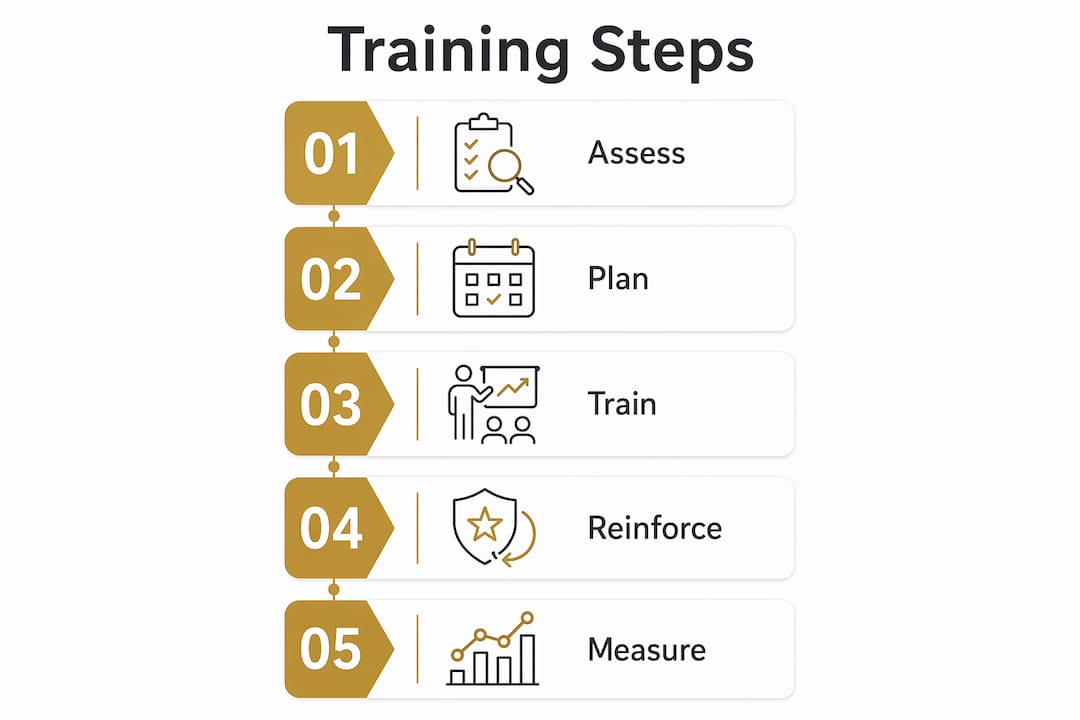
A NIST-aligned training program follows an iterative lifecycle that starts with assessing current awareness and ends with continuous improvement. That lifecycle structure prevents the common failure of launching training once and never revisiting it.
Follow these six steps to build your program:
- Assess current awareness. Survey employees and review past incidents to find knowledge gaps. Use the NIST Cybersecurity Framework as a baseline to identify where your workforce is most exposed.
- Develop clear security policies. Define roles, responsibilities, and acceptable use before you write a single training module. Policies give training content its authority.
- Design role-based training content. Build separate tracks for general users and functional specialists. A finance employee faces different threats than a warehouse worker or a system administrator.
- Deploy training across the employee lifecycle. Start at onboarding, then schedule monthly simulations and annual full refreshers. Verizon recommends embedding security awareness during onboarding as the foundation of a security culture.
- Measure behavioral outcomes. Track phishing click rates, incident reporting rates, and time to report. Completion percentages alone tell you nothing about real behavior change.
- Iterate based on results. Update content quarterly when new threats emerge. Replace modules that score poorly on behavioral metrics with revised, scenario-based alternatives.
Pro Tip: Build your training plan with clear timelines and named owners for each step. A structured training plan with defined accountability prevents the program from stalling after launch.
How to tailor security training content for different roles and risks

Generic training fails audits and fails employees. ISO 27001 guidance warns that auditors expect evidence that training content is appropriate and specific to employee functions. One-size-fits-all modules are a common reason organizations receive audit findings.
NIST SP 800-16 separates learners into two categories: general users and functional specialists. General users need awareness of phishing, password hygiene, and physical access control. Functional specialists, such as IT administrators and finance staff, need deeper training on the specific attack vectors relevant to their systems and data.
Segment your training tracks by these risk profiles:
- General employees: Phishing recognition, password policies, clean desk practices, and visitor management.
- Remote and hybrid workers: Secure Wi-Fi use, VPN requirements, and BYOD policies. Remote employees lack on-site security culture reinforcements, so their training must compensate with more frequent digital touchpoints.
- Executives and finance staff: Social engineering, wire fraud scenarios, and data handling under regulatory requirements.
- Contractors and third parties: Organizations under ISO 27001 must extend training to contractors and third parties they control. Skipping this group creates audit gaps and real security exposure.
- All staff on physical security: OSHA recommends training every employee and supervisor on de-escalation and emergency response as part of a workplace violence prevention cycle. Physical security is not optional content.
Scenario-based exercises outperform lecture-style content for every group. A finance employee who practices identifying a fraudulent wire transfer request retains that lesson far longer than one who reads a policy document.
Pro Tip: Use job-specific scenarios pulled from real incidents in your industry. A retail employee responds better to a shoplifting or tailgating scenario than to an abstract cybersecurity case study.
What are best practices for deploying and reinforcing security training?
Deployment is where most programs lose momentum. The content exists, but the delivery is inconsistent, the formats are boring, and employees disengage after the first module. Sustained behavior change requires multiple reinforcement layers because no single training format changes all behavior effectively.
Build your delivery rhythm around this schedule:
- Onboarding session: Cover core policies, physical access procedures, and the most common threat types on day one.
- Monthly simulations: Run phishing simulations using realistic attack methods. Verizon highlights that realistic phishing exercises with clear reporting procedures drive measurable behavior improvement.
- Quarterly refreshers: Rotate short modules on emerging threats. Keep each session under 15 minutes to maintain completion rates.
- Annual full cycle: Conduct a comprehensive review of all policy areas, update content for new regulations, and reassess baseline awareness.
Format variety matters as much as frequency. Combine these delivery methods:
- Asynchronous e-learning for flexibility across time zones and shifts.
- Live sessions or webinars for high-risk groups who need direct Q&A.
- Gamified quizzes and scenario challenges to increase engagement.
- Environmental nudges such as posters, screensavers, and desk reminders that reinforce key messages between formal sessions.
Maintaining training records is not optional. NIST 800-53’s AT family requires documented training records that can be produced on demand for audits. Use your learning management system to log completion dates, assessment scores, and remediation actions for every employee. A practical security training checklist helps confirm you have covered every required element before an audit window opens.
Communicate program goals clearly to the whole organization. Employees who understand why training exists participate more seriously than those who see it as a compliance checkbox.
How can organizations measure and continuously improve security training?
Measurement separates programs that reduce risk from programs that only generate completion reports. Behavioral metrics provide a truer measure of program success than completion statistics alone. This distinction matters because an employee can finish every module and still click a phishing link.
Track these metrics to assess real impact:
| Metric | What it measures |
|---|---|
| Phishing simulation click rate | Percentage of employees who click simulated phishing links |
| Incident reporting rate | How often employees report suspicious activity |
| Mean time to report | Speed of employee response when a threat is identified |
| Assessment pass rate by role | Knowledge retention across different employee groups |
| Repeat offender rate | Employees who fail simulations multiple times |
Use assessment data to identify vulnerable groups. If your finance team consistently clicks phishing simulations at a higher rate than other departments, that signals a content gap, not a personnel problem. Revise the finance track with more targeted scenarios before the next simulation cycle.
Conduct a formal program review at least twice per year. Update modules when new threat types emerge, when regulations change, or when an internal incident reveals a training gap. Document every review and every content update. Auditors under frameworks like ISO 27001 and NIST 800-53 expect evidence of continuous improvement, not just evidence that training happened once.
Integrate employee feedback into each review cycle. A short post-training survey asking what felt relevant and what felt generic gives you direct data for improving content quality. Security culture indicators, such as the number of voluntary incident reports, also signal whether training is shifting employee mindset or just satisfying a compliance requirement.
Pro Tip: Set a baseline phishing click rate before your first simulation. Without a starting point, you cannot demonstrate improvement to leadership or auditors. Document the baseline and track it quarterly.
Key Takeaways
A security training program only reduces risk when it follows a structured cycle from assessment through continuous improvement, with role-specific content and behavioral metrics at every stage.
| Point | Details |
|---|---|
| Start with assessment | Map current awareness gaps using NIST frameworks before building any content. |
| Segment by role and risk | Follow NIST SP 800-16 to separate general users from functional specialists with tailored content. |
| Deploy in layers | Combine onboarding, monthly simulations, quarterly refreshers, and environmental nudges for sustained behavior change. |
| Measure behavior, not completion | Track phishing click rates, reporting rates, and mean time to report as the real indicators of program success. |
| Document everything | NIST 800-53 AT-4 and ISO 27001 both require training records that can be produced on demand for audits. |
What I have learned from watching security training programs succeed and fail
The programs that actually change employee behavior share one trait: they treat training as an ongoing operation, not a project with an end date. The ones that fail almost always launch with strong content and then go quiet for 11 months until the annual compliance deadline arrives.
The second pattern I see repeatedly is the assumption that remote workers will absorb security culture through osmosis. They will not. Remote employees need more frequent digital touchpoints, not fewer, because they are not walking past security posters or overhearing conversations about incidents. Ignoring this group is one of the fastest ways to create an audit finding and a real vulnerability at the same time.
Generic training is the other consistent failure point. When a warehouse employee sits through a module built for a software developer, they disengage within minutes. That disengagement is not a motivation problem. It is a design problem. Role-based content built around scenarios employees actually encounter produces measurably better outcomes.
The most underrated element of a strong program is the physical security layer. Cybersecurity training gets most of the attention, but an employee who holds a door open for a stranger or leaves sensitive documents on a desk creates just as much exposure. Integrating physical security protocols into your office security plan alongside digital threat training produces a more complete defense.
Build security into your culture by making it visible, specific, and continuous. That is the only approach that holds up under real-world pressure.
— Safes and Security Solutions
Physical security products that support your training program
A well-trained workforce is one layer of your defense. Physical security equipment is another, and the two work best together.
Safes and Security Solutions carries a full range of products that reinforce what your employees learn in training. Surveillance cameras, access control systems, and fire-resistant safes give your team the physical tools to act on their security awareness every day. When employees know the cameras are recording and the safe is locked, security protocols become habits rather than abstract rules. Browse the workplace security products at Safes and Security Solutions to find equipment that fits your facility and supports the security best practices your training program teaches.
FAQ
What are the first steps in a security training program?
The first steps are assessing current employee awareness and establishing clear security policies. These two actions define the gaps your training must close and give the content its authority.
How often should employees receive security training?
Employees should receive training at onboarding, monthly phishing simulations, quarterly refreshers, and an annual full program review. Verizon recommends this rhythm to build and sustain a security-aware culture.
Why does role-based training matter for compliance?
ISO 27001 auditors expect evidence that training content matches each employee’s job function and risk level. Generic training that ignores role-specific threats is a documented cause of audit failures.
What metrics should HR track to measure training effectiveness?
Track phishing simulation click rates, incident reporting rates, mean time to report, and assessment pass rates by role. Completion rates alone do not indicate whether employees have changed their behavior.
Do contractors need to complete security training?
Yes. ISO 27001 requires organizations to extend training to contractors and third parties under their control. Excluding this group creates both audit findings and genuine security gaps.
Recommended
- Office security plan: Step-by-step to a safer workplace – Safes and Security Direct
- How to Enhance Office Security for Better Workplace Safety – Safes and Security Direct
- Top security best practices for property managers 2026 – Safes and Security Direct
- Asset Protection Workflow Guide for Maximum Security – Safes and Security Direct