

Gun Owners: EMP Proof Safe Locks Don't Exist, Use a Mechanical Backup
No lock is truly EMP-proof, but genuinely EMP-resistant electronic locks exist, and they work by pairing hardened electronics with a mechanical backup that needs no power at all. Your move is simple: buy a lock with documented independent test results, or retrofit your existing safe with a mechanical spin-dial or keyed override. Skip anything that claims “EMP-proof” without a lab report and a functional test behind it.
TL;DR:
- Genuine EMP-resistant locks combine hardened electronics with a mechanical backup, and they require documented independent testing for validation.
- Solid-state keypad locks are highly vulnerable to EMP-induced damage, whereas mechanical or motor-driven mechanical locks are more resilient.
- The most effective EMP-resistant design features shielding, mechanical redundancy, and battery power to ensure functionality during an electromagnetic event.
- Upgrading existing safes with dual-access retrofit kits provides a practical way to add EMP resistance without complete replacement, but precise measurements are essential.
- Mechanical redundancy, such as a spin-dial or keyed override, is more reliable than relying solely on electronic shielding claims, making it a top priority for secure preparedness.
Table of Contents
- How an EMP Affects Electronic Safe Locks
- What “EMP-Resistant” Actually Means
- EMP-Resistant Lock Designs That Actually Hold Up
- How to Choose an EMP-Resistant Safe Lock
- Retrofitting Options and Installation Notes
- Why Trust Safes and Security Solutions for EMP-Aware Buyers
- What Gun Owners Get Wrong About EMP Protection
- Get Your Safe Ready for an EMP Scenario
- Sources
- FAQ
How an EMP Affects Electronic Safe Locks
An electromagnetic pulse is a short, intense burst of energy that induces stray voltage in nearby wiring and circuit boards. That induced current can fry a microcontroller, corrupt a keypad’s memory, or lock a solenoid in the wrong position, even when the safe itself is untouched.
Not every component reacts the same way. Pure solid-state locks, the kind that rely entirely on a chip to read a code and fire a tiny solenoid, have the least tolerance for a voltage spike. Motor-driven mechanical actuators and purely mechanical systems have fewer exposed circuits to damage in the first place.
- Solid-state keypad locks: highest vulnerability, no moving parts to fall back on.
- Motor-driven electromechanical locks: circuit board is exposed, but the locking bolt itself is mechanical.
- Pure mechanical dial or key locks: no circuitry to damage at all.
Weaponized EMP devices remain a strategic, nation-state concern rather than an everyday threat, though reporting on developing first-strike EMP capability keeps the scenario on preparedness radars. Solar-driven geomagnetic events are the more statistically plausible risk for civilian electronics, and they hit the same vulnerable components.
What “EMP-Resistant” Actually Means
“EMP-proof” is marketing language. Nothing sold to consumers has been proven to survive every pulse strength and every frequency profile a real event could throw at it. “EMP-resistant” is the more honest term, and it should point to an actual test, not a slogan.
Statistic Callout: Vendor pages often advertise “EMP-resistant” locks without standardized disclosure of test parameters, so the label alone tells you little about actual performance.
Before you trust a claim, ask the vendor for three things:
- The name of the independent testing lab, not an in-house test.
- The field strength and pulse profile used during testing.
- A written functional check confirming the lock still opened and locked correctly after exposure.
A credible test isolates the lock, exposes it to a defined electromagnetic field, then verifies it still performs its basic job: locking, unlocking, and reading the correct code. Vague phrases like “military-grade protection” or “EMP shielded” without a lab name attached are red flags. If a company can’t produce a report, treat the claim as unverified.
EMP-Resistant Lock Designs That Actually Hold Up
Real EMP resistance comes from engineering, not a sticker on the box. Motor-driven mechanical blocking devices, where a small motor throws a physical bolt rather than relying on a solenoid alone, tend to survive better because the locking function depends on a mechanical linkage instead of a single fragile circuit path.
Three design elements separate a genuinely resistant lock from a marketing label:
- Shielding and surge suppression. Enclosing sensitive circuits in a grounded metal housing, similar in principle to a Faraday cage, along with filtered power inputs, blunts induced voltage before it reaches the microcontroller, an approach echoed in engineering research on electromagnetic lock hardening.
- Mechanical redundancy. A spin-dial, mechanical combination, or independent keyed override that works with zero electronics gives you a way in even if every chip in the lock is dead.
- Battery-only power. A lock that never depends on external mains power avoids one entire pathway for a pulse to enter the system through household wiring.
Pro Tip: Choose a lock powered by standard AA or 9-volt batteries rather than a rechargeable pack wired into your home’s electrical system. Fewer wires means fewer places for an induced surge to sneak in.
How to Choose an EMP-Resistant Safe Lock
Picking the right lock is less about chasing a brand name and more about verifying specific, checkable facts before you buy.
- Demand documented test evidence. An independent lab report with named parameters beats any front-page claim.
- Prioritize fail-secure behavior with mechanical redundancy. The lock should stay locked if power dies, and you should have a non-electronic way in. This is also where fail-secure and fail-safe electromagnetic locks diverge in a way worth understanding, since maglocks are built to release on power loss, the opposite of what a security safe needs.
- Confirm footprint and boltwork compatibility. A lock that’s technically hardened is useless if it doesn’t physically fit your safe’s door.
- Check battery life and vendor support. Ask how long the batteries last under normal use and whether the manufacturer offers documented service and warranty coverage.
- Weigh convenience against redundancy. A pure electronic keypad is faster day to day, but a dual-access retrofit kit that adds a mechanical backup costs little extra and removes your single point of failure entirely.
Our guide to safe lock types and costs breaks down price ranges across mechanical, electronic, and biometric options if you want a fuller cost comparison before deciding.
Retrofitting Options and Installation Notes
Most owners don’t need to replace an entire safe to get EMP resistance. Dual-access electro-mechanical retrofit kits swap in an electronic keypad alongside an independent mechanical spin-dial or combination, so the safe still opens if the electronics die completely.
Before ordering any retrofit kit, run through these checks:
- Measure the boltwork’s direction of travel; some safes throw bolts vertically, others horizontally, and a mismatched kit simply won’t engage.
- Measure the spindle length precisely, since a spindle that’s too short or too long will not seat correctly in the new lock body.
- Confirm the lock’s footprint matches your safe’s cutout using standard industry dimensions before you buy.
- Decide between professional installation and DIY: if your safe has a complex relocker or an unusual boltwork pattern, a professional locksmith avoids costly mistakes.
- Test the new lock immediately after installation, then repeat that functional test every few months as routine maintenance.
Skipping the measurement step is the single most common reason a retrofit fails, not because the lock itself was defective, but because it never physically matched the safe.
Why Trust Safes and Security Solutions for EMP-Aware Buyers
A range of gun safes, home safes, and jewelry safes designed to pair with upgradeable lock hardware is available, helping to avoid mismatched parts from multiple vendors. If you’re deciding between electronic and mechanical access before you buy, our breakdown of digital versus mechanical safe locks walks through the fail-secure behavior that matters most in a power-loss scenario.
[BRAND_SIGNAL: author credentials and technical certifications to be inserted] [BRAND_SIGNAL: customer testimonials and verified reviews to be inserted] [BRAND_SIGNAL: proprietary lab testing data to be inserted]
Before purchasing, check product compatibility notes or seek technical documentation to ensure a specific lock fits your safe.
What Gun Owners Get Wrong About EMP Protection
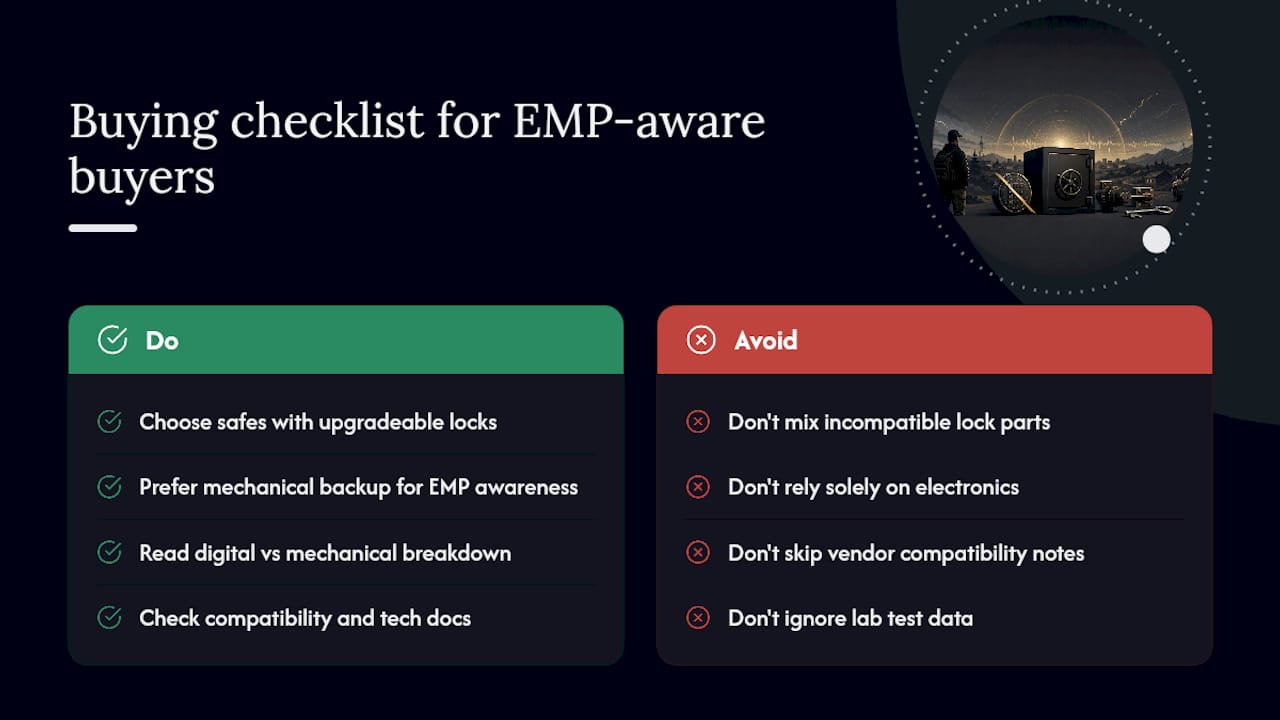
The biggest mistake in this space isn’t buying the wrong lock. It’s assuming that “resistant” and “proof” mean the same thing, then building a false sense of security around a term nobody has defined consistently. The research here supports a narrower, more useful conclusion: mechanical redundancy beats any electronic hardening claim you can’t independently verify.
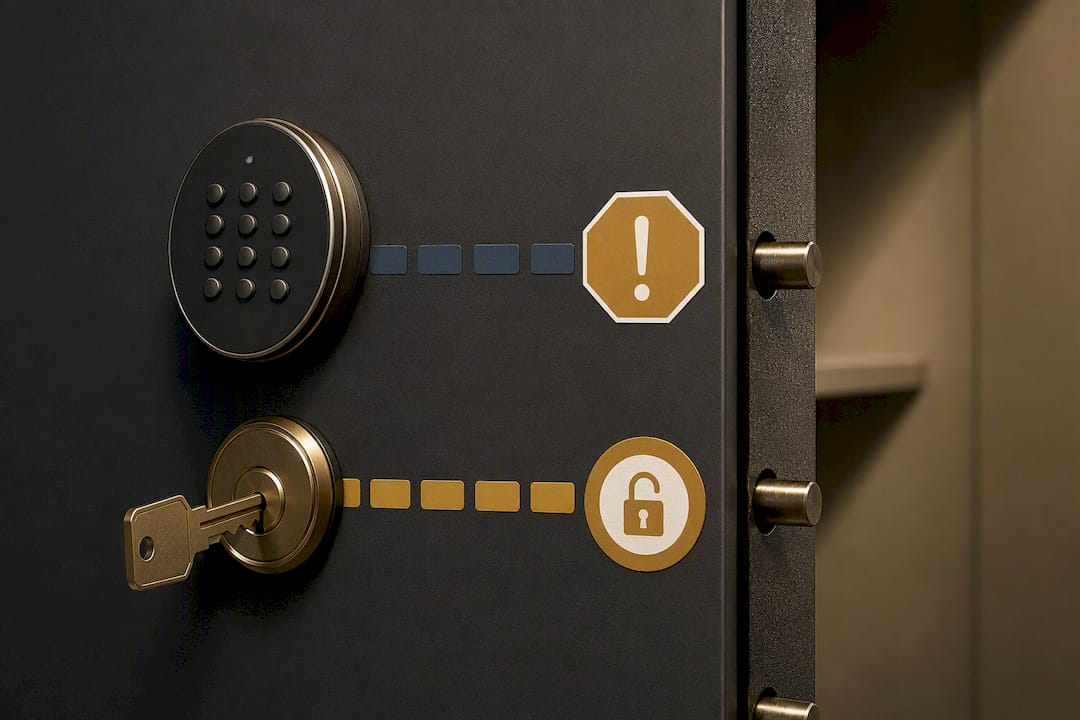
Conventional advice tends to focus buyers on finding the single best EMP-resistant keypad, as if the lock’s circuitry were the whole problem. That’s backwards. A lock with excellent shielding but no mechanical override is still a single point of failure. A mediocre electronic lock backed by a working spin-dial or keyed override survives a scenario the fancier lock might not.
Prioritize the backup before you prioritize the branding. Ask what happens to your safe if every chip inside that lock stops working tomorrow. If the honest answer is “you’d need a locksmith with a drill,” that’s the gap to close first, regardless of what the marketing copy on the box promises.
— Safes and Security Solutions
Get Your Safe Ready for an EMP Scenario
Rather than searching for a “provably EMP-proof” lock, consider gun safes, home safes, and jewelry safes built to accept upgradeable lock hardware with a mechanical backup in mind.

Browse options like the Gardall matte finish gun safes or the Sports Afield Domain SA5530DOM fire safe if you’re shopping for a unit that pairs well with a dual-access retrofit kit. Not sure which lock configuration fits your current safe? Check our page on burglary-resistant safe options for compatibility notes, or contact our support team directly for a fit check and an installation quote before you order anything.
Sources
- Electromagnetic lock
- Electromagnetic lock design for space/launch applications (IEEE conference paper)
FAQ
What Can an EMP Not Penetrate?
A pulse struggles to reach electronics fully enclosed in continuous, grounded metal shielding, similar to a Faraday cage, with no gaps or exposed wiring. Pure mechanical components, like a steel dial or a keyed lock with no circuit board, have nothing for an EMP to damage in the first place.
How Do You Protect Yourself Against an EMP Attack?
For a safe lock specifically, the most reliable protection combines a hardened electronic lock with an independent mechanical backup, such as a spin-dial or keyed override. Household-level protection more broadly involves unplugging sensitive electronics and storing backups in shielded containers, though this goes beyond safe security alone.
Can You Make a House EMP-Proof?
Not entirely. Full-house EMP shielding is an extreme, expensive undertaking reserved mostly for military and critical infrastructure applications, and even then it isn’t absolute. For a homeowner, the realistic goal is hardening specific high-value systems, like your safe’s lock, rather than the entire structure.
What Does “EMP Resistant” Mean for a Safe Lock?
It means the lock has been engineered and, ideally, tested to withstand a defined electromagnetic pulse without losing its locking function. That’s different from “EMP-proof,” which implies a guarantee no legitimate manufacturer can back with real test data.
Are Electromagnetic Locks the Same as EMP-Resistant Locks?
No. Electromagnetic locks, or maglocks, need constant power and unlock automatically when that power fails, which is the opposite behavior you want in a security safe. EMP-resistant safe locks are fail-secure and typically include a mechanical backup that works with no power at all.