

7 Depository Safe Features Small Businesses and Individuals Must Check
Prioritize a depository safe with an anti-fishing deposit mechanism, electronic code management, reinforced door and boltwork with re-lockers, bolt-down anchoring, and enough capacity to avoid daily overflow. For businesses handling regular cash drops, the strongest combination pairs an electronic keypad lock with a one-way rotary or hopper deposit chute, backed by professional installation and local locksmith support.
TL;DR:
- An effective depository safe must have an anti-fishing deposit mechanism, reinforced construction, and proper anchoring to prevent theft and tampering.
- Electronic keypad locks are ideal for businesses with multiple employees because they allow instant code management and include low-battery alerts.
- Hopper and rotary deposit mechanisms handle bulk deposits more efficiently and reduce jamming compared to narrow slot-style openings.
- Heavier steel doors, multiple locking bolts, and re-lockers are essential for resisting drills and physical attacks, especially when securely anchored into solid concrete.
- Regular staff training on deposit procedures, backup access plans, and alarm integration help mitigate daily risks and ensure operational continuity.
Table of Contents
- What Are the Must-Have Depository Safe Features?
- Which Lock Type Fits Your Business Best?
- Slot, Hopper, or Drawer: Which Deposit Mechanism Wins?
- How Much Steel and Anchoring Do You Actually Need?
- How Big Should Your Depository Safe Be?
- What Operational Features Reduce Daily Risk?
- How to Choose the Right Depository Safe: A Step-By-Step Checklist
- Do Depository Safes Affect Insurance and Compliance?
- Should Your Depository Safe Connect to Your Alarm System?
- How Should Staff Be Trained to Use a Depository Safe?
- What Happens If Access Fails During an Emergency?
- Why We Recommend Electronic Depository Safes With Bolting Capability
- Ready to Compare Depository Safe Models?
- Sources
- FAQ
What Are the Must-Have Depository Safe Features?
Run through this checklist before you compare a single model. Skipping any of these categories usually means paying twice, once for the safe and again after a loss it should have prevented.
- Deposit security: a true anti-fishing mechanism, not just a slot cut into a standard safe door.
- Lock type: electronic keypad, mechanical dial, key, or biometric, matched to who needs access and how often.
- Construction: solid steel barrier material, multiple locking bolts, and a door built heavier than the body.
- Re-lockers: hidden secondary bolts that trigger if someone drills or punches the main lock.
- Anchoring: pre-drilled holes and hardware rated for bolting into concrete.
- Capacity: enough interior room for your busiest deposit day, not your average one.
- Serviceability: an accessible locksmith network and available replacement parts.
Walk away from any listing that describes the barrier material as “composite” without a steel gauge, or that offers no bolt-down option at all. A true depository safe uses a one-way deposit path with anti-fishing baffles so nothing can be pulled back out once it drops in, and that single design detail separates a real depository safe from a cabinet with a hole cut into it.
Which Lock Type Fits Your Business Best?
Electronic keypad locks are the default choice for most retail and restaurant operations, and for good reason. You can issue individual codes to each shift, kill a code the moment an employee quits, and get a low-battery alert before the lock strands you. Digital keypad drop safes also let staff deposit cash without ever opening the main compartment, which keeps daily drops separate from the bulk cash inside.
Mechanical combination dials and keyed locks still have a place, particularly for owner-only access or backup entry on a safe that already runs on batteries. The trade-off is key control. A lost key or a combination watched over someone’s shoulder is a permanent liability until you swap the lock.
- Electronic keypad: best for multi-employee access and fast code changes.
- Mechanical dial: durable, no batteries, but slower and harder to update.
- Keyed lock: simple backup, weak if keys circulate.
- Biometric: fast for single users, less practical for shared shift access.
- Time-delay: adds a forced wait before the lock opens, a real deterrent during a robbery in progress.
Pro Tip: Pair a time-delay lock with a silent alarm trigger built into the keypad. An employee under duress can enter a duress code that opens the safe normally while quietly notifying your monitoring service.
Slot, Hopper, or Drawer: Which Deposit Mechanism Wins?
The mechanism that receives the cash matters as much as the lock protecting it. Narrow slot-style openings give the strongest anti-fishing performance because there’s less room to maneuver a tool inside, but they can jam if someone stuffs a thick bank bag through too fast.
Hopper-style and rotary designs solve that jamming problem. Hopper and rotary mechanisms generally handle bulk and folded deposits more easily than narrow slots, which makes them the better fit for restaurants and retail counters processing dozens of transactions a shift. The rotary door swings the deposit into the chamber and locks back into place, blocking any reach-back attempt.
- Slot-style: highest anti-fishing resistance, best for coins and thin bill stacks.
- Hopper/rotary: faster bulk handling, slightly more moving parts to maintain.
- Drawer deposit: convenient for bundled envelopes, less common in true anti-fishing models.
Installation form matters too. Countertop units are easiest to add later, through-the-wall models keep the bulk of the safe out of customer sight, and under-counter placement balances quick staff access with a lower theft profile.
How Much Steel and Anchoring Do You Actually Need?
Steel thickness and bolt placement are where cheap safes fall apart under real pressure. Buying guides for depository safes stress solid steel barrier material, UL-approved locks, re-lockers, and bolting capability, and warn against vague “composite” or panel-based bodies marketed as burglary resistant. Look for a door thicker than the body, multiple locking bolts on at least two sides, and hinges that can’t be knocked off with a hammer.
Re-lockers are the feature most buyers overlook. These are hidden secondary bolts wired to the main lock; if someone drills into the lock mechanism, the re-locker fires and jams the boltwork solid, turning a five-minute drill attack into a demolition job.
- Steel and door design: heavier door than body, concealed hinges or non-removable pins.
- Boltwork: multiple bolts on more than one side of the door.
- Re-lockers: hidden bolts that trigger automatically on drill or punch attempts.
- Anti-drill plates: hardened steel positioned directly behind the lock face.
Anchoring reality check: weight alone rarely stops removal. Anchoring to concrete is recommended because a heavy safe can still be pried, rolled, or hauled out on a dolly, and professional locksmith installation ensures the bolts land in structural concrete, not a thin topping slab that will crack under load.
How Big Should Your Depository Safe Be?
Undersizing is the most common mistake business owners make, and it’s an easy one to avoid. A commonly cited planning rule is to budget at least 50% more capacity than your current estimate, since deposit volume grows with sales and a jammed, overstuffed chute defeats the whole anti-fishing design.
- Estimate your busiest single shift, not your daily average, when sizing the interior.
- Under-counter and recessed placements keep the safe out of customer view while staying within arm’s reach of the register.
- Through-the-wall models work well when the back office sits adjacent to the sales floor.
- Concrete flooring anchors far more securely than plywood subfloor. If you’re on wood, schedule a locksmith to add a steel anchoring plate before bolting down.
Placement should balance two competing goals: staff need fast, low-friction access during a shift, but the safe shouldn’t be visible or reachable from outside the counter area.
What Operational Features Reduce Daily Risk?
The features that matter after installation are the ones staff interact with every day. Tamper indicators and electronic access logs tell you exactly who opened the safe and when, which turns a “someone took it” argument into a two-minute lookup. Depository safes with multi-user codes often include lock-out modes and low-battery warnings, so a string of failed code attempts locks the keypad instead of letting someone keep guessing.
- Access logs: timestamped entry records tied to individual user codes.
- Lock-out mode: temporary keypad freeze after repeated failed attempts.
- Low-battery alerts: warning before the electronic lock fails completely.
- POS integration: some higher-volume setups tie deposit counts to register reconciliation software.
Serviceability rounds out the list. A model with local locksmith support and available replacement parts costs less over its lifetime than a cheaper safe nobody nearby can service.
How to Choose the Right Depository Safe: A Step-By-Step Checklist
- Estimate your deposit volume for a typical shift and your busiest shift of the month, then size capacity around the higher number.
- Pick your deposit mechanism based on what you’re depositing. Loose bills and coins favor a slot; bundled or folded cash favors a hopper.
- Choose a lock type that matches staff turnover. High turnover businesses should default to electronic keypads with individual codes.
- Verify construction specs directly. Ask for steel gauge, bolt count, and whether re-lockers are included, not just a “burglary resistant” label.
- Confirm anchoring hardware and installation options, and book a locksmith if the floor is anything other than solid concrete.
- Check service and warranty terms before buying, including where you’d send the unit or who locally can service the lock.
Ask any vendor these three questions before you buy: What steel gauge is the barrier material? Is bolting hardware included or sold separately? Who services this lock if it fails? A vague answer to any of the three is a red flag.
Pro Tip: Light personal use, like storing a spare house key drop for a rental property, doesn’t justify paying for commercial-grade boltwork. Save the premium construction budget for cash-handling businesses where daily theft exposure is real.
Do Depository Safes Affect Insurance and Compliance?
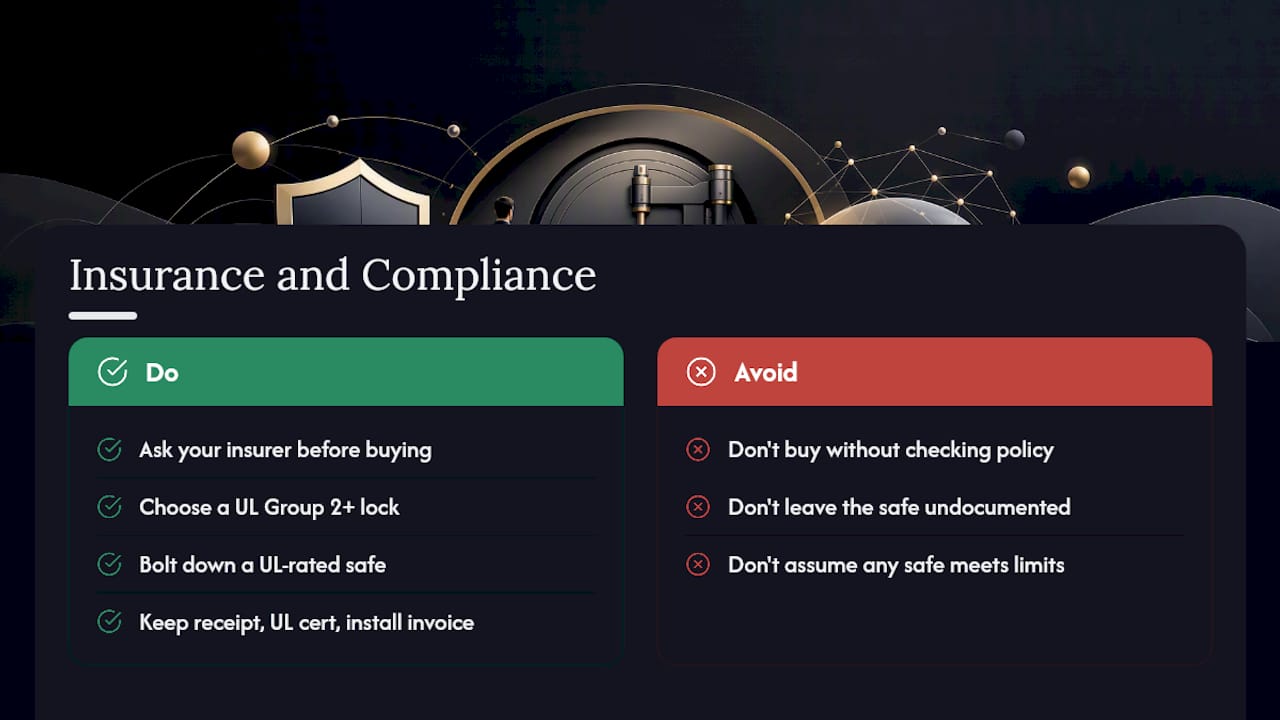
Insurance carriers frequently set safe-rating requirements as a condition of cash coverage, and the rating threshold usually scales with how much cash you keep on hand overnight. A UL-listed lock rated Group 2 or better is a common baseline insurers look for on burglary coverage, since UL testing verifies the lock resists manipulation and drilling for a set time under controlled conditions.
Ask your insurance agent directly what safe rating your policy requires before you buy, not after. Underwriters may reduce your premium once a bolted-down, UL-rated safe is documented on file, and some policies cap cash-loss reimbursement sharply if the safe on record doesn’t meet the stated rating.
Compliance obligations layer on top of insurance for regulated businesses. Pharmacies handling controlled substances, jewelers, and check-cashing operations often face state or industry-specific storage rules in addition to whatever your insurer requires. Keep your purchase receipt, the lock’s UL certification documentation, and your installation invoice together. That paperwork is exactly what an adjuster or auditor asks for first after a loss.
Should Your Depository Safe Connect to Your Alarm System?
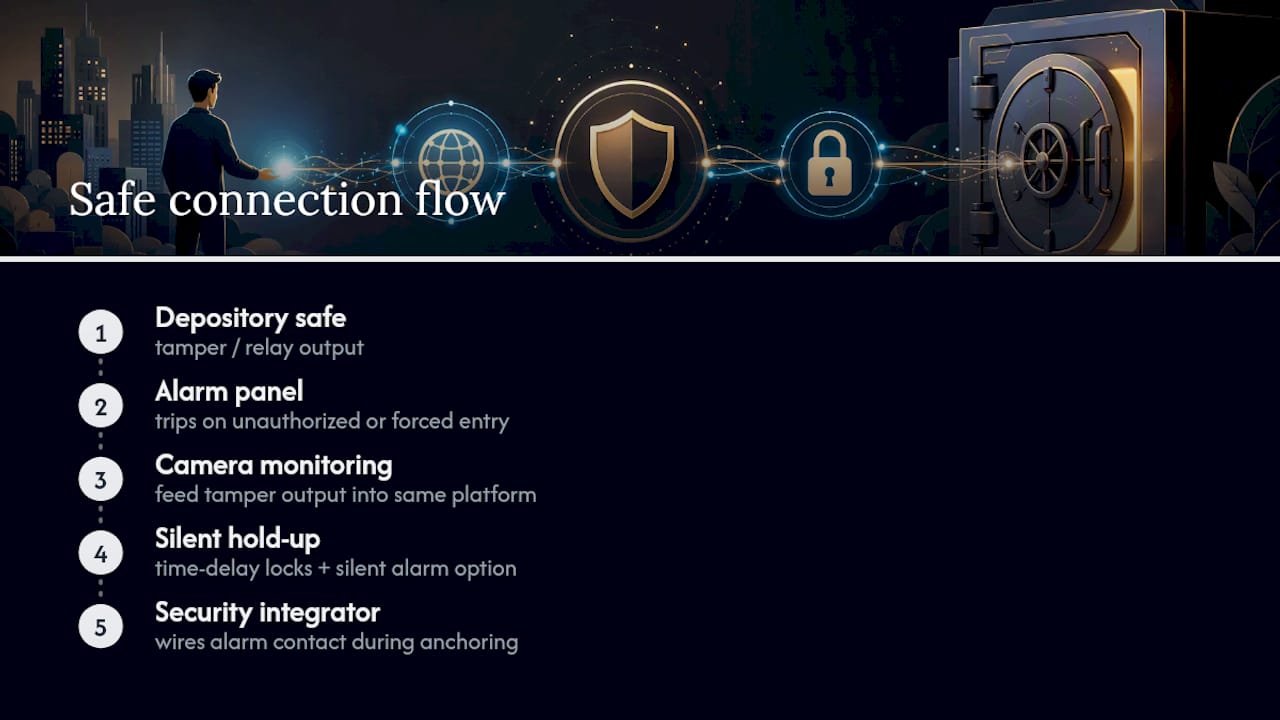
A standalone safe stops opportunists. A safe wired into your broader security system stops the ones who plan ahead. Many electronic locks support a dry contact or relay output that trips your alarm panel the instant someone attempts an unauthorized code entry, drills the lock, or forces the door.
Silent hold-up alarms deserve particular attention for cash-handling businesses. Time-delay locks paired with silent alarm options are recommended specifically to deter smash-and-grab robberies, giving staff a way to trigger a police response without tipping off whoever is standing in front of them.
If you already run camera coverage near the safe location, confirm the safe’s tamper output can feed into that same monitoring platform rather than sitting isolated. A locksmith or security integrator can usually wire a depository safe’s alarm contact into an existing panel during the same visit as anchoring, which saves a second service call.
How Should Staff Be Trained to Use a Depository Safe?
The best safe on the market fails if the people using it were never trained properly. New hires should learn the deposit procedure on day one, including how to confirm the deposit chute locked shut, how to read a tamper indicator, and what the lock-out mode looks like if someone fat-fingers a code too many times.
Set a clear policy on code sharing. Individual codes only work as an accountability tool if nobody writes theirs on a sticky note taped near the register. Rotate codes whenever an employee leaves, not on some quarterly schedule that leaves a gap.
Run a physical walkthrough, not just a verbal briefing. Have each employee actually deposit a test envelope, watch the mechanism close, and check the access log entry that follows. That five-minute exercise catches confusion before it becomes a real incident during a rushed Friday night close.
What Happens If Access Fails During an Emergency?
Every electronic lock eventually needs a backup plan. Dead batteries, a forgotten code, or a jammed keypad shouldn’t leave a business owner locked out of their own deposits. Most electronic depository safes include an emergency key override or a manager-level master code separate from daily staff codes.
Store that backup access information somewhere other than the store itself. A locked drawer at a manager’s home or a sealed envelope at a second location works better than a note taped inside a desk that a break-in would also compromise.
Write down, in advance, exactly who calls the locksmith if the primary lock fails entirely. Decide this before an emergency happens, not during one. A same-day locksmith response plan, confirmed with a provider who stocks parts for your specific lock model, keeps a lock failure from turning into a full business-day shutdown.
Why We Recommend Electronic Depository Safes With Bolting Capability
Many security solution providers tend to steer business customers toward electronic drop safes with anti-fishing designs and bolting capability, basing recommendations on feature combinations that prevent losses versus those that only look secure on a spec sheet. Multi-user code management solves the employee turnover problem that mechanical locks never address well.
Some providers offer commercial depository models built around the checklist covered here, along with buyer education content designed to help match a model to your actual deposit volume rather than a generic recommendation. If you’re planning an installation and want anchoring or wiring guidance specific to your floor plan, consider requesting a quote before you buy so the model and the install plan match from day one.
— Safes and Security Solutions
Ready to Compare Depository Safe Models?
Safes and Security Solutions carries commercial-grade depository options built around the exact features covered in this checklist, including burglary and fire-rated construction that goes beyond a basic drop box. The American Security BFS2214 Burglary and Fire Safe and the smaller-footprint American Security BFS912 Burglary and Fire Safe both pair reinforced boltwork with fire protection, which matters if your deposit safe also holds paperwork you can’t afford to lose in a fire.
Before you buy, pull up the spec sheet for any model you’re considering and check it against the construction, lock, and anchoring points covered above. If you need help matching anchoring hardware to your flooring, or want to confirm which lock configuration fits your staff turnover, contact our sales team for an installation quote and get a straight answer before the safe ships.
Sources
- 7 Benefits of a Digital Keypad Drop Safe for Retail and Restaurant Owners
- Best Depository Safes in 2026: Buyer’s Guide
- Depository Safe Buying Tips - Buying Guide to Deposit Safes and Drop Safes - Brown Safe Mfg.
FAQ
What Makes a Depository Safe Different From a Regular Safe?
A depository safe has a dedicated one-way deposit mechanism, usually a slot or rotary hopper, that lets cash go in without opening the main lock, while a regular safe requires full access every time.
Are Electronic Locks Reliable for Business Cash Drops?
Yes. Electronic keypad locks let you assign and retire individual employee codes instantly, which mechanical dials and keys can’t match, and most include low-battery warnings well before failure.
Do I Really Need to Bolt Down a Depository Safe?
Yes, if the safe holds meaningful cash volume. Weight alone doesn’t stop a determined thief with a dolly or pry bar; anchoring into concrete is the standard professional recommendation.
Can Safes and Security Solutions Help With Installation?
Some providers offer commercial depository models built to anti-fishing and bolting standards covered in this guide and can provide installation guidance through a direct quote request.