

Cash Management Safe Buying Tips for 2026
The single most important cash management safe buying tip: prioritize UL or ETL certification and user-level audit trails over price. A safe without independent certification is a marketing claim in a steel box. One without audit trails leaves you blind to internal theft, which is often the bigger threat.
Before you shop, here is what actually matters:
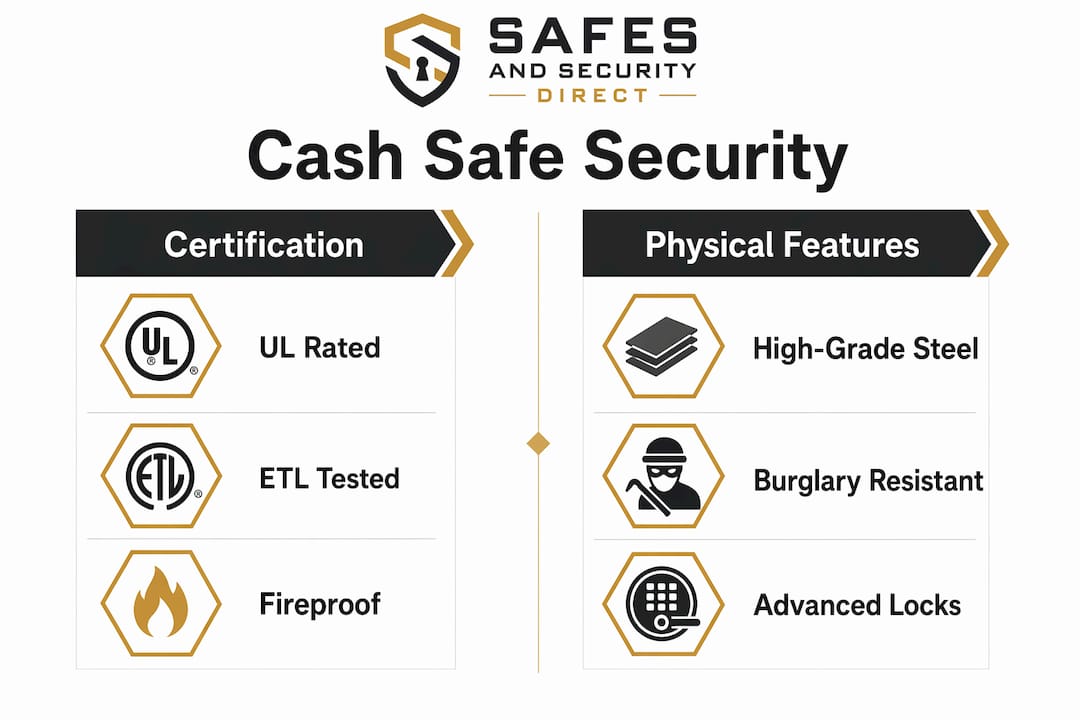
- Security certification first. Require UL or ETL fire and burglary ratings. A UL-certified fire safe protects paper and cash for at least 30 minutes at 1,550°F. Anything less is untested.
- Buy more capacity than you think you need. Businesses consistently underestimate storage volume. Purchase a safe with extra interior space beyond your current needs to avoid replacing it within a year.
- Audit trails are non-negotiable for businesses. Every deposit should be logged by user ID, denomination, time, and date. Without that, discrepancies are nearly impossible to trace.
- Check POS and software integration before you buy. A smart safe that cannot talk to your point-of-sale system creates a second reconciliation process instead of eliminating one.
- Plan the installation before the purchase. Confirm you have a concrete floor or structural wall for anchoring, a nearby power outlet, and a network connection if the unit requires remote reporting.
- Calculate total cost of ownership. Factor in service contracts, armored carrier fees, and software licensing alongside the purchase price.
- Verify warranty and support terms. Know whether the manufacturer provides on-site service or ships replacement parts, and how quickly they respond.
What are smart safes and how do they work?
A smart safe is a cash management device that automatically counts, validates, and records every deposit the moment cash enters the unit. Unlike a traditional depository safe, which simply stores whatever you drop in, a smart safe reads each bill by denomination and cashier ID in real time.
The core components are a bill validator, a deposit chute, secure storage, and a user interface, typically a touchscreen or keypad. When an employee makes a deposit, the validator scans each note, rejects counterfeits, and logs the transaction electronically. That data feeds into a reporting portal where managers can see cash activity by location, shift, and individual user.
The operational payoff is real. Automating cash counting and balancing can save retail employees between 60 minutes and 4 hours daily, time that was previously spent on manual counting, till prep, and bank runs. Smart safes also connect via ethernet or cellular to remote dashboards, enabling managers to monitor cash flow across multiple locations remotely.
Key functions at a glance:
- Real-time bill recognition and counterfeit rejection
- Electronic logging by denomination, cashier, and timestamp
- Remote monitoring and reporting via web portal
- Automated end-of-day reconciliation reports
- Integration with armored carrier pickup scheduling
What security features should a cash safe have?
Certification and physical hardening are the baseline. Everything else builds on top.
| Security Feature | What to Look For | Why It Matters |
|---|---|---|
| Fire rating | UL or ETL certified, 30-min minimum at 1,550°F | Protects cash and documents in most commercial fires |
| Burglary resistance | UL TL-rated or equivalent for high-cash businesses | Fire safes alone can be pried open quickly |
| Anchoring hardware | Pre-drilled holes, expansion bolts included | An unanchored safe can be removed rapidly by thieves |
| User access control | Individual PIN or biometric per employee | Limits exposure and creates accountability |
| Audit trail | Logs user, denomination, time, and date per deposit | Enables fraud detection and discrepancy investigation |
| Alarm and tamper detection | Audible alarm on forced entry or repeated wrong codes | Deters opportunistic theft |
| Remote alerts | Real-time notifications for unusual activity | Allows immediate response without on-site presence |
| Data security | Encrypted software, password-protected admin access | Prevents external hacking of transaction records |
UL and ETL certifications are the only fire ratings worth trusting. Manufacturer claims without third-party testing are meaningless. For businesses handling significant daily cash, look for a safe that carries both a fire rating and a burglary rating. They test for different threats, and most cheaper safes only address one.
Smart safe systems provide 100% accurate electronic cash counting by denomination and cashier, which enables real-time fraud detection and immediate alerts on suspicious activity. That combination of physical security and electronic monitoring is what separates a smart safe from a well-built box.
How do smart safes compare to traditional cash safes?
The right choice depends on your cash volume, staff size, and tolerance for manual processes.
| Category | Traditional Cash Safe | Smart Safe |
|---|---|---|
| Security features | Physical lock, fire/burglary rating, anchoring | All of the above plus electronic audit trails and remote alerts |
| Automation level | Manual counting, no electronic logging | Real-time bill validation, automated reconciliation |
| Installation needs | Anchoring to floor or wall, no power required | Anchoring plus power outlet and network connection |
| Cost and fees | Lower upfront, minimal ongoing costs | Higher upfront, possible service and software fees |
| Suitability | Low-to-moderate cash volume, home or small office | High cash volume retail, multi-location businesses, loss prevention priority |
Traditional safes do one thing well: they keep cash locked up. A quality burglary-rated model with proper anchoring is genuinely hard to defeat physically. What it cannot do is tell you who deposited what, flag a counterfeit, or send your finance team a reconciliation report at midnight.
Smart safes cost more upfront and typically carry ongoing service fees. The math shifts when you factor in that cash automation can save retailers over $10,000 annually and more than 500 labor hours. For a single-location shop with modest daily cash, a well-chosen traditional depository safe may be the smarter spend. For a restaurant group or a retail chain, the manual alternative gets expensive fast.
Pro Tip: When evaluating smart safe vendors, ask specifically whether you can use any armored carrier or whether the system locks you into one. Fiserv’s guidance on smart safe selection flags carrier flexibility as a top criterion, since multi-location businesses need competitive pricing across regions.
Which businesses benefit most from smart safes?
Smart safes deliver the clearest return in environments where cash moves fast and accountability is hard to maintain manually.
- High-volume retailers with multiple registers and daily cash totals in the thousands need automated reconciliation. Manual counting at that scale is slow, error-prone, and a theft risk.
- Restaurants and quick-service operations with frequent shift changes benefit from per-employee deposit tracking. Shift handovers are one of the highest-risk points in any cash cycle.
- Multi-location businesses gain the most from remote reporting. A manager overseeing five stores cannot physically verify cash at each location daily; a smart safe dashboard makes that possible.
- Businesses with high employee turnover need a system that is fast to learn. Easy, intuitive interfaces reduce training time and adoption barriers in high-turnover retail environments.
- Operations focused on loss prevention get a documented audit trail that makes internal theft far harder to conceal and far easier to investigate.
- Managers planning for growth benefit from scalable technology that handles increasing cash volume without adding headcount.
For home use or very small businesses with low daily cash, a cash deposit safe with a drop slot and a solid burglary rating often covers the need at a fraction of the cost.
What should you know about installation, maintenance, and support?
Installation is where many buyers underestimate the work involved. A smart safe is not a plug-and-play device.
- Anchoring is the single most important physical security step. Bolt the unit to a concrete floor or structural wall using the manufacturer’s hardware. Safe weight alone does not deter theft; an unanchored unit can be removed faster than most people expect.
- Power and connectivity must be confirmed before delivery. Smart safes require a dedicated power outlet and, depending on the model, an ethernet port or cellular connection for remote reporting.
- Backup power matters. If your location loses power during a shift, know whether the safe has a battery backup and how long it lasts.
- Firmware and software updates need a schedule. Outdated software can create security vulnerabilities. Confirm with the vendor how updates are delivered and whether they require on-site service.
- Routine maintenance prevents lock failures. Electronic locks wear with use. Schedule periodic inspections with a qualified locksmith, especially for high-frequency deposit environments.
- Staff training is part of the installation process. A smart safe only works as intended when every employee who touches it understands the deposit procedure, their unique ID, and what to do when the unit flags an error.
Review warranty terms carefully. Know whether coverage includes parts, labor, and on-site service, or only the hardware itself. For smart safe placement inside your business, position the unit away from public view and in a secured back-of-house area whenever possible.
Expert cash handling practices that make your safe work harder
Technology handles the counting. Humans still control the process around it.

Dual custody is the most effective structural control you can implement. No single employee should have complete control over cash handling from receipt through deposit. Requiring two people at key steps, such as safe counts, cash drops, and bank deposits, removes the opportunity for undetected manipulation.
Standardizing and documenting procedures is what turns a smart safe from a piece of equipment into a system. Write down exactly who handles cash, at what points, in what order, and what documentation each step requires. Then retrain on it regularly, including tenured employees who have developed shortcuts.
Additional practices that reinforce your safe investment:
- Use the audit trail actively. Pull reports weekly, not just when something goes wrong.
- Schedule deposits to prevent cash accumulation. The more cash sitting in a register, the bigger the target.
- Vary bank deposit times and routes if you transport cash manually.
- Combine electronic monitoring with physical oversight. Smart safe alerts flag anomalies; a manager still needs to follow up.
Brink’s cash handling guidance notes that more than 90% of U.S. consumers still use cash as a payment method, which means the operational stakes for getting this right remain high for most businesses.
How do top smart safe models compare on features?
Smart safe models vary significantly on the features that matter most to business buyers. The table below covers the categories worth comparing when you evaluate specific units.
| Feature Category | Entry-Level Models | Mid-Tier Models | Enterprise Models |
|---|---|---|---|
| Bill validation speed | Basic denomination recognition | Multi-denomination, counterfeit detection | High-speed multi-note validation |
| Reporting portal | Basic deposit logs | Full reconciliation reports, exportable | Real-time multi-location dashboards |
| User capacity | Single PIN or key | Multiple user IDs with permission levels | Unlimited users, role-based access |
| Connectivity | USB or local only | Ethernet, optional cellular | Ethernet, cellular, API integration |
| Carrier flexibility | Often locked to one vendor | Limited carrier options | Open carrier selection |
| Audit trail depth | Deposit totals only | Per-user, per-denomination logs | Full transaction history with alerts |
NationalLink and Clip Money both operate smart safe networks in the U.S. market, offering managed service models where the hardware, software, and armored pickup are bundled. Brink’s provides smart safe technology alongside its armored carrier network, giving businesses a single vendor for the full cash cycle. Fiserv’s smart safe platform focuses on software integration, with real-time reporting and reconciliation built for retail finance teams.
The right model depends on your daily cash volume, the number of users, and whether you need multi-location visibility. An enterprise platform is overkill for a single-location retailer; an entry-level unit will frustrate a high-volume operation within months.
How do you evaluate smart safe software integration compatibility?
Software compatibility is the step most buyers skip, and it causes the most post-purchase friction.
Start by mapping your current technology stack. Identify your POS system, accounting software, and any existing cash management tools. Then ask each smart safe vendor three direct questions: Does your platform integrate natively with my POS? What data formats do you export? Is there an open API?
Native POS integration means deposit data flows automatically into your sales reconciliation without manual entry. Without it, you are running two parallel records and reconciling them by hand, which defeats much of the purpose. Fiserv’s platform, for example, is built around central management and reporting that gives finance teams visibility by cashier and denomination across all locations from a single dashboard.
Check whether the reporting portal is web-based or requires installed software. Web-based portals are easier to access across locations and devices. Also confirm that the vendor’s software update cycle does not break existing integrations. Ask for a reference from a customer using the same POS system you run.
Pro Tip: Request a live demo using your actual transaction volume. Vendors often demo with clean, low-volume data. Seeing how the reporting portal handles a busy Friday night’s worth of deposits tells you far more than a slide deck.
How do you future-proof your smart safe purchase?
A safe you replace in two years is not a good investment, regardless of the upfront price.
Buy capacity ahead of your current need. If your daily cash volume is growing, a unit that fits today’s deposits will constrain you faster than you expect. The same logic applies to user capacity: a system that supports only a handful of user IDs becomes a bottleneck as your team grows.
Choose open carrier compatibility. Locking into a single armored carrier removes your negotiating leverage on pickup fees, which can become a significant ongoing cost. Fiserv’s smart safe guidance specifically identifies carrier flexibility as a must-have for businesses with multiple locations or regional coverage.
Verify the vendor’s software roadmap. A smart safe running on unsupported firmware in three years is a security liability. Ask how long the current platform is supported and what the upgrade path looks like. For guidance on safes for small businesses at different growth stages, the right unit today should still serve you at twice the transaction volume.
Finally, evaluate the vendor’s financial stability and support infrastructure. A company that cannot provide on-site service within a reasonable window, or that exits the market, leaves you with hardware and no support. Check contract terms for service-level commitments before signing.
Key Takeaways
Smart safe buying decisions hinge on UL/ETL certification, audit trail depth, software integration, and total cost of ownership, not purchase price alone.
| Point | Details |
|---|---|
| Certification is the baseline | Require UL or ETL fire and burglary ratings; uncertified safes offer no verified protection. |
| Audit trails prevent internal theft | Per-user, per-denomination logging makes discrepancies traceable and deters fraud. |
| Automation saves real money | Cash automation can save retailers over $10,000 annually and more than 500 labor hours. |
| Dual custody multiplies safe effectiveness | No single employee should control cash from receipt through deposit; two-person steps close the gap. |
| Future-proof with open carrier access | Carrier flexibility and scalable user capacity protect your investment as the business grows. |