

50mm ≈ 39.6°: Camera FOV Coverage for Photo, Security & Machine Vision
Camera field of view is the angular or physical extent of a scene that a lens and sensor combination can capture, expressed either in degrees or as a width and height at a given distance. Two things set it: the lens focal length and the sensor size, with working distance determining how those angles translate into actual feet or meters on the ground. Get those two variables right and lens selection for a photo, a security install, or a machine-vision rig stops being guesswork.
TL;DR:
- A 50mm lens on a full-frame sensor provides roughly a 39.6-degree horizontal field of view, suitable for natural perspective shots.
- Crop factors reduce the field of view when using smaller sensors, so the same lens behaves as a longer focal length on APS-C or Micro Four Thirds cameras.
- To accurately determine scene coverage, use the FOV angle and working distance with the tangent formula, adding a buffer to accommodate installation variations.
- Wide-angle lenses (14 to 24mm) offer large FOVs for cramped spaces or landscapes, while telephoto lenses (85mm and up) are better for subject isolation and background compression.
- Online FOV calculators simplify the math but do not account for fisheye lenses; manual calculation remains essential for precision in critical security or machine vision setups.
Table of Contents
- What Does Field of View Actually Mean?
- How Do You Calculate Angular Field of View?
- How Does Sensor Size Change Your Field of View?
- How Do You Convert Angular FOV to Real Scene Width?
- What FOV Do Common Focal Lengths Actually Give You?
- What Tools Can You Use to Calculate FOV Fast?
- How Should You Choose FOV for Photography, Security, or Machine Vision?
- How Does Safes and Security Solutions Use FOV in Product Recommendations?
- Where Can You Learn More About FOV Formulas and Tables?
- An Editorial Take on Getting FOV Right
- Get Coverage Calculations Right Before You Buy
- Sources
What Does Field of View Actually Mean?
Field of view splits into two related but distinct ideas: angular FOV and linear FOV. Angular FOV is measured in degrees, describing how wide a cone the lens sees. Linear FOV converts that angle into a real-world measurement, like a scene that’s 12 feet wide at a distance of 20 feet. Both matter, but for different reasons. Angular FOV tells you what the lens can do regardless of distance; linear FOV tells you what that lens will actually cover in your specific room, parking lot, or conveyor belt.
Most spec sheets break FOV into three axes: horizontal, vertical, and diagonal. Horizontal FOV gets used most often in casual conversation because it maps closest to how people describe framing, “how wide is this shot.” Vertical FOV matters more for security cameras mounted to catch full-height subjects, and diagonal FOV shows up in lens marketing because it’s always the largest number of the three, which makes for a better spec sheet.
There’s a subtler distinction worth knowing: angle of coverage versus angle of view). Angle of coverage describes the image circle a lens projects, which is often larger than the sensor. Angle of view is what the sensor actually records within that circle. A lens can cover more than your sensor uses, and manufacturers occasionally lean on that gap when describing “image circle” performance.
How Do You Calculate Angular Field of View?
The formula every FOV table traces back to is:
FOV = 2 × arctan(d / (2 × f))
Here, d is the sensor dimension you’re measuring, width, height, or diagonal, and f is the lens focal length, both in the same units (usually millimeters). This assumes a rectilinear lens, meaning straight lines in the scene stay straight in the image. Fisheye lenses use different math entirely, since they intentionally bend the projection.
For quick mental estimates, some people use a small-angle approximation, but it loses accuracy fast on wide-angle lenses. The full arctan formula is worth using every time you need a real number.
Here’s the calculation in practice, using a full-frame sensor (36mm wide) and a 50mm lens:
- Divide the sensor width by twice the focal length: 36 / (2 × 50) = 0.36
- Take the arctangent of that result: arctan(0.36) ≈ 19.8 degrees
- Double it to get the full angle: 19.8 × 2 ≈ 39.6 degrees
That 50mm lens on a full-frame body gives you roughly 39.6 degrees of horizontal field of view, which is why 50mm has earned its reputation as a “normal” lens. It roughly matches what the human eye perceives as natural perspective, at least along one axis. Run the same three steps with the sensor’s height instead of width, and you get the vertical FOV. Swap in the diagonal measurement, and you get the number most often printed on the box.
How Does Sensor Size Change Your Field of View?
A 50mm lens does not behave the same way on every camera. Put it on a smaller sensor and the field of view shrinks, even though the glass itself hasn’t changed. That shrinkage is described by crop factor, a multiplier that tells you how a lens’s focal length translates into “35mm-equivalent” terms.
Crop factor is calculated by comparing a sensor’s diagonal to the full-frame (35mm) diagonal. Multiply the actual focal length by the crop factor to get the equivalent focal length, the number that lets you compare lens behavior across formats.
- Full-frame (36 x 24mm): crop factor of 1.0x. A 50mm lens stays a 50mm-equivalent.
- APS-C (roughly 23.5 x 15.6mm, varies by brand): crop factor around 1.5x to 1.6x. That same 50mm lens behaves like a 75 to 80mm lens.
- Micro Four Thirds (17.3 x 13mm): crop factor of 2.0x. The 50mm lens now frames like a 100mm telephoto.
This is why manufacturers quote 35mm-equivalent focal lengths on compact cameras, phones, and security cameras. It gives buyers a common reference point, since “28mm equivalent” means roughly the same field of view no matter what physical sensor sits behind the lens. Skip that conversion and you’ll buy a lens that frames narrower or wider than you expected, a common and avoidable mistake when shopping across sensor formats.
How Do You Convert Angular FOV to Real Scene Width?
Knowing the angle in degrees is only half the job. What actually matters when you’re mounting a security camera or setting up a machine-vision inspection station is how many feet or millimeters that angle covers at your specific working distance. The formula for that is:
Frame width = 2 × distance × tan(FOV_horizontal / 2)
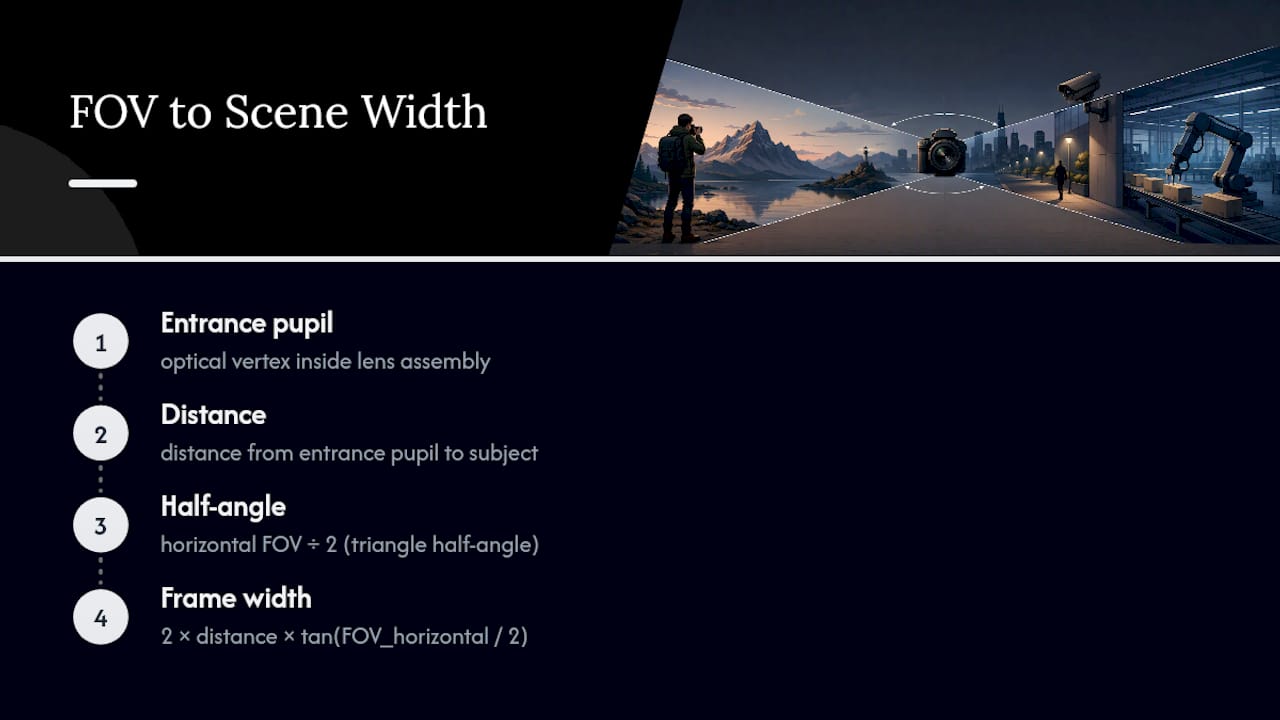
Plug in the horizontal angular FOV you calculated earlier and the distance from the lens to the subject, and you get the physical width of the scene. Run the same formula with vertical FOV to get scene height. Multiple calculators will do this math automatically once you enter sensor size, focal length, and distance.
One measurement convention trips people up: where exactly does “distance” start? Technically, the vertex of the FOV triangle isn’t the front of the lens barrel, it’s the entrance pupil, an optical point usually somewhere inside the lens assembly. At long working distances the difference is negligible. At short working distances, common in machine vision and close-quarters security mounts, using the lens’s mechanical front edge instead of the entrance pupil introduces measurable error that can throw off tight tolerance calculations.
Pro Tip: When you’re setting up a fixed camera for identification-critical work, like reading license plates or verifying faces, add a modest buffer to your calculated frame width. Real installs rarely hit the exact mounting distance you planned on paper, and a buffer keeps your subject inside the usable frame even if the mount ends up a foot off.
Also double-check your sensor’s aspect ratio before finalizing a layout. A 16:9 sensor and a 4:3 sensor cover different vertical territory even with identical horizontal FOV, which matters if your subject is a standing person rather than a low, wide storage aisle.
What FOV Do Common Focal Lengths Actually Give You?
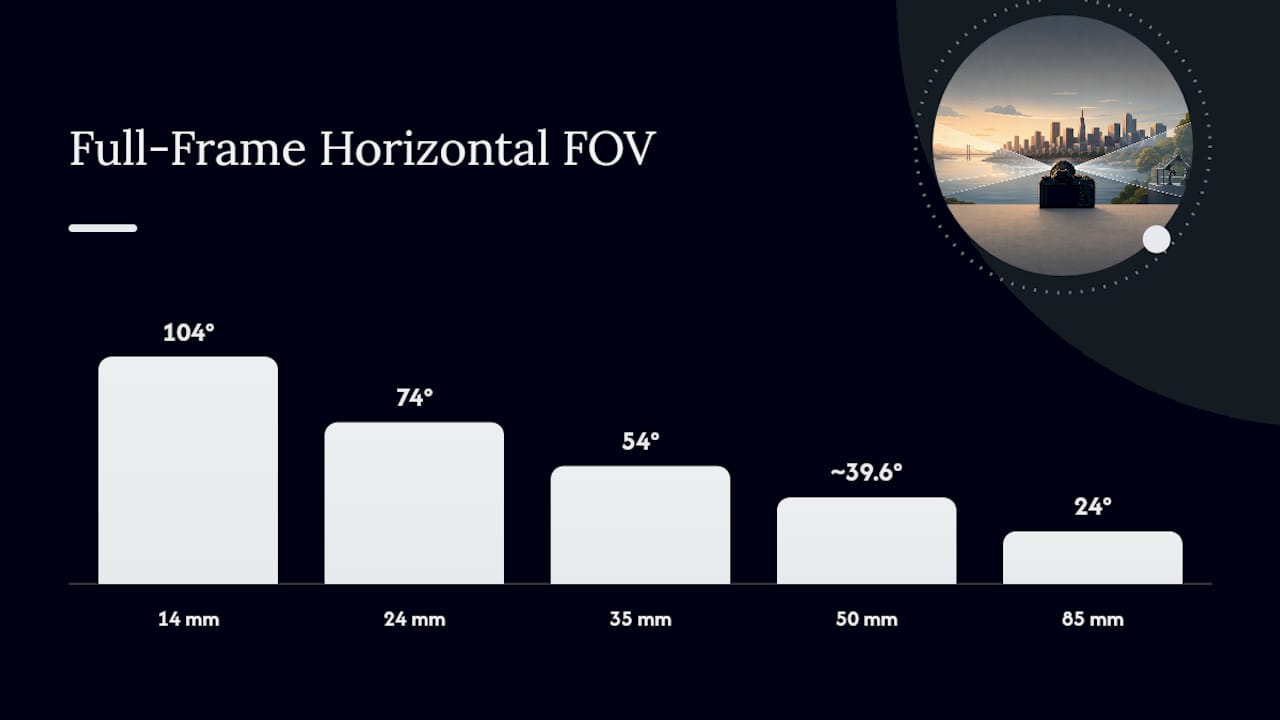
Here’s how focal length translates into field of view on a full-frame sensor, with APS-C figures included for comparison. These numbers come from standard FOV reference tables built on the same arctan formula covered earlier.
| Focal Length | Full-Frame Horizontal FOV | Full-Frame Diagonal FOV | APS-C Horizontal FOV (1.5x) |
|---|---|---|---|
| 14mm | 104° | 114° | 79° |
| 24mm | 74° | 84° | 53° |
| 35mm | 54° | 63° | 38° |
| 50mm | ~39.6° | 47° | 27° |
| 85mm | 24° | 29° | 16° |
| 135mm | 15° | 18° | 10° |
In practice, 14 to 24mm lenses are what most people call wide-angle, useful for cramped interiors, landscapes, and any scene where you need to fit a lot into the frame without physically backing up. Tamron’s lens classifications put anything at 35mm and shorter into wide territory, with 50mm marking the standard, natural-perspective zone. 85mm and upstarts compressing background elements and flattering portrait subjects, and by 135mm you’re solidly into telephoto territory, isolating subjects and compressing distance between foreground and background.
One exception worth flagging: fisheye and other non-rectilinear lenses don’t follow this table at all. Their whole design goal is to cram far more than 180 degrees of coverage into a frame by intentionally bending straight lines, so the standard arctan formula doesn’t apply to them.
What Tools Can You Use to Calculate FOV Fast?
You don’t need to run the arctan formula by hand every time. A handful of online tools handle it instantly once you enter sensor size, focal length, and distance:
- The Tools for Film FOV calculator outputs horizontal, vertical, and diagonal angles along with a visual cone, useful for cinematographers scouting a shot before ever picking up a camera.
- Sites offering camera FOV calculators return both the angular figures and the physical frame width and height at your chosen distance.
- Precomputed lookup tables save time when you already know your sensor format and just need a fast reference.
As a mental shortcut: halving the focal length does not double the angle of view. The arctan relationship is non-linear, especially at wide angles, so eyeballing it will get you in the ballpark but not to a number you should build an installation around. And if you’re working with a fisheye or VR-style lens, skip the calculators built for rectilinear glass entirely. They’ll give you a confidently wrong answer.
How Should You Choose FOV for Photography, Security, or Machine Vision?
The math stays the same across all three fields; the priorities that drive your final choice don’t.
- For photography, let composition lead. Wide lenses exaggerate depth and distance between foreground and background, telephoto lenses compress it, and the “right” choice depends on the story you’re telling with the frame, not a technical optimum.
- For security, separate coverage goals from identification goals. Wide FOV lenses cover more ground but sacrifice pixel density on any single subject, which matters if you need to read a face or license plate rather than just confirm movement happened. A moderate mounting height, angled down slightly, is commonly recommended for entryway cameras. Build in a coverage buffer at property lines rather than cutting the frame edge exactly on the boundary.
- For embedded vision, work backward from pixel-per-millimeter requirements on your target object, then derive the working distance and focal length needed to hit that resolution. At short working distances, use entrance-pupil-based measurements rather than the lens’s front edge. The error margin at close range is exactly where inspection tolerances tend to break.
A security camera buying guide can help translate these FOV principles into an actual shopping list once you know what coverage angle your property needs.
How Does Safes and Security Solutions Use FOV in Product Recommendations?
Camera listings on our site include both angular and linear field of view figures, not just a headline number, because a raw degree value doesn’t tell a customer whether a camera will actually cover their driveway or hallway. When a customer describes a mounting height and distance, our staff run that working-distance math to confirm the frame width and height match what the space actually needs before recommending a specific model.
Coverage on paper and coverage in a real hallway are two different things until someone runs the working-distance numbers for that specific mount.
Where Can You Learn More About FOV Formulas and Tables?
- Understanding Focal Length and Field of View, the core application note behind the FOV formula and entrance-pupil precision notes.
- FOV Tables by Focal Length, precomputed reference tables across sensor formats.
- Tools for Film FOV Calculator, a fast visual tool for cross-sensor comparisons.
An Editorial Take on Getting FOV Right
Most FOV content stops at the formula and calls it done. That’s backwards for anyone actually mounting a camera. The formula matters, but the working-distance conversion, the step that turns 39.6 degrees into “12 feet wide at 20 feet,” is where real installs succeed or fail. We’d argue the industry undersells this conversion because it’s less elegant than a clean trigonometric formula, even though it’s the number that determines whether a camera actually catches the delivery entrance or leaves six feet of blind spot at the property line.
The other place conventional advice falls short: treating entrance-pupil precision as an academic footnote. It isn’t, if your working distance is short. Prioritize the physical frame size at your actual install distance first, then worry about the exact angular spec. A wider-angle lens with the wrong coverage math will disappoint you faster than a narrower one you measured correctly.
— Safes and Security Solutions
Get Coverage Calculations Right Before You Buy
Running FOV math on your own gets you close. Pairing that math with hardware built for the coverage you actually calculated is what closes the gap between a spec sheet and a camera that catches what you need it to catch. Security solutions providers typically offer surveillance systems alongside fire and burglary-resistant storage that often share the same protection plan, so the footage a wide-coverage camera captures has somewhere secure to point.
If you’ve just worked out that your entryway needs a wider horizontal FOV than your current camera delivers, our types of security cameras guide walks through mounting and lens options suited to different coverage needs. And once footage is being recorded, protecting the physical valuables it’s watching over is the other half of the equation. Browse a model like the American Security BFS912 Burglary and Fire Safe to see how coverage planning and asset protection fit into the same security plan, and reach out to our team if you want help matching a camera’s FOV to your exact mounting distance before you order.