

Bolt Down Undercounter Safes For Installers and Small Businesses
For most homes and small businesses, the best undercounter safe is a compact steel unit with an anti-fish baffle over the deposit slot and pre-drilled holes for bolting into the counter or floor framing. The American Security UL1511 UL Listed 2 Hour Home Fire Safe is a practical option worth inspecting for buyers who need both fire protection and daily accessibility. Cash-heavy retail counters usually want a dedicated deposit slot, while home offices lean toward a general-purpose fire and burglary box.
TL;DR:
- Anti-fish baffles are necessary for deposit safes to prevent cash theft through fishing tools, making their absence a major security flaw.
- Safe installation must involve anchoring into structural framing or concrete using appropriate hardware; unbolted safes are easy to carry away.
- Higher burglary ratings like UL TL15 or TL30 offer 15 to 30 minutes of protection against tools and drills, while fire ratings indicate resistance to heat for up to two hours.
- Mechanical locks require minimal maintenance but lack access logs, whereas electronic and biometric locks improve accountability but need regular battery or sensor upkeep.
- Ensuring proper installation, including correct mounting surface and periodic tamper checks, is more critical to security than choosing a brand with a higher price or fancy features.
Table of Contents
- What to Look for in an Undercounter Safe
- Undercounter Safe Types and Best Use Cases
- Locks, Access Control, and Accountability
- How to Install and Secure an Undercounter Safe
- Certifications and Security Ratings That Actually Mean Something
- Maintenance and Troubleshooting by Lock Type
- How Steel Gauge and Build Quality Determine Real Security
- Warranty Coverage and Support Worth Checking Before You Buy
- Why Installation Quality Beats Brand Name Every Time
- Ready to Buy: What to Check Before You Order
- Sources
What to Look for in an Undercounter Safe
Skip the marketing copy and check six things before you buy. Miss any of these and you’ve bought a box, not a safe.
- Anti-fish baffle. If the safe has a deposit slot, it needs an internal saw-tooth baffle that blocks adhesive-tipped tools or wire from fishing cash back out. This design shows up on most dedicated depository units, and its absence is a dealbreaker for retail cash drops.
- Bolt-down provisions. Pre-drilled holes in the floor of the safe aren’t decoration. Every undercounter safe should be anchored into structural framing, because an unbolted safe, no matter how heavy the door, can simply be carried out the back door.
- Lock type. Mechanical keys are simple and cheap to replace but hard to audit. Electronic keypads log entries. Biometric scanners add speed but bring their own quirks, which the next section covers in more detail.
- Door and body thickness. Thicker steel and active relockers (small pins that jam the bolt mechanism if someone attacks the lock) resist prying and drilling far better than thin sheet metal with a single locking bolt.
- Fire rating versus burglary rating. These are different tests measuring different threats, and a safe strong against one isn’t automatically strong against the other.
- Everyday usability. Interior lighting, a carpeted floor to protect jewelry or electronics, and removable trays matter more once the safe is actually part of your daily routine.
Pro Tip: If you’re storing both a fire hazard risk (paper documents) and daily cash, don’t assume one rating covers both. A safe built for fire protection often trades away some burglary resistance, and vice versa, so match the rating to your bigger risk.
Undercounter Safe Types and Best Use Cases
Not every undercounter safe does the same job, and picking the wrong category is the most common buying mistake.
- Deposit/drop safes. Built around a slot with an anti-fish baffle, these are designed for retail counters where employees drop cash through the top without opening the main compartment. Capacity is intentionally limited. You’re storing envelopes and bundles, not filing cabinets’ worth of paper.
- Compact undercounter or desk safes. These skip the deposit slot entirely and function more like a mini vault for keys, small electronics, or a backup hard drive. Many models add interior lighting and carpeted trays since they’re opened and closed throughout the day.
- Hotel-style small safes. Lightweight, keypad-driven, and inexpensive, these fit tight budgets but rarely carry meaningful burglary ratings. Fine for a hotel room. Risky as your only safe for a cash-handling business.
Weight matters more than people expect. A 200-pound safe is harder to remove even before bolting, while anything under 100 pounds needs anchoring the day it’s installed, not “eventually.” Match interior dimensions to your actual items: a standard cash bag, letter-size documents, or a stack of key fobs all need different depth and shelf configurations, so measure your real inventory before ordering.
Locks, Access Control, and Accountability
The right lock depends less on brand preference and more on how many people need access and how often.
- Mechanical key locks are reliable and need no batteries, but a lost key means a locksmith visit, and there’s no record of who opened the safe or when. High-security cylinders, Medeco-style key systems included, resist picking and unauthorized duplication far better than standard cylinders.
- Electronic keypad locks log every open attempt and let you change the code without replacing hardware. Keep a battery replacement schedule (most run on standard 9V batteries) and always record the manufacturer’s backup key or override procedure somewhere other than inside the safe.
- Biometric locks offer the fastest legitimate access, but fingerprint sensors can struggle with wet hands, cuts, or dust buildup on the reader. Treat biometric as a convenience layer, not your only access method. Comparing biometric and keypad systems side by side before buying saves a lot of frustration later.
- Dual-key or dual-control setups, where two separate credentials are required to open the safe, suit businesses that need accountability, particularly cash-handling operations with shift changes.
- Backup access planning isn’t optional. Store an emergency key or code recovery process off site, not taped under the counter next to the safe.
How to Install and Secure an Undercounter Safe
Buying the right safe accomplishes nothing if it sits unbolted on a countertop.
- Check the mounting surface first. Structural framing, concrete subfloor, or a genuinely reinforced counter works. Particle-board cabinetry does not; the bolts will simply pull through under stress.
- Match the hardware to the surface. Lag bolts into wood framing, concrete anchors into a slab. Use the fasteners specified for the material, not whatever is already in the toolbox.
- Follow a deliberate bolt sequence. Tighten opposite corners first, then work around the base, checking that the safe sits flush with no rocking before final torque.
- Run a pull test. After bolting, try to shift the safe by hand from multiple angles. If it moves at all, the anchor point is wrong or the hardware is undersized.
- Inspect for tamper signs periodically, loose bolts, scratched anchor plates, or gaps around the mounting flange are early warning signs worth catching before a break-in attempt, not after.
- Know when to call a professional. If you’re drilling into a slab, running conduit for an alarm tie-in, or the counter material is unclear, a licensed installer protects both the warranty and, in some cases, your insurance coverage. Ask what the installer’s own work is guaranteed for.
Pro Tip: Do the pull test with the safe empty and again once loaded. A safe that holds firm empty can behave differently once weight shifts the load against the anchor points. Full bolt-down steps and mounting mistakes are worth reviewing before you drill a single hole.
Certifications and Security Ratings That Actually Mean Something
UL listings are the closest thing this industry has to a universal scorecard, and they matter more than any marketing claim on a product page. A UL Residential Security Container (RSC) rating means the safe survived five minutes of attack with common tools in a lab test. UL TL15 and TL30 ratings step up from there, requiring the safe to resist tool, torch, or drill attacks for 15 or 30 minutes respectively, and these show up on higher-end undercounter models built for cash-heavy businesses.
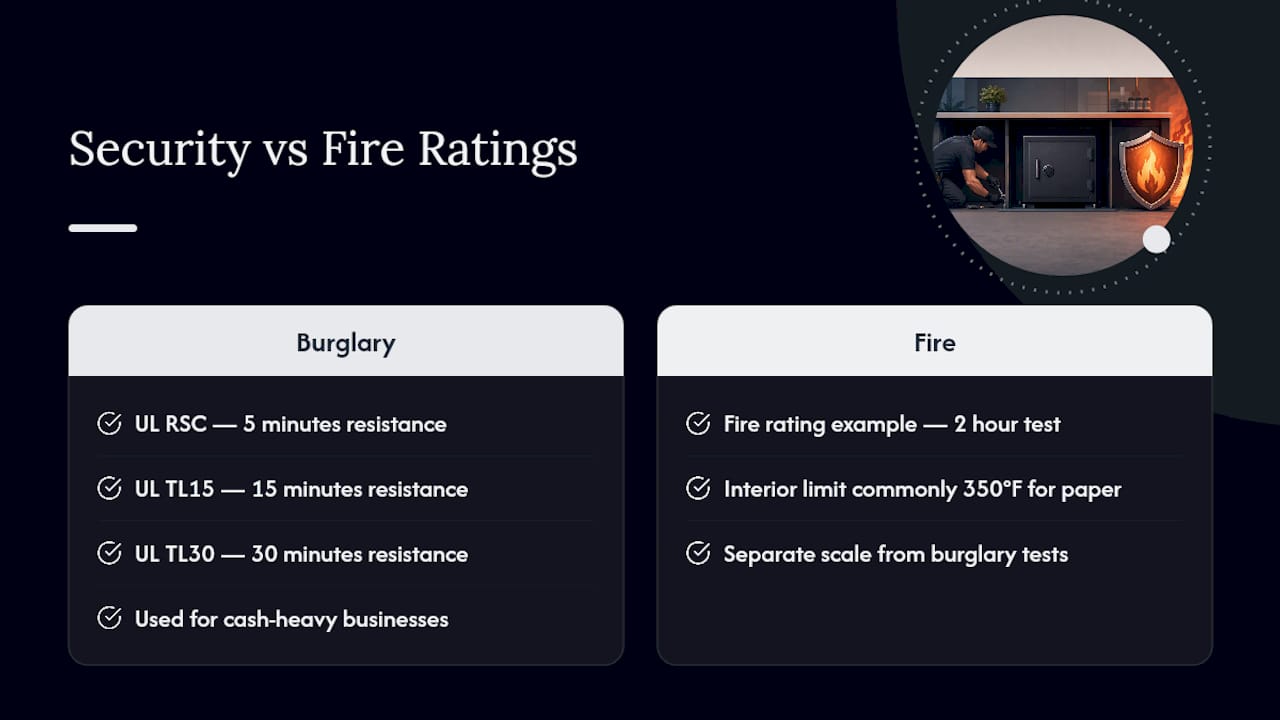
Fire ratings run on a separate scale entirely, usually expressed as a time and temperature the safe’s interior stays below a damage threshold (commonly 350°F for paper) during a fire. A “2 hour” fire rating means the safe was tested to hold that interior temperature for two hours in a standard fire exposure test.
Regulated storage adds another layer entirely. Safes holding controlled substances, such as pharmacy narcotics, often need to meet DEA-specific construction standards paired with UL TL ratings. If that applies to your business, check current DEA guidance directly rather than relying on a retailer’s general safe recommendation.
Maintenance and Troubleshooting by Lock Type
Mechanical locks need the least attention: an occasional drop of graphite or lock-specific lubricant in the keyway keeps the mechanism smooth, and a spare key stored off-site prevents a lockout from becoming an emergency. If a mechanical lock starts feeling gritty or the key needs extra force, that’s early wear, not something to ignore.
Electronic keypads fail almost exclusively for one reason: dead batteries. Set a calendar reminder every six to twelve months and replace batteries before they die, not after. Keep the manufacturer’s override key accessible somewhere other than inside the safe itself. If the keypad becomes unresponsive after a battery change, check the contacts for corrosion before assuming the unit failed.
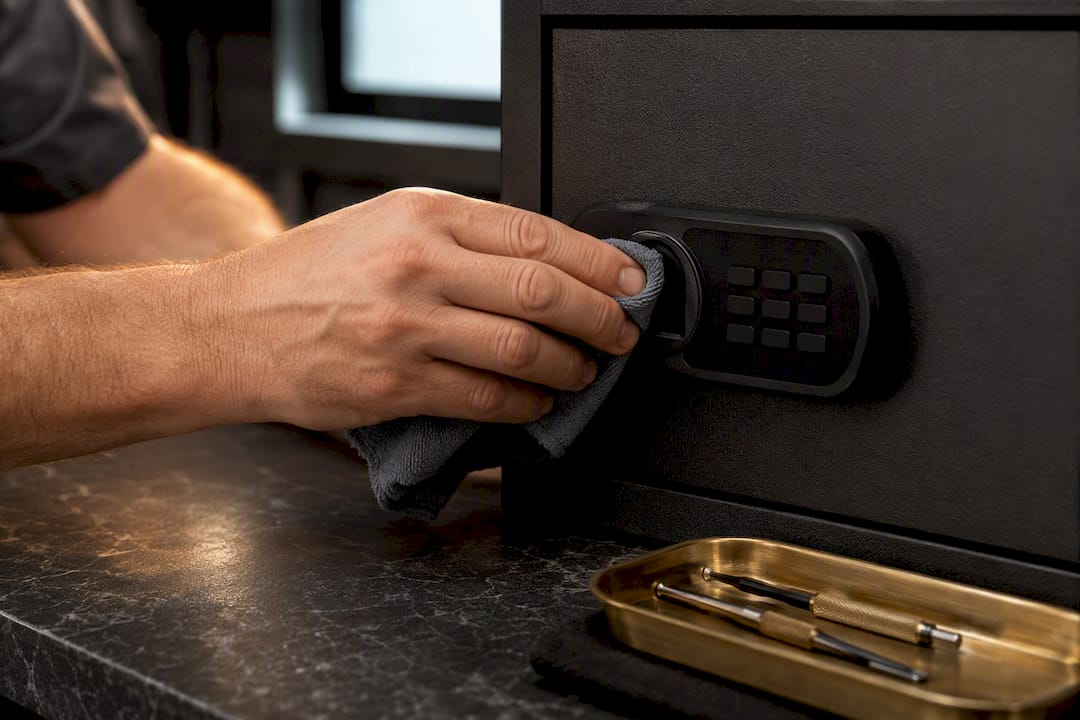
Biometric readers need a clean sensor surface. Wipe the scanner with a dry microfiber cloth weekly in dusty environments, and re-enroll fingerprints periodically since scar tissue and skin changes over time can degrade recognition accuracy. Most biometric units include a keypad or key backup for exactly this reason. Use it, and test it occasionally, so you’re not discovering it doesn’t work during an actual lockout.
How Steel Gauge and Build Quality Determine Real Security
A safe’s advertised weight is a decent proxy for how seriously it was built, but gauge and construction detail tell the real story. Thicker steel resists prying and drilling longer, and the door typically carries heavier gauge steel than the body since it’s the point of attack. Look for multiple locking bolts rather than a single bolt securing the door. A safe with one locking point can sometimes be pried open at the opposite corner even with a good lock.
Active relockers matter more than most buyers realize. These are small internal components that jam the bolt mechanism permanently if someone drills or torches near the lock, turning a defeated lock into a welded-shut door. Continuous-hinge construction, where the door hinge runs the full height rather than using two or three separate hinge points, also resists prying attempts that target hinge-side vulnerabilities. None of this shows up in a glance at a product photo, so check the spec sheet for locking bolt count, relocker presence, and steel gauge before assuming heavier automatically means better.
Warranty Coverage and Support Worth Checking Before You Buy
Warranty terms vary widely across the safe industry, and the fine print matters more than the length of the coverage period. Check whether the warranty covers the lock mechanism separately from the body, since electronic components typically fail before the steel does. Ask whether a warranty claim requires the original purchase receipt and whether it transfers if you sell the property with the safe still installed, relevant for commercial buyers who lease space.
Support responsiveness matters just as much as the paper warranty. A locksmith or manufacturer support line that can talk you through a jammed keypad or a lost combination on the same day beats a longer warranty period with no real access to help. Before buying, confirm whether installation guidance and troubleshooting support come from the retailer directly or get routed to a third-party manufacturer, since that affects how fast you get an answer when something goes wrong.
Why Installation Quality Beats Brand Name Every Time
The pattern that shows up again and again in retailer rankings and buyer feedback is simple: the single biggest driver of real-world security isn’t the brand on the door, it’s whether the safe got bolted down correctly. A mid-tier safe anchored into structural framing outperforms a premium unit sitting loose on a countertop.
The trade-offs are real and worth naming honestly. A higher fire rating usually means a bulkier interior wall, which eats into usable capacity. A biometric lock speeds up daily access but adds a failure point that a mechanical lock doesn’t have. None of these are dealbreakers, but pretending they don’t exist sets buyers up for disappointment. Choose based on which trade-off costs you less, not which spec sheet number looks biggest.
— Safes and Security Solutions
Ready to Buy: What to Check Before You Order
Once you’ve settled on anti-fish protection, a solid lock type, and a bolt-down plan, the remaining decision is picking hardware that fits your space and risk profile. The American Security UL1511 UL Listed 2 Hour Home Fire Safe fits buyers who want documented fire protection alongside everyday accessibility for cash, keys, and small valuables, without needing a full-size floor safe.
Before ordering anything, measure your available undercounter space and confirm the mounting surface, whether that’s a subfloor, a reinforced counter base, or structural framing, since that determines which anchor hardware you’ll need on day one. Product specifications and installation guidance are provided to help match a safe to your space, and support teams can assist with custom mounting questions for unusual counter setups. Check the dimensions against your actual inventory of cash, documents, or valuables first, then reach out for a quote or installation guidance before you commit to a model.
Sources
For deeper category background, see choosing the right under counter deposit safe, and for fire-protection context in commercial spaces, review the role of fireproof doors in commercial buildings.
- How to Anchor a Gun Safe the Right Way – Safes and Security Solutions