

Avoid Failed DEA Audits: Narcotics Safes That Export Audit Logs
For most hospitals and pharmacies, electronic locking narcotics cabinets are the best narcotics safes on the market because they solve the compliance problem, not just the physical security problem. Smaller clinics and EMS operations often do better with double-lock boxes or bolted safes sized to their volume. Either way, the feature that decides whether an inspector signs off is the audit trail. This guide walks through the categories, the checklist, and the setting-by-setting tradeoffs so you can buy the right unit the first time.
TL;DR:
- Electronic locking cabinets with individual access logs are essential for hospitals and high-volume clinics to meet federal and inspector requirements.
- Smaller clinics or emergency services should opt for double-lock boxes or bolted safes, as they rely on paper logs and staff discipline for compliance.
- Proper installation, mounting hardware rated for mobile use, and connectivity testing are critical for EMS units to maintain audit trails and operational safety.
- Vendors must be able to export full, readable audit logs and support compliance documentation before purchase to avoid inspection failures.
- Budgeting should include long-term costs such as installation, servicing, software licensing, and potential replacement costs for undersized units.
Table of Contents
- What the Rules Actually Require for Controlled-Substance Storage
- Types of Narcotics Safes and When to Use Each
- Features That Actually Matter: A Quick Checklist to Vet Specs
- How Choice Differs by Setting: EMS, Pharmacy, and Hospital
- Installation, Transport, and EMS-Specific Technical Notes
- Procurement Checklist and Red Flags for Compliance
- Publisher Resources From Safes and Security Solutions
- Maintenance and Inspection Routines That Keep You Compliant
- Cost Ranges and Budgeting Tips for Purchasing Narcotics Safes
- An Editorial Take on Buying for Compliance, Not Just Storage
- Find the Right Narcotics Safe Through Safes and Security Solutions
- Sources
What the Rules Actually Require for Controlled-Substance Storage
Federal regulation on controlled substances calls for storage that is “securely locked” and “substantially constructed.” That phrase sounds vague on purpose. It leaves room for a locked drug cart in a small clinic and a vault-grade cabinet in a hospital pharmacy, as long as each one matches the risk of the setting. What inspectors actually check is narrower than the regulation’s language suggests: they want to know who opened the storage and when.
That accountability requirement is where most narcotics storage solutions succeed or fail. A safe can be rated, bolted, and fireproof, and still get flagged during a Drug Enforcement Administration style audit if nobody can produce a clean access record. Auditors typically ask for:
- User-level logs showing who accessed the cabinet and at what time
- Tamper logs or alerts documenting any forced or failed entry attempts
- Proof of installation, including anchoring and mounting documentation
- Written SOPs covering who holds access credentials and how they’re issued
Hospital systems and state pharmacy boards frequently add their own layer on top of the federal floor, often requiring two-person controls for high-risk narcotics or additional sign-off for controlled substance waste. Buy for the strictest rule that applies to you, not the loosest one.
Types of Narcotics Safes and When to Use Each
Volume and audit exposure should drive the category you shop in, not price alone.
Electronic locking cabinets dominate hospital pharmacies and high-volume clinics for good reason. They offer drawer-level access control, biometric or card-based authentication, and a full digital audit trail. Some models can be configured so a drawer only opens for the specific medication a clinician requests, which reduces errors associated with accessing the wrong drawer in busy units and helps prevent stock theft and shrinkage through electronic controls as explained in this EPOS system stock-theft prevention guide. These narcotics cabinets also tend to integrate with pharmacy inventory systems, which matters if you’re already tracking stock electronically.
- Best fit: hospitals, high-volume pharmacies, any site facing regular audits
- Tradeoff: higher upfront cost, more setup time, ongoing software or service fees
Double-lock, double-key narcotics boxes are the simplest form of dual custody. Two separate staff members hold separate keys, and neither can access the contents alone. A double-lock narcotics box works well for small clinics with low-volume, low-turnover inventories where an electronic system is overkill.
- Best fit: small clinics, satellite offices, low-volume EMS supply rooms
- Tradeoff: no digital audit trail. Compliance depends entirely on paper logs and staff discipline
Heavy-duty pharmacy safes and UL/TL-rated safes add physical burglary and fire protection on top of access control. A professional-grade pharmacy safe built with thick steel and an electronic lock supporting dozens of users and a multi-thousand-record audit trail suits long-term, high-value inventory storage better than a lighter cabinet.
- Best fit: pharmacies storing high-value or long-dated inventory, sites with break-in risk
- Tradeoff: heavier footprint, professional installation, higher purchase price
Features That Actually Matter: A Quick Checklist to Vet Specs
Vendor spec sheets bury the features that matter under ones that don’t. Run every candidate against this list before you compare pricing.
- Access control. Require individual user IDs at minimum. For high-risk narcotics, require dual authentication or a two-person rule built into the workflow, not just policy.
- Audit trail depth. Confirm retention length, whether logs export to CSV or PDF, and whether tamper attempts get logged with readable timestamps.
- Physical security rating. Check steel gauge, bolt count, and anchoring points. Ask whether a fire rating applies if you’re storing paper records alongside product.
- Tamper and alarm integration. Look for time-delay locking, alarm triggers on forced entry, and compatibility with existing camera systems.
- Drawer sizing and capacity. Match compartment count and size to your actual SKU count, not a generic “small/medium/large” label.
- Logistics. Confirm battery backup behavior, manual override procedure, service response time, and parts availability under warranty.
Pro Tip: Ask the vendor to export a sample audit report before you buy, not after. If the export is clunky, hard to read, or missing timestamps, that’s the same report an inspector will be squinting at during a real audit.
How Choice Differs by Setting: EMS, Pharmacy, and Hospital
The right safe for a fixed pharmacy is often the wrong safe for a moving ambulance, and the checklist above needs local translation.
- EMS units need to survive vibration, hard braking, and repeated door slams, not just theft attempts. Mounting hardware matters more here than drawer count. Battery backup and a documented failsafe are non-negotiable since a dead lock mid-shift is a real operational problem, and connectivity for inventory sync after transport keeps the audit trail intact between calls.
- Pharmacy settings favor high-capacity, audit-capable cabinets that integrate with existing inventory software. Anchoring the unit to a wall or floor, and securing the room itself, usually matters as much as the cabinet’s own lock rating.
- Hospital wards need a balance: drawer-level access at the bedside or nursing station, with central pharmacy retaining override control. Some hospitals use transport carts with their own locking compartments instead of a single fixed cabinet per floor, which keeps custody continuous during patient transfers.
A rural EMS unit running one ambulance might reasonably choose a compact vibration-rated cabinet with a simple PIN pad. A 400-bed hospital pharmacy almost certainly needs a networked electronic system across multiple floors. Both can be fully compliant; the difference is volume and movement, not standards.
Installation, Transport, and EMS-Specific Technical Notes
A safe that’s rated correctly but installed poorly still fails an inspection. Anchoring has to happen at install, not as an afterthought, and you should photograph the bolts and mounting points before the unit gets covered by shelving or a cabinet skin.
- Test battery backup and manual override immediately after install, not months later during an actual power failure.
- For EMS, insist on mounting brackets rated for vehicle use, and confirm the unit has passed shock and vibration testing for mobile deployment.
- Run a connectivity test to confirm inventory sync reaches your central system correctly after the vehicle is back in service.
- Pair the cabinet with existing alarm and camera systems where possible, and set a retention policy for how long that footage gets kept as supporting evidence.
Procurement Checklist and Red Flags for Compliance
Buying the right cabinet on paper doesn’t help if the vendor can’t back it up with documentation. Before you sign anything, get answers on:
- Can the system export a full audit log, and in what format?
- How are tamper events logged, and can you see a sample tamper log?
- What’s the maximum number of individual users the system supports?
- What’s the service response time under the warranty, and is it in writing?
- Does the vendor offer installation support, and can they provide proof of past GPO contract work or installation service for similar facilities?
Keep every answer in a compliance folder alongside spec sheets, installation photos, your written access policy, and staff training logs. That folder is what you hand an inspector, not a sales brochure.
Red flags: a vendor who can’t produce a sample audit export, a lock system with no user cap disclosed, or a “lifetime warranty” that turns out to exclude the lock mechanism itself.
Pro Tip: Run a 30 to 60 day pilot with one unit before rolling out across a facility. Verify the audit logs actually match your manual counts before you commit to a full purchase order.
Publisher Resources From Safes and Security Solutions
Safes and Security Solutions carries pharmacy and narcotics safes built around the same features covered in this guide, from single-door cabinets to full pharmacy vaults. The NARCO3824 single door pharmacy safe is a practical example of a compact unit sized for a single-location pharmacy or clinic.
For readers still deciding whether their facility even needs a dedicated unit, the narcotic safe benefits guide walks through the case for secure medication storage in plain terms. And if you’re trying to figure out the threshold where a locked cabinet stops being enough, the pharmacy compliance guide breaks down when a full safe becomes necessary versus when a smaller box will do.
Maintenance and Inspection Routines That Keep You Compliant
A narcotics safe isn’t a set-and-forget purchase. Locks wear, batteries degrade, and staff turnover creates gaps in who’s actually trained on the system. Build a recurring inspection schedule rather than waiting for an annual audit to surface problems.
Monthly checks should cover battery backup status, physical inspection of bolts and anchoring points, and a spot check of the audit log against a manual count of inventory. Quarterly, test the manual override procedure end to end, confirm alarm integration still triggers correctly, and review who currently holds access credentials against your active staff roster. Terminated employees whose access hasn’t been revoked are one of the most common findings in internal compliance reviews.
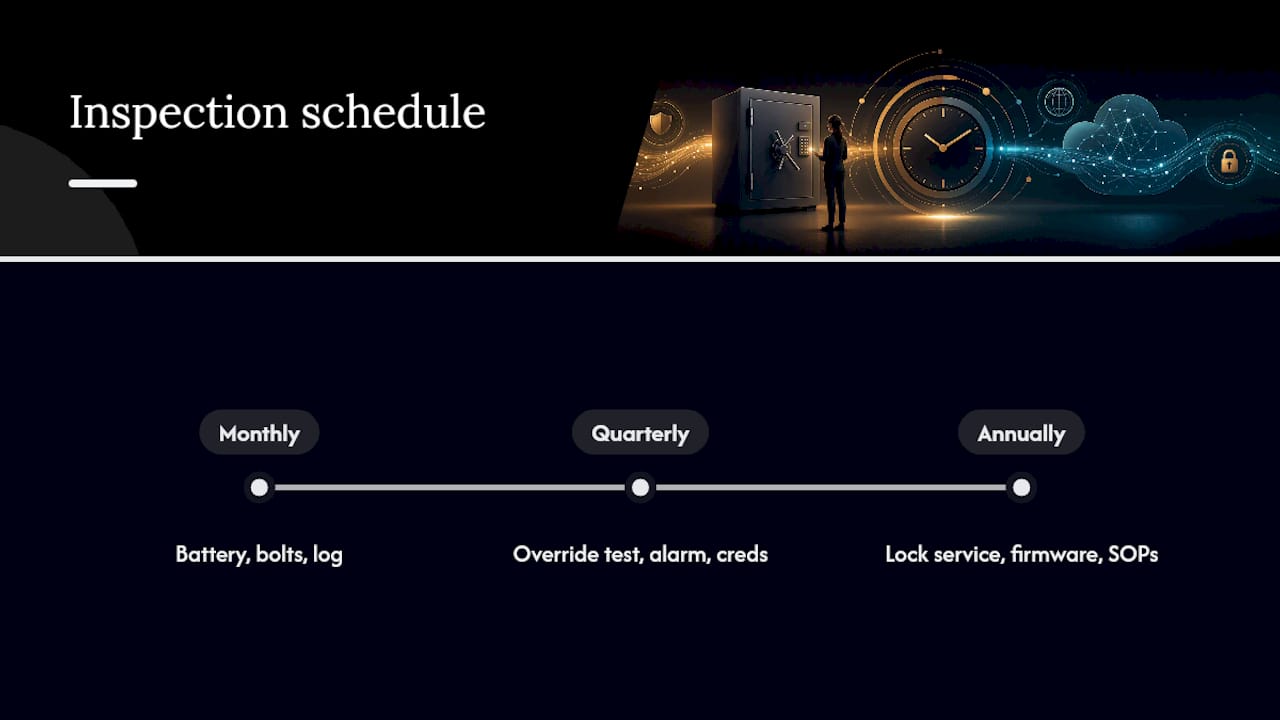
Annually, have the lock mechanism serviced by the manufacturer or an authorized technician, especially on electronic units where firmware updates can affect log accuracy. This is also the point to revisit your SOPs. Staffing changes, new drug categories, or a shift from fixed cabinets to transport carts all justify a policy refresh.
Document every inspection, even the ones that turn up nothing wrong. An empty maintenance log looks worse to an inspector than a log full of minor fixes, because it suggests nobody’s actually checking. Keep these records in the same compliance folder as your installation photos and access policy so everything lives in one place when an audit request comes in.
Cost Ranges and Budgeting Tips for Purchasing Narcotics Safes
Prices scale directly with capacity and audit sophistication, so the honest budgeting question isn’t “what does a narcotics safe cost” but “what does compliance at my volume cost.”
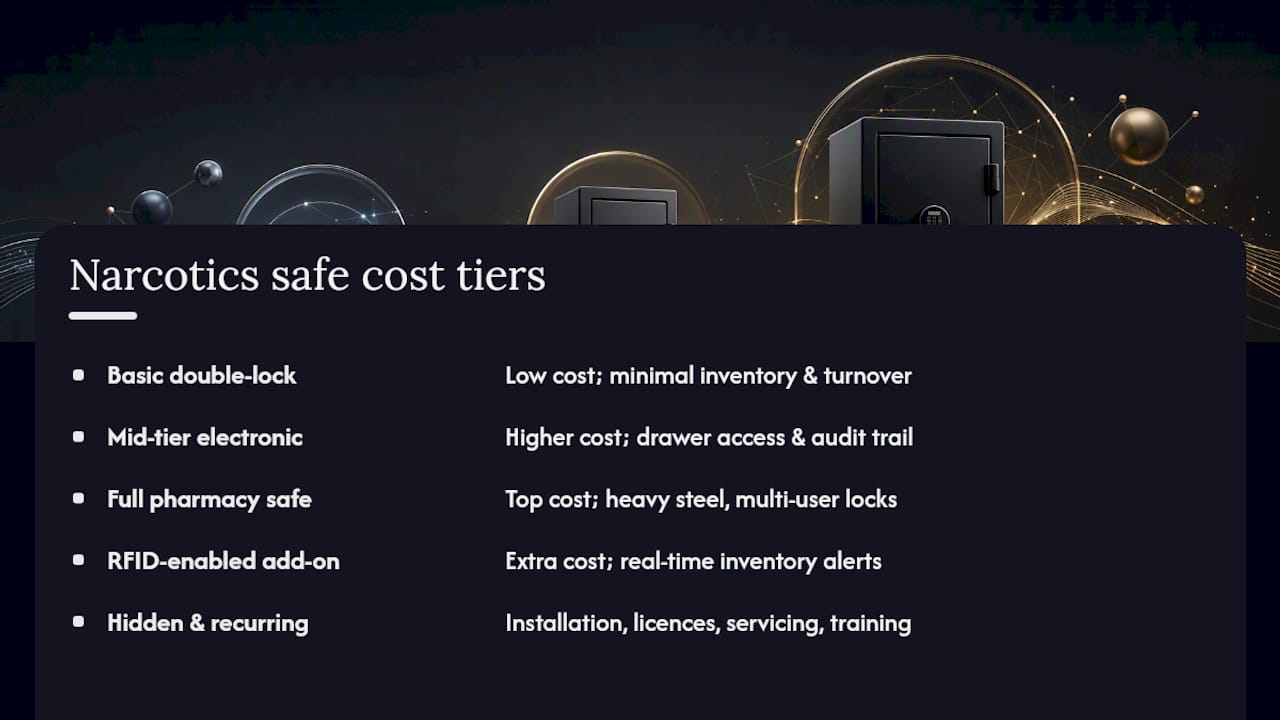
A basic double-lock narcotics box sits at the low end of the market and fits clinics with minimal inventory and low turnover. Mid-tier electronic cabinets with drawer-level access and digital audit trails cost considerably more, reflecting the lock mechanism, software, and support that come with them. Full pharmacy safes with heavy steel construction, multi-user electronic locks, and burglary ratings sit at the top of the range, and RFID-enabled cabinets with real-time inventory alerts add further cost on top of that for the added tracking precision.
Budget beyond the sticker price. Installation, anchoring, and any electrical work for backup power add to the upfront number. Ongoing costs include software licensing for audit exports, periodic lock servicing, and staff training time whenever access policy changes. For EMS fleets, factor in mounting hardware per vehicle, since that cost multiplies across your fleet size in a way a single fixed pharmacy cabinet never does.
The cheapest option on paper is rarely the cheapest option after an audit finding forces a rushed upgrade. Facilities that undersize their first purchase often end up paying for a second cabinet within a few years once volume outgrows capacity. Buying one tier above your current need, rather than exactly matching today’s volume, tends to cost less over five years than replacing an undersized unit twice.
An Editorial Take on Buying for Compliance, Not Just Storage
Most buying advice in this space treats narcotics safes like any other piece of security hardware: bigger steel, better lock, higher price, better product. That logic breaks down the moment an inspector walks in and asks not “how strong is this safe” but “show me who opened it on March 14th.” A cabinet with a mediocre fire rating and a clean, exportable audit log will pass an inspection that a beautifully built safe with no access record will fail.
The conventional advice also tends to treat EMS, pharmacy, and hospital buyers as one audience. They aren’t. An EMS supervisor worrying about vibration and battery failover has almost nothing in common with a hospital pharmacy director managing hundreds of daily transactions across multiple floors, yet most buying guides give both the same generic checklist.
If you take one thing from this guide, prioritize the audit export over the marketing sheet. Ask every vendor to show you a real report before you ask about price. Everything else, capacity, mounting, fire rating, matters, but it matters after you know the compliance evidence will hold up.
— Safes and Security Solutions
Find the Right Narcotics Safe Through Safes and Security Solutions
You can find a direct path to purchase rather than a maze of distributors and quote requests. Published specs, pricing, and product details are available up front, so you can compare fire ratings, steel gauge, and lock type against the checklist in this guide before you talk to a sales rep.
If your facility needs burglary and fire protection alongside narcotics storage, the American Security BFS2214 burglary and fire safe and the smaller American Security BFS912 burglary and fire safe both pair heavy steel construction with fire protection for facilities that need more than a lock and a drawer. For sites prioritizing fire survival for paper records and sensitive inventory alongside a locked unit, the American Security UL1511 two-hour fire safe is worth reviewing against your capacity needs. Check the spec sheet against your procurement checklist, then reach out for a quote on the model that fits your facility’s volume.